Full Article
about Alpens
Mountain village known for its blacksmithing tradition and charming cobbled streets.
Hide article Read full article
A quiet start in northern Osona
Early in the morning, before the sun rises above the line of pines, the square in Alpens is still in shadow. A wooden door opens somewhere, a car starts up slowly, and little else breaks the silence. Tourism in Alpens tends to begin like this: unhurried, with the sense that the village keeps to its own rhythm whether visitors are there or not.
Alpens sits at the northern edge of Osona, close to the boundary with Ripollès. Reaching it involves leaving the busier roads behind and following gentler, winding stretches that pass through woodland and meadows. The village appears all at once, compact and tightly grouped, with stone houses and dark roofs. Just over two hundred people live here, so everything remains on a small scale, and most places are only a short walk apart.
Stone streets and Sant Pere
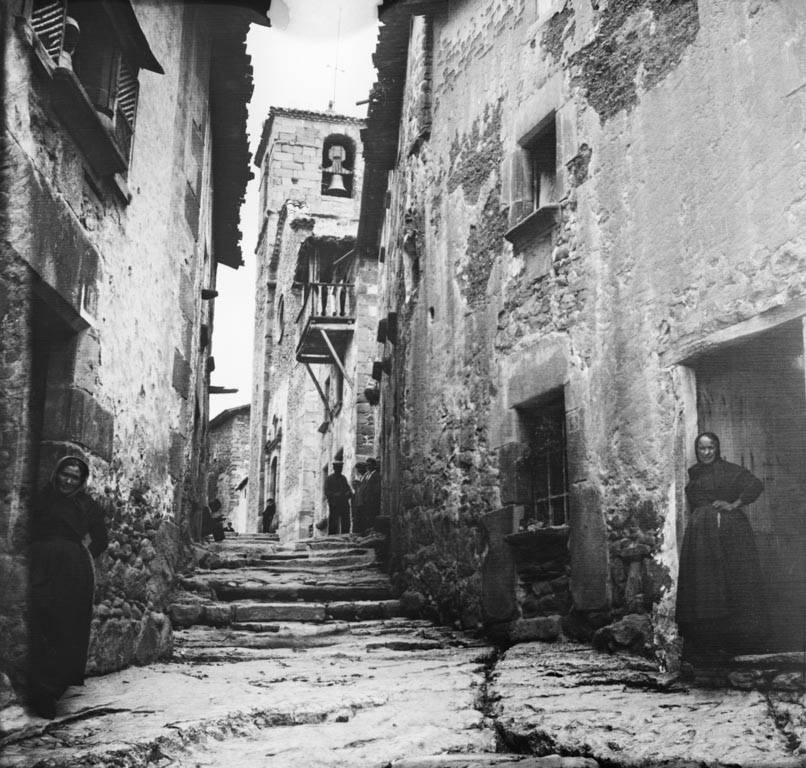
The streets in the centre are short and slightly irregular. The tone of the stone façades shifts with the light: cool grey in the morning, warmer ochre by late afternoon. Many houses still have thick wooden doors and small windows, designed to hold in heat during the colder months, which can be harsh in this part of Catalonia.
At the heart of the village stands the church of Sant Pere. Its origins are Romanesque, a style common in much of rural Catalonia, with solid walls and very few openings. Inside, the atmosphere is simple and dim, with a faint smell of wax and damp stone that lingers in older churches. Around it lies the main square, which serves both as a meeting point and as the starting place for several paths that lead out into the surrounding countryside.
Masías and the changing landscape
Step beyond the built-up area and the landscape opens up quickly. Sloping meadows stretch out between wooden fences, while nearby hills are covered with pine and holm oak. Scattered among them are masías, traditional rural farmhouses typical of Catalonia, some of which are still linked to livestock farming.
These buildings often retain their original stone walls and heavy roofs, designed to withstand wind and snow. The character of the landscape shifts noticeably with the seasons. In winter, fog can settle in the valleys for hours, and the quiet feels thicker, more enclosed. In summer, the dominant scents are dry grass and pine resin, carried across the open fields.
Walking the rural paths
Several paths begin directly from the village, crossing meadows and small streams. Some follow old agricultural routes that once connected masías. Not all are clearly signposted, so it helps to carry a map or a digital track if planning a longer walk.
Distances are generally modest. Within one or two hours, it is possible to reach small բարձր points that offer wide views over northern Osona. On clear days, looking north, the first outlines of terrain that hint at the Pyrenees can be seen in the distance.
After rain, conditions can change quickly. Some sections of track become slippery with mud, something that is not uncommon following summer storms.
Quiet roads and cycling routes
The secondary roads around Alpens carry very little traffic. They are narrow, with constant curves that keep the surrounding forest in view at every turn.
Road cyclists often pass through, drawn by short but demanding climbs. There are also forest tracks suitable for mountain bikes, provided the ground is dry. After several days of rain, some of these routes become soft and harder to ride.
When the village becomes livelier
For much of the year, Alpens remains quiet. Activity increases in summer and during certain traditional celebrations, when families with ties to the village return or people connected to it come back for a time.
The festa major, the main annual festival common in many Catalan towns, is usually held at the end of August. It brings music and community events to the square. In winter, smaller celebrations linked to the religious calendar continue, though these are mostly intended for local residents.
Those looking to see the village at its most active will find late summer a good moment. For quieter walks in the surrounding landscape, spring and autumn mornings are often more rewarding. The air tends to be clear, and the forest still carries a trace of moisture.


