Full Article
about Rupit i Pruit
One of the most visited villages for its stone architecture and hanging bridge
Hide article Read full article
A change of pace in the Collsacabra
Some villages force you to slow down the moment you park. Rupit i Pruit is one of them. You arrive via a winding road, leave the car on the edge of the old quarter and within minutes you are walking over worn stone, with the sense that everything around you has been there for a very long time.
Tourism in Rupit i Pruit revolves around that feeling. It is not a large destination, nor somewhere packed with sights to tick off. Instead, it acts as a pause in the Collsacabra highlands, about 800 metres above sea level. A handful of streets, the sound of a torrent running below and a noticeable hush once you step away from the centre define the experience.
Just over two hundred people live here. That small population shapes the atmosphere. Even when visitors arrive at the weekend, there is still everyday life behind the stone façades.
Reaching Rupit i Pruit and understanding its setting
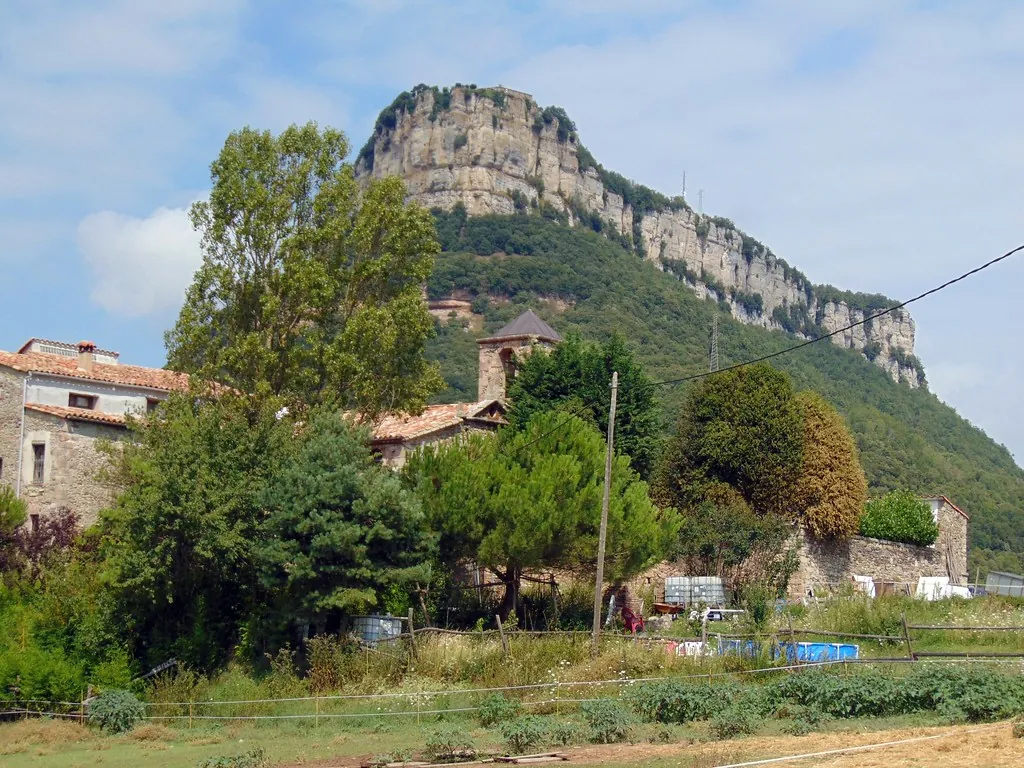
Rupit i Pruit sits in the comarca of Osona, on the Collsacabra plateau in Catalonia. The landscape here feels different from the more Mediterranean parts of the region. Dense woodland replaces coastal vegetation, sheer rock faces rise above the roads and open meadows appear suddenly after a bend.
As the road approaches the village, Rupit i Pruit looks compact and self-contained, set firmly on rock and surrounded by ravines. The location gives the impression of having been chosen for protection. It feels easy to defend and hard to attack, and the history of the settlement follows that logic.
The setting explains much of its character. The altitude, the cliffs and the surrounding countryside shape both the architecture and the rhythm of life.
Stone streets and the suspension bridge
Entering the historic centre means heading uphill. The streets are narrow, with uneven steps and solid stone houses lining the way. Many of these buildings still have wooden beams and small balconies where there is barely space for a single plant.
The main street and the lanes that climb towards the upper part of the village contain most of what there is to see. A map is hardly necessary. Wandering without a fixed route often works better than following marked directions.
Before reaching the centre, visitors cross a suspension bridge over the torrent. It dates from the mid 20th century and sways just enough to make most people glance down more than once. On quiet days, the crossing takes only a moment. When there are more people around, there is usually a short wait while everyone pauses for the customary photograph.
The bridge acts as a kind of threshold. Once on the other side, the modern world feels further away and the medieval layout begins to take over.
Sant Miquel and the remains of the castle
The church of Sant Miquel often receives less attention than the bridge, partly because so many cameras are pointed elsewhere. It is worth taking time here. Its origins are Romanesque, although the current building was reconstructed centuries later. The square bell tower is visible from several points across the valley, serving as a reference as you move around the village.
From the church, the streets continue upwards to a small promontory where the castle once stood. Very little remains today. There are scattered traces and the outline of what must have been defensive walls, rather than a complete structure. Even so, the strategic value of the position becomes obvious straight away. From this height, the surrounding land is easy to survey.
It is the sort of place where you pause for a moment, look out across the landscape and understand why anyone keeping watch from here would have had a clear advantage.
The Salt de Sallent and the paths of Collsacabra
A short distance from the village centre lies the Salt de Sallent, a waterfall that drops from a high rock face. The amount of water varies with the season. After periods of rain, the sound carries from far away. In drier times, the flow becomes much lighter.
The path to the viewpoints crosses fields and wooded areas. It is not especially difficult, although there are sections of earth and stone where it makes sense to walk carefully.
Similar footpaths branch out across the wider area. Some wind through beech and oak woods. Others lead towards sanctuaries or to the edges of cliffs where the Collsacabra landscape opens up in front of you. The terrain shifts between forest, open ground and abrupt drops, which keeps the walks varied without needing to travel far.
These routes reinforce the sense that Rupit i Pruit belongs as much to its natural surroundings as to its historic streets.
Local food and taking your time
After time spent walking, most people feel like sitting down. In the village, the cooking is closely linked to local produce. Potatoes from the comarca feature regularly, as do cured meats. When the season allows, mushrooms gathered from nearby forests appear on menus.
The dishes tend to be hearty. That makes sense in a place with cold winters and a history of agricultural work. The food aims to satisfy rather than to experiment.
A visit to Rupit i Pruit does not require a detailed plan. Arrive without rushing. Walk through the old quarter, cross the suspension bridge and explore the higher streets. Head out to the Salt de Sallent if a short walk appeals. Then sit down for a meal before leaving.
Half a day is enough to see it at an unhurried pace. The impression that remains is of a village that still functions according to its own rhythm, shaped by stone, landscape and a small resident community in the Collsacabra hills.