Full Article
about Sant Sadurní d'Osormort
Small municipality in the heart of the Guilleries, surrounded by forests
Hide article Read full article
A village you see in half an hour
Tourism in Sant Sadurní d'Osormort is straightforward. You arrive, park near the church and within half an hour you have seen the whole village centre. There are very few residents and on weekdays it is usually easy to find somewhere to leave the car.
The real challenge is not crowds but conditions. If it has rained, mud can be an issue, and the access roads are narrow country lanes. Setting off early helps. By mid-morning hikers and cyclists begin to pass through, drawn by the surrounding countryside rather than the village itself.
There are no shops or bars in the village. People come here for a short walk and then move on. Anyone needing food or supplies has to head down to other towns in the Osona comarca, the wider county where Sant Sadurní d'Osormort is located.
The small heart of Sant Sadurní
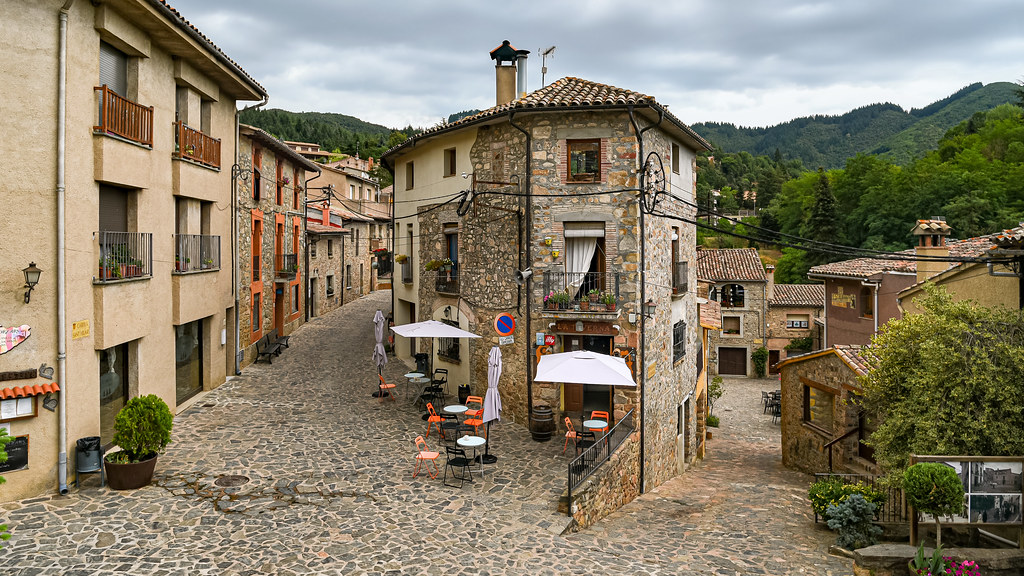
The centre is compact. One main street, a handful of houses and the church. There are no grand squares or notable civic buildings.
The parish church of Sant Sadurní is Romanesque and quite austere. It has plain stone walls, small windows and a simple bell gable rising above the façade. You can take it in within a few minutes, yet it says a great deal about the kind of settlement this is: agricultural, modest and without pretension.
There is no attempt to turn the village into a heritage attraction. No interpretative panels or curated routes appear in the centre. What you see is what has always been here, a tiny rural nucleus that continues at its own pace.
Forest tracks and scattered farmhouses
What surrounds Sant Sadurní d'Osormort is more compelling than the village itself. Thick woodland stretches out in every direction, cut through by forest tracks and dotted with scattered masías, traditional Catalan farmhouses. Many of these are still inhabited, so it is important not to wander up private access lanes even if they look like public paths.
This area lies within the surroundings of the Parc Natural del Montseny, one of Catalonia’s best known protected landscapes. The character of the countryside changes noticeably with the seasons. Spring brings strong greens and fresh growth. Summer creates dense shade beneath the trees. Autumn covers the ground in dry leaves. Winter strips the forest back, leaving a barer, harsher feel to the terrain.
The setting makes sense of the village. Sant Sadurní d'Osormort is not a destination packed with sights. It is a starting point for quiet time outdoors.
Simple walks without complication
Several paths begin close to the village. Some are signposted, others are simply forest tracks without further indication. There is no need to plan a long route. A walk of one or two hours is enough to get a sense of the land, the slopes and the rhythm of the woods.
It is still wise to download a map in advance. Many junctions of forest tracks look very similar, and it is easy to take the wrong one if you do not know the area. The landscape is not dramatic or extreme, but it is uniform enough to confuse first time visitors.
These are straightforward walks rather than major hikes. The appeal lies in the quiet and the absence of infrastructure. There are no visitor centres or organised circuits described here. The experience depends on the paths under your feet and the forest around you.
Clearings with long views
If you follow certain tracks uphill towards higher ground, the forest begins to open up. Clearings appear where the trees thin out. On clear days, these spots offer wide views over part of the Plana de Osona, the broad plain that defines much of the comarca.
Further away, the distinctive silhouette of Montserrat can sometimes be seen on the horizon. There are no built viewpoints or information boards to frame the panorama. The views simply emerge where the woodland breaks, and you stand in an open patch of hillside.
The effect is understated. No railings, no platforms, no signs explaining what you are looking at. Just a gap in the trees and the landscape beyond.
Quiet roads for cycling
The roads around Sant Sadurní d'Osormort are secondary and carry little traffic. This makes them suitable for cycling, especially for those who enjoy short but steady climbs. The terrain rolls rather than soars, asking for consistent effort rather than long ascents.
Conditions vary with the season. Some stretches can collect gravel or mud, particularly after wet weather. Descents require care when surfaces are loose. As with the walking routes, the attraction lies in the calm and the limited number of vehicles.
Cyclists and hikers begin to appear as the morning progresses, yet the area never feels busy in the way larger destinations can.
A very small community
Sant Sadurní d'Osormort has very few inhabitants, and that shapes the atmosphere. There are no tourist services and no weekend buzz. The village does not reinvent itself for visitors.
A local celebration usually takes place at the end of August in honour of the patron saint, Sant Sadurní, but it is primarily a matter for residents rather than an event aimed at outsiders.
The advice is clear. Come if you are passing through the Montseny area or if you want a short, quiet walk without noise. Do not expect a lively village or a list of attractions to tick off. Sant Sadurní d'Osormort offers a pause in the woods, little more and little less.