Full Article
about Tavertet
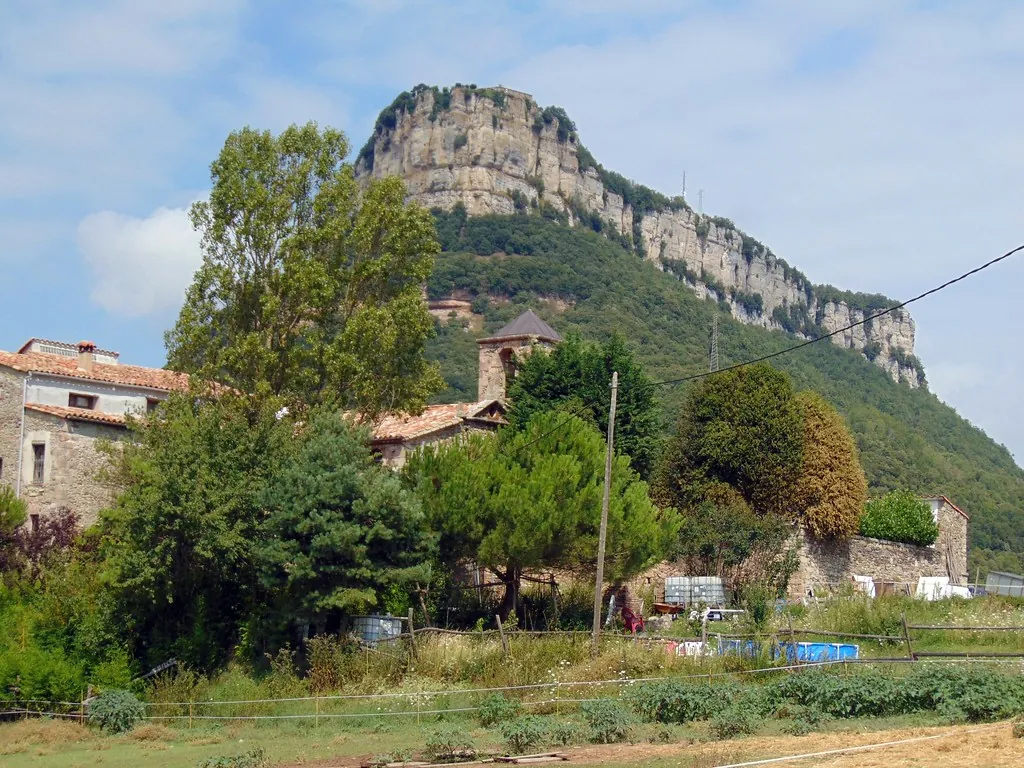
Stone village on dramatic cliffs overlooking the Sau reservoir
Hide article Read full article
A Village Hanging Over the Valley
There are places where you arrive, look around and immediately understand why people make the journey. Tourism in Tavertet has that effect. The village quite literally stands on the edge of a vast cliff, with the Sau reservoir and the Ter valley stretching out below. And this is not poetic exaggeration. Some streets end almost at the drop itself.
Tavertet is in the comarca of Osona, in Catalonia, and has just over a hundred residents. The settlement is small and compact, with stone houses and tiled roofs clustered around a handful of streets. It is not somewhere packed with attractions or explanatory panels on every corner. Instead, it works as a place to slow down, walk a while and let the landscape do most of the talking.
The sense of scale is what makes it so striking. One moment you are in a quiet village street, the next you are looking out across a wide valley carved by the Ter river, with the water of the Sau reservoir drawing curves between the surrounding hills.
A Small Historic Centre, Easy to Explore
The historic centre can be covered quickly. In half an hour it is easy to get your bearings. The streets rise and fall gently, and many of the houses still have old stone doorways, small windows and iron grilles.
The church of Sant Cristòfol stands beside the main square. It is Romanesque in origin, although it has been altered over the centuries, something common in villages that have been inhabited for so long. It is not a monumental building, but it fits the scale of Tavertet perfectly: simple, solid and unmistakably a village church that has watched generations come and go.
There are no large museums and no historic quarter filled with shops. Tavertet remains, above all, a lived-in village. That gives a walk through its streets a particular feel. On one corner there are plant pots, on another a small vegetable patch behind a house, and then you turn a bend and suddenly the view opens into a vast sweep of valley and water.
Viewpoints Over the Sau Reservoir
The reason many people travel up to Tavertet becomes obvious as soon as you approach the edge of the village. The cliffs drop away abruptly and from above you can see the Sau reservoir tracing its path between the mountains.
There are several points where visitors gather to look out. Some are simply clearings between rocks, others feel like natural balconies. On clear days the horizon stretches far, with much of the valley visible and even the outline of the Montseny massif in the distance.
Light changes everything here. Early in the day the reservoir often appears a deeper, cleaner blue. Later on, as the sun lowers, the rock faces take on warmer tones. It is the sort of place where people end up sitting for a while without any particular plan, simply watching how the colours shift across the landscape.
Walking Along the Cliffs
One of the most common walks follows the edge of the cliffs along marked paths linking several viewpoints. Among them are the area known as l’Escudella and the surroundings of Sant Valentí.
It is not a difficult walk, but attention is needed. In some sections the path runs quite close to the edge and there are no railings or barriers. There is rock, a narrow trail and a significant drop below. Good sense and steady footing are enough, yet it is not somewhere to be careless.
For those who like to look closely at the terrain, the area has rock formations shaped by erosion over time. The cliffs also create ideal conditions for birds of prey that ride the air currents rising from the valley. With a bit of patience it is common to spot griffon vultures circling overhead.
The combination of open sky, sheer rock and the reservoir below gives these walks a sense of space that is hard to ignore. Even short stretches feel expansive.
Routes Into the Surrounding Countryside
Several walking routes start from Tavertet and allow you to extend your visit beyond the village itself. One of the best known is the Ruta dels Riscos, which runs for several kilometres through woodland dominated by holm oaks and oaks.
The terrain alternates between comfortable stretches and more uneven sections, so proper walking shoes are advisable. It is not a technical hike, yet there are loose stones and short inclines that require a steady pace.
Other paths descend towards the reservoir. The drop in height is considerable and it is particularly noticeable on the way back up. On a map the distance may appear modest, but the climb can feel more demanding than expected. In warm weather it makes sense to set off early or choose a cooler day.
These routes underline what Tavertet offers best: a mix of village and open landscape, with the cliffs always close by.
When the Weather Changes the Scene
One of the most surprising aspects of Tavertet is how dramatically the atmosphere shifts depending on the conditions. Under a clear sky the village feels like an enormous viewpoint suspended above the valley. When fog rolls in, something fairly common in this part of Osona, the mood changes completely.
The village can become partially wrapped in mist and the cliffs disappear from sight. The view that seemed endless only hours before is replaced by a curtain of white. The landscape feels quieter and more enclosed, as if the drop beyond the houses had temporarily ceased to exist.
It is a reminder that the appeal of Tavertet lies as much in its setting as in its buildings. The same streets can offer entirely different impressions from one day to the next.
A Place to Take Your Time
Tavertet does not suit a tick-list approach. The village is small and the interest lies in walking a little, approaching the cliff edge more than once and letting the surroundings set the pace.
It can be compared to stopping at a roadside viewpoint, except here the entire village plays that role. You wander through the streets, head towards the edge of the cliffs a couple of times, perhaps follow one of the shorter routes, and before long more time has passed than expected.
There may be just over a hundred residents and only a handful of streets, yet the scale of the landscape gives Tavertet a presence far beyond its size. In Osona, above the Sau reservoir and the Ter valley, it stands quite literally on the edge, inviting visitors to pause and look out.