Full Article
about Gavet de la Conca
Scattered municipality in the Tremp basin; farmland ringed by mountains.
Ocultar artículo Leer artículo completo
The bread van arrives at 11:00 sharp. If the horn doesn’t wake you, the village dogs will. By 11:03 the loaf racks are empty and the square falls quiet again—until the bar owner rolls up the shutters at 11:30. That is the daily pulse of Gavet de la Conca, a scatter of stone houses wedged between the turquoise mirror of reservoir Terradets and the saw-tooth wall of the Montsec ridge.
A parish that never quite became a town
Gavet is the administrative centre, yet only 130 people call it home. The rest of the 257 residents live in four hamlets strung along a 12-kilometre loop of the C-147: Mur, Llimiana, Castell de Mur and El Pont de Montanyana. Each has its own medieval church, its own summer fiesta, and—crucially—its own WhatsApp group for warning of rock falls or wandering cattle. The road climbs from 421 m at the reservoir to 862 m at the castle ruins, enough gain to swap almond groves for black pine in under ten minutes of driving. In January that can mean sunshine on the water and sleet on the battlements; pack layers even for a day walk.
The Romans mined copper here; the Counts of Pallars built a frontier castle; the reservoir arrived in 1955 and swallowed the valley’s best apricot orchards. What remains is a working landscape: dry-stone terraces of olives and vines, hay meadows irrigated by 11th-century canals, and a chain of small hydro-electric turbines that hum inside converted mills. You are welcome to look, but no one has tidied the place for Instagram. Expect rusty irrigation pipes, chained dogs and the smell of silage when the wind swings north.
Stone, water and sky
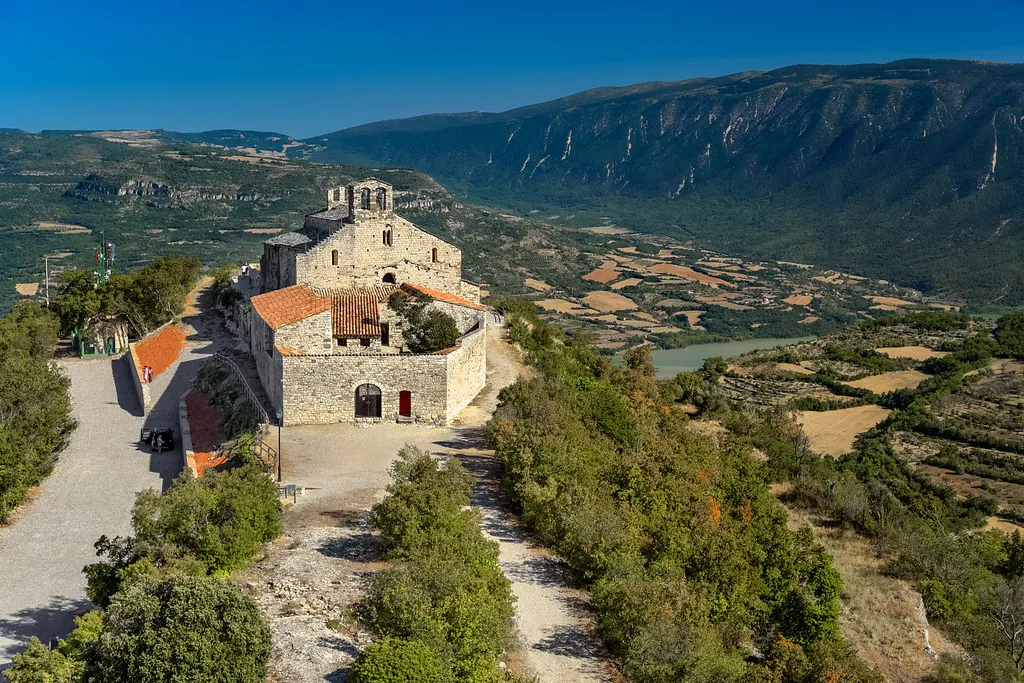
Start at Mur, five minutes above the water. The church of Santa Maria still stands exactly as it did in 1067—thick walls, tiny windows, a bell tower you can climb if you borrow the key from Sr. Ramon at number 17. The original frescoes are in Barcelona’s MNAC, yet the bare interior feels oddly complete: swallows nest in the vaulting and the flagstones echo like a drum. Outside, the castle keep is missing its south face (dynamited during the Carlist wars) but the view compensates: the entire Conca de Tremp laid out like a geological textbook, limestone folds striped with marl and the reservoir a careless streak of cobalt.
From the castle a way-marked path drops 250 m to the hamlet of Llimiana in 45 minutes. Halfway down you pass a shepherd’s hut built into the cliff; if the door is open you’ll spot a rusting Coca-Cola crate used since 1978 to store salt blocks. The church of Sant Serni waits in the main square, door unlocked, a single candle burning. No donation box, no postcards—just a visitors’ book that records more golden eagles than humans most weeks.
Moving without moving
This is low-altitude Prepirineo walking, not high Alpine drama. Typical circuits run 6–12 km with 200–400 m of climb, which means you can be back for lunch yet still feel thighs the next morning. The GR-1 long-distance footpath skirts the ridge; a 9 km section between Mur and Santa Maria de Còll gives 360-degree views for the effort of a Wimbledon Parkrun. Mountain-bikers prefer the forest track south to Vilanova de Meià—wide enough for a Land Rover, rough enough to loosen fillings. Take two litres of water in summer: the only spring marked on the map dried up in 2022 and no one has updated the panels yet.
Rowing and SUP are tolerated on Terradets though the reservoir is officially for hydro generation. There is no hire outlet; bring your own kit and launch from the concrete slip at Les Lles. Water levels fluctuate six metres between May and October, exposing a white “bath-tub ring” of bleached driftwood that makes finding a shoreline picnic spot oddly tricky. Swimming is unofficial—Catalan police turn a blind eye provided you stay away from the dam wall where suction currents are real.
What you’ll eat, what you’ll pay
The municipality has one grocery shop (opens 09:00-13:30, 17:00-20:00, closed Monday), one bakery counter twice a week, and zero cash machines. The bar serves a three-course menú del día for €14 including wine; on Saturday night it morphs into the village social club, television blaring Moto GP, children chasing dogs between tables. Expect vedella bruna (brown-cow beef) stew, local trout if the dam has been kind, and trinxat—bubble-and-squeak with pancetta. Vegetarians get grilled goat cheese with herbs; vegans should self-cater.
Restaurant Terradets, four kilometres away on the lakeside road, offers English menus and will grill plain fish for children. Mains €16-22, reservation essential at weekends when climbers return from the limestone cliffs. The nearest supermarket with British staples (Weetabix, cheddar, baked beans) is Lidl in Balaguer, 45 minutes south on the C-13. Fill the tank there too—prices rise 12 c/litre once you leave the main highway.
When to come, when to stay away
April-May: orchards in flower, nights cool, days 18-22 °C, lambs in the lower meadows. October: forest colour, stable highs of 20 °C, reservoir mirror-calm, wine harvest festivals in every hamlet. Both shoulder seasons give empty trails and hotel rooms at €55 B&B.
July-August: fierce sun, 32 °C in the valley, water levels low. Spanish families occupy weekend houses, quad-bikes appear on forest tracks, fireworks at 02:00. Accommodation jumps to €90 and the bar runs out of beer by Sunday evening. Mid-August fiestas are authentic but loud: giant paella pans, brass bands, sardana dancing in the road until dawn.
Mid-December to February: dazzling light, snow on the ridge, empty churches—and a real risk of being snowed in. The C-147 is ploughed first, yet the loop road to Castell de Mur closes after 5 cm of snow. Chains or 4×4 essential; walking poles suffice for the village paths.
Getting here, getting stuck, getting out
No railway comes closer than Lleida (1 h 20 min drive). ALSA buses run twice daily from Barcelona to Tremp; from there a local school service reaches Gavet at 07:15 and 15:10—book the day before on +34 973 650 110 or you will be waved past. A taxi from Tremp costs €35; pre-book because there is only one licensed car. Car hire from Barcelona Airport adds €45 in tolls each way; the scenic alternative via C-1412 is toll-free but 45 minutes slower.
Mobile coverage is patchy: Vodafone picks up 4G on the ridge, Orange drops to 2G in the village centre. Wi-Fi exists in two rental flats and nowhere else. Download offline maps, then savour the silence that made British reviewers write “finally, a place the world hasn’t found”.
Leave before the bread van if you must; otherwise stay until the reservoir turns glassy at dusk and the castle silhouette merges with the ridge. Just remember the grocery shuts at 20:00 sharp—after that, dinner is whatever you caught, picked or thought to buy in Balaguer.