Full Article
about Salàs de Pallars
Walled medieval town known for its period Shops-Museum
Ocultar artículo Leer artículo completo
First glimpse of the high country
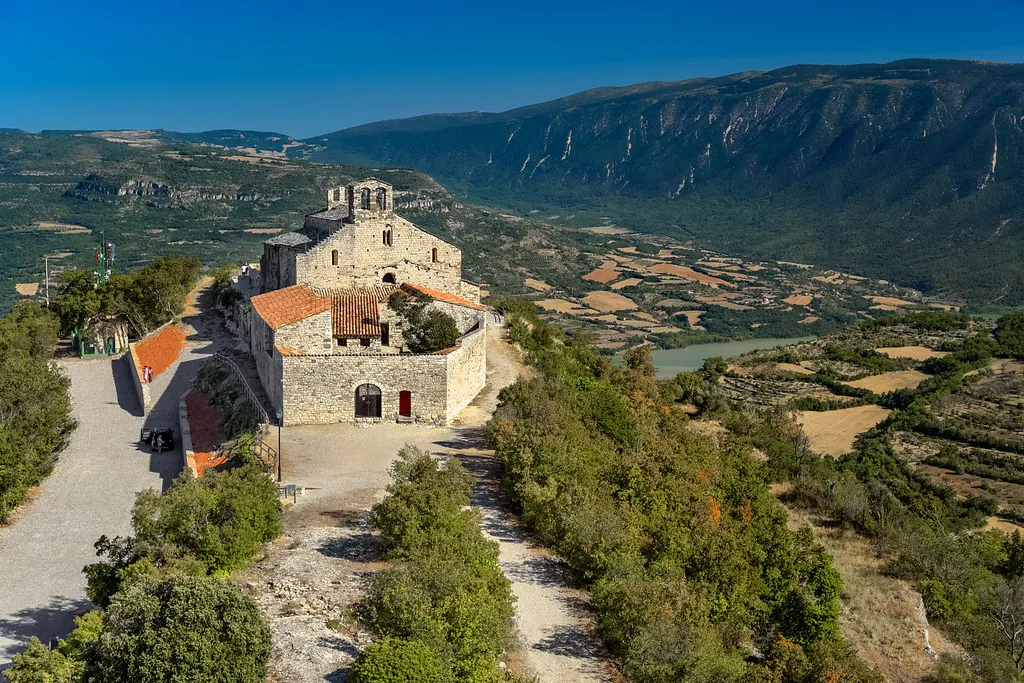
Fifty-three metres above sea level, the motorway leaving Barcelona still feels flat. Three hours later, at 573 m, the tarmac folds into hairpins and the air smells of pine and cold stone. Salàs de Pallars appears suddenly: a tight knot of slate roofs balanced on a ridge, the Sant Llorenç de Montgai reservoir glittering 300 m below like a dropped shard of turquoise glass. There is no dramatic gateway, no sign promising “authentic Spain”—just a narrow bridge, a petrol pump that may or may not be open, and an elderly farmer in a barretina who will watch you park with the same curiosity he’d give a passing shepherd’s dog.
What passes for a centre
The village has one proper street, Carrer Major, wide enough for a tractor and a reluctant donkey. Stone houses press in from both sides; their wooden balconies sag with geraniums that survive on morning dew alone. Look up and you’ll read dates—1789, 1823, 1902—chiselled into lintels, usually above a doorway now fitted with aluminium instead of oak. Halfway along, the parish church of Sant Martí squats on a tiny plaça; its Romanesque bell tower was repaired after lightning in 1935, the new stone still paler than the rest. Sunday mass is at eleven, attended by twelve locals and, in high season, the occasional bemused Brit who thought the building was open for tourism. It isn’t. Sit at the back anyway; the priest delivers his homily in a Catalan so mountain-thick even Barcelonans struggle.
There is no tourist office. The closest thing is the Rebombori Cultural Association, open Tuesday and Thursday from six till eight, where Lluís will lend you a photocopied map of walking routes in exchange for a €5 donation towards roof repairs. The paper is damp and the ink smudges, but the trails exist: follow the red dashes for the reservoir, the blue triangles for the oak woods, the green circles if you fancy a 12-kilometre loop that ends at an abandoned lime kiln. Markers are sporadic; phone signal is worse. Take the map.
Reservoir days and forest nights
The Sant Llorenç reservoir was created in 1932 to regulate the Noguera Pallaresa river. From Salàs, the GR-1 footpath drops 200 m in forty minutes to reach the water’s edge—steep enough to make you reconsider that second croissant at breakfast. In May the slope is loud with cuckoos; by late July the grass has burnt to straw and every step raises dust. British anglers come for the carp, which grow fat on underwater olive roots; you need a regional licence (€20 online, print it twice). Swimmers favour the southern cove near the ruined farmhouse; the water is clean, if chilly, and there are no lifeguards, no cafés, no ice-cream vans—just cliffs echoing with the occasional splash of someone braver than you.
Evening walks head uphill instead. A twenty-minute climb on the Camí Vell de Sant Martí brings you to a sandstone bluff where griffon vultures ride thermals at eye level. Bring binoculars: in spring you might add Egyptian vulture, short-toed eagle, bee-eater. The sun drops behind the Montsec ridge, the reservoir turns ink-blue, and the village lights flick on one by one, distant as stars. Descend quickly; the path is rocky and head-torches attract moths the size of fifty-pence pieces.
What you’ll eat (and when you’ll eat it)
Meals are arranged around farm hours, not yours. Breakfast is coffee and a buttered baguette at Bar Quim, open 7–10, closed Wednesday. Lunch is the fixed menu at Hotel Bertran: three courses, wine included, €14. Expect grilled river trout with almonds, or trinxat—cabbage, potato and streaky bacon pressed into a cake and fried until the edges caramelise. Vegetarians get a larger portion of the same minus bacon; vegans receive a sympathetic shrug. Dinner must be ordered by 20:00; after that the kitchen staff sit down to eat themselves. Try the serrat, a mild sheep’s cheese that tastes of thyme and damp cave. Payment is cash only; the nearest functioning ATM is 18 km away in Tremp, so fill your wallet before you arrive.
If self-catering, the Coop shop sells local hazelnuts, honey labelled only in Catalan, and butifarra sausages that travel badly in a rucksack. Friday morning brings a travelling baker who parks his van by the church; arrive early—he sells out of croissants by nine-thirty and drives off whistling.
Getting here, staying put
Fly to Barcelona, hire a car, head west on the A-2. After Lleida, the C-14 follows the river; thirty kilometres of switchbacks begin at Tremp. Allow two and a half hours total, longer if a tractor ahead decides the verge is wide enough for both of you. Buses reach Tremp from Barcelona twice daily; from there, a twice-weekly service meanders to Salàs, timed for pensioners rather than planes. Miss it and a taxi costs €40—if the driver fancies the return journey on empty roads.
Accommodation is limited. Hotel Bertran has eight en-suite rooms, €55 a night including breakfast; the Wi-Fi password is taped above the reception desk but works only in the corridor. Two rural cottages sleep four each, booked through the Catalan tourism board; bring firewood in winter (nights drop to –5 °C) and note that the listed “five-minute walk to the village” is straight up a 15% gradient. Wild camping is tolerated along the reservoir outside bird-nesting season (February–July), but fires are banned and rangers appear at dawn.
The quiet months
August empties the village: locals close shutters and migrate to the coast; even Bar Quim shuts for two weeks. Come instead in late April when almond blossom foams along the terraces, or mid-October when oak woods smoulder copper and the air smells of mushrooms. Winter brings snow perhaps twice; roads are cleared within hours but ice lingers on north-facing bends. Chains are rarely needed, yet without them you’ll creep downhill at walking pace while a queue of Catalan pick-ups breathes on your bumper.
Rain is sudden and vertical. Storms roll off the Pyrenees, soak the fields for twenty minutes, then leave steam curling from hot stone. Waterproofs live in the car boot; umbrellas are useless against wind that scuffs the ridge like a giant wire brush. On clear nights the sky is absurdly starry—no streetlights beyond the single sodium lamp outside the church. Bring a red-filter torch; astronomers camp on the old threshing floor and dislike white glare.
Leaving without regret
Salàs de Pallars will not change your life. You will not tick off Unesco sites, nor gather Instagram trophies. What you might collect instead is the memory of silence so complete you hear your own pulse while the vultures turn overhead; the taste of trout caught at dawn and eaten three hours later; the sight of an elderly woman in black, singing to her goats as she beats rugs over a balcony at nine in the morning. Drive away slowly—partly because the descent demands it, partly because once you reach the motorway the hum returns, the clock restarts, and the mountains shrink to a line in the rear-view mirror, blue-grey and already smaller than you remember.