Full Article
about Sant Esteve de la Sarga
Montsec municipality with the spectacular Mont-rebei gorge
Ocultar artículo Leer artículo completo
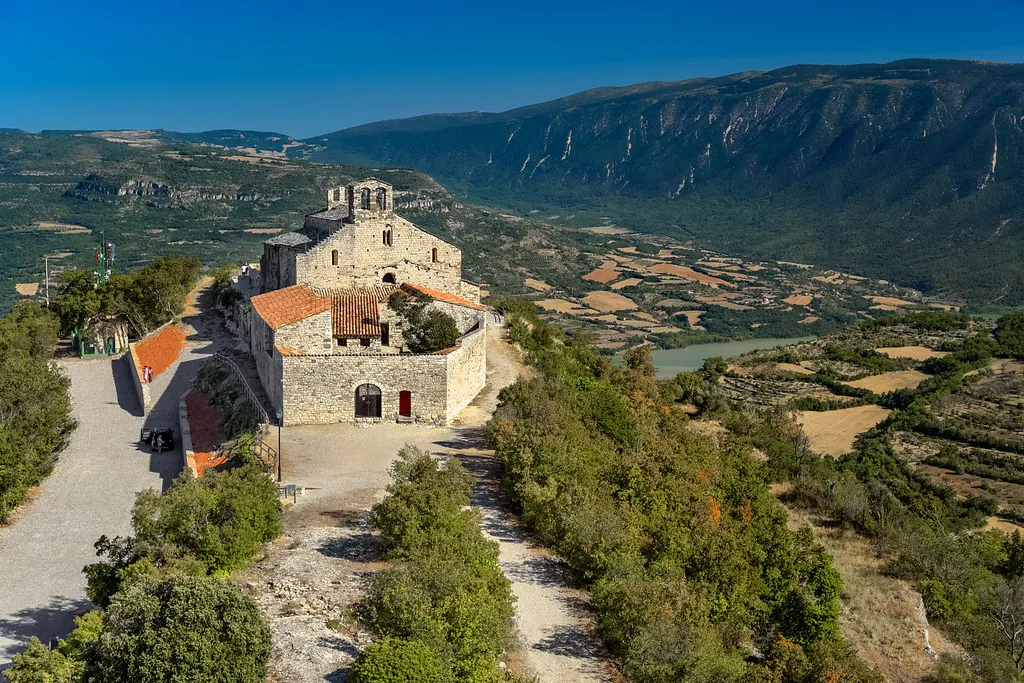
The griffon vultures arrive first, circling on thermals that rise from the Montsec escarpment like steam from a kettle. From the church gate of Sant Esteve de la Sarga you can watch them eye-level, gliding past the 11th-century bell gable that still keeps time for 129 residents. No ticket office, no interpretation board, just a view that costs nothing and demands only that you remember to look up.
This is the Pallars Jussà, the last county before the Pyrenees rear into full snow-capped majesty. At 875 m the air thins and the asphalt thins with it; the C-13 from Tremp narrows to a single-track lane where stone cottages shoulder the tarmac. Mobile signal dribbles away entirely beside the cemetery—handy for Google Maps, less so for Instagram. Bring cash; the nearest ATM wheezes 25 km back down the valley in Tremp, and the village shop opens when the owner finishes feeding her goats.
Romanesque without the ropes
Catalonia’s tourist offices love the word "romànic", but here it is simply what was left lying around when the Middle Ages ended. The parish church of Sant Esteve squats at the top of the only paved gradient: slate roof, crude stone font, a single nave cool enough to store wine. Walk inside and the silence smells of damp sandstone and candle smoke. No entry fee, no guard; if the door is bolted, ask at the house opposite—Joan keeps the key in a margarine tub and will lend it in exchange for a polite "bon dia".
Three kilometres north, a farm track peters out at the ermita de Sant Martí, a thumbnail-sized chapel built when the county border doubled as a frontier with Moorish Spain. The walk takes forty minutes, skirts two wheat terraces and a field usually occupied by chestnut-coloured cows who stare but rarely charge. Inside, the apse retains original 10th-century fresco fragments: ochre stars and a stern Christ Pantocrator that once scared shepherd boys into good behaviour. Flash photography forbidden; frankly, flash is redundant when the doorway frames the Montsec cliffs like a floodlight.
Gorge tactics
Drive ten minutes east and the world drops away. The Congost de Mont-rebei is a limestone slit 500 m deep, carved by the Noguera Ribagorçana river and now shared between Catalonia and Aragón. A mule path—half a metre wide, no handrail—clings to the cliff. British hikers in walking boots overtake Spanish families in flip-flops until the first vertigo attack; after that, progress sorts itself by nerve rather than nationality. Kayaks can be rented at the far end (€25 half-day, life-jacket included) but you’ll paddle back against the current, so budget forearms as well as time.
Spring is kindest: the gorge smells of thyme and rock rose, and temperatures sit in the low twenties before the inland furnace ignites in June. Autumn trades flowers for golden rowan berries and the risk of sudden tramontana winds that can pin even large birds to the thermals. Either season, arrive before 09:30; by eleven the car parks resemble a Barcelona suburb on a bank holiday and the vultures have competition from drones.
Calories and carburettors
Food options mirror the altitude: limited, but what exists is decent. Cal Tronc, the only bar-restaurant in the village, opens Friday dinner through Sunday lunch out of season; mid-week you self-cater or drive to Àger (18 km). The menu is short and seasonal—escudella stew thick with chickpeas and mountain lamb, trout that tastes of snowmelt, and coca de recapte, a roasted-veg flatbread that works as lunch for two at €8. Vegetarians survive, vegans negotiate. Beer comes in 33 cl bottles; there is no IPA, thank God.
Self-caterers should stock up in Tremp: the supermarket closes Saturday afternoons and all day Sunday. Olive oil, tins of chickpeas, local goat cheese that squeaks between the teeth—enough for two days’ walking rations. Fill the petrol tank too; the last garage before the climb shuts at 19:00 sharp and refuses cards after 13:00 Saturday.
When the sun clocks off
Evenings are long and star-stuffed. Light pollution is measured in candlepower: one street lamp outside the ajuntament flickers off at midnight to save the council €17 a month. Bring a torch for the stagger home from Cal Tronc; the cobbles are polished to ice by centuries of hooves. Night-time temperatures drop twelve degrees below the coast—pack a fleece even in July.
Accommodation splits between three stone cottages converted into tourist apartments (€70–€95, two-night minimum) and the rural hostel in the next hamlet, Cellers, where dorm beds start at €18 but you share with whichever German cycle club turned up that afternoon. All places supply extra blankets; none supplies air-conditioning—unnecessary at this height and offensive to local sensibilities. Book ahead for Easter and the September long weekend; otherwise, turning up usually works.
Exit strategy
Leaving feels like descending through centuries. The road corkscrews down to the C-13, Tremp’s petrol stations reappear, and suddenly every car has four passengers and a ski box. Look in the rear-view mirror: the cliffs recede, the vultures shrink to motes, the radio regains its signal. Two hours later Barcelona’s ring road swallows the silence whole. You’ll still find sandstone grit in your boot eyelets weeks later—proof that somewhere above the clouds, Sant Esteve keeps its own slow time, and the Middle Ages never quite clocked off.