Full Article
about Talarn
Noble town with stately homes; home of the Academia General Básica de Suboficiales
Hide article Read full article
The stone streets of Talarn hold a particular quiet after dark, a dense silence broken only by the reservoir’s water tapping the shore far below. The air carries the scent of sun-baked earth and pine resin, cooled now by the altitude. From the edge of the village, you look down on the scattered lights of Tremp and the vast, sleeping form of the Embalse de Sant Antoni, a sheet of obsidian under the moon.
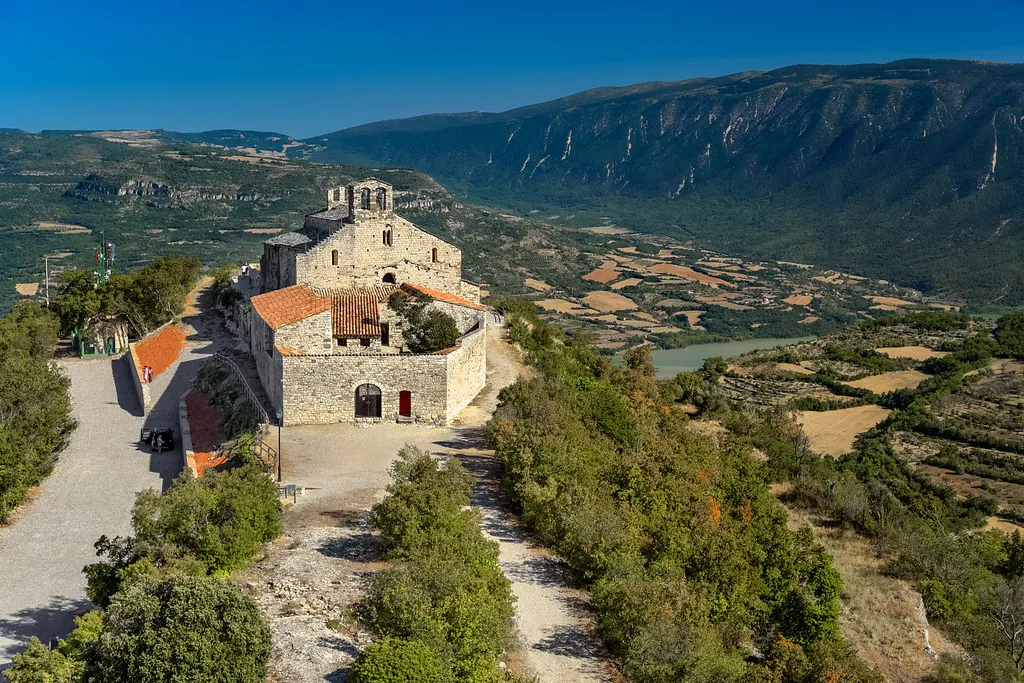
At 570 metres, Talarn occupies a small promontory. This isn’t a dramatic peak, but a watchful rise. For generations, that slight elevation meant everything. It placed the village between the plains to the south and the gorges of the Noguera Pallaresa to the north. You feel that in-between quality in the light, in the way the wind moves.
Calles de piedra y cal
The old quarter is a puzzle of pale stone. Streets climb at unexpected angles, turn into shallow steps, open into pocket-sized squares where sunlight pools for an hour before moving on. The buildings show irregular stonework or flaking white render. Narrow balconies of wrought iron hold their faded paint against the sun.
The church of Sant Martí acts as an anchor. Its square tower is a landmark from across the valley, its bells still keep time. There’s no prescribed route here. Wandering works better. Notice the texture of a worn wooden door, the cool draft from a vaulted passageway, geraniums in tin cans on a windowsill. You can walk every street in twenty minutes, but you should take an hour.
El peso del agua
The Embalse de Sant Antoni is never out of mind for long. From certain corners, the view opens to reveal that expanse of water, its colour shifts from leaden grey to a surprising blue-green. The dam changed everything decades ago. Now, the reservoir dictates the rhythm and the light.
At dawn, its surface is often glassy and still. An afternoon breeze usually picks up, scribbling patterns on the water. Local tracks follow its shoreline. In summer, you’ll see kayaks and paddleboards near designated areas. Come autumn, it’s quieter, left to anglers and herons stalking the reed beds. This engineered lake has become part of the natural order.
Senderos de transición
The land around Talarn feels like a negotiation between mountain and plain. The slopes are gentler here than upstream. Farm tracks ribbon through fields of cereal and past stands of young pine. Holm oaks dot the hillsides.
Walk these paths in April or May and you move through clouds of wild thyme scent and the buzz of insects. Summer sun is intense and unrelenting on the open ground; start early or wait for evening. These are not epic mountain trails, but routes of quiet observation. They connect to viewpoints where you see the whole valley laid out: water, town, terraced fields, and the rising wall of the Pre-Pyrenees beyond.
Una cocina de interior
The food in Pallars Jussà speaks of an inland life. You find lamb reared on local hillsides, pork, potatoes, and beans from garden plots. Cooking over wood embers is common, a method that imparts a specific, smoky depth to meats and vegetables.
Autumn means mushrooms foraged from the woods nearby. Winter is for escudella, a substantial stew that simmers for hours. The flavours are direct and hearty, shaped by cold nights and agricultural cycles rather than any passing trend.
Cómo y cuándo moverse
Talarn has distinct seasons. July and August draw more people to the reservoir shores, particularly on weekends. For walking or cycling without the heat or crowds, aim for late spring or early autumn. The light is softer then, and traffic on back roads is minimal.
The drive from Lleida follows the river north for about an hour. Tremp is just minutes away by car for fuel or supplies. A bus service exists, but its frequency is limited; check schedules in advance.
This village isn’t about ticking off sights. It’s about feeling a specific landscape—a place shaped by water held back by concrete, by old stone walls, by a slow pace. Go for an evening walk when bats flicker above the streets. Sit on a bench and watch the last light leave the surface of the reservoir. That’s when Talarn makes sense