Full Article
about Farrera
Known for its Centro de Arte y Naturaleza; a charming high-mountain village
Hide article Read full article
A village above the valley
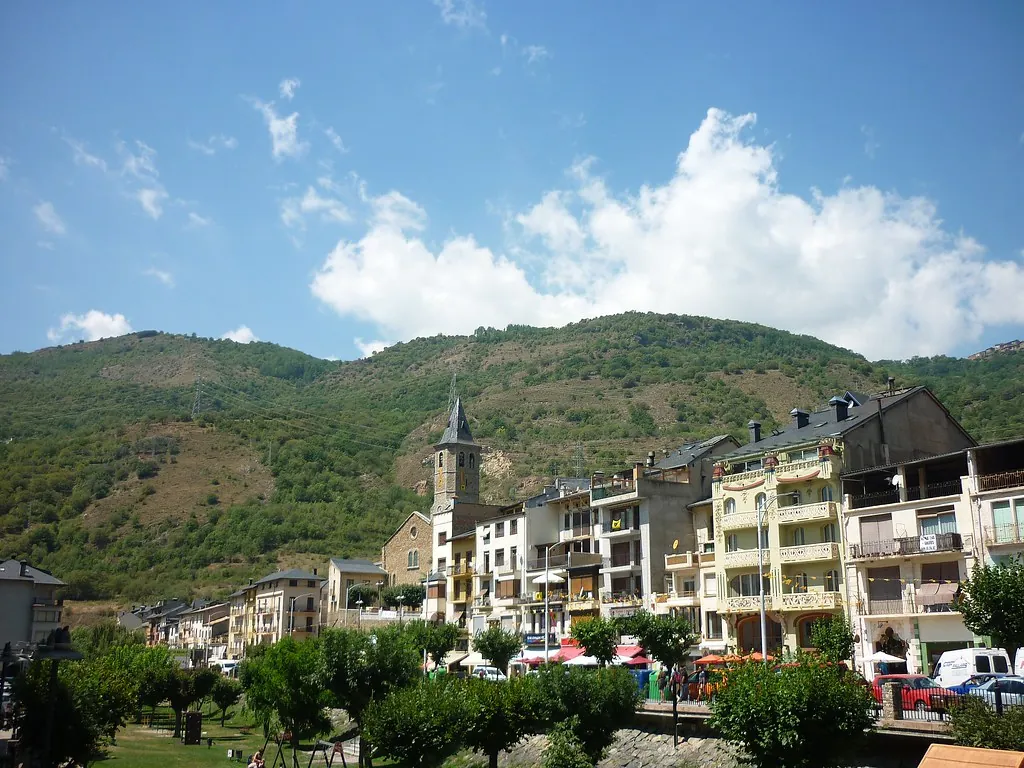
Early in the day, when light has barely begun to brush the peaks of the Pallars Sobirà, mist often lingers in the valley bottoms. From the small mountain pass where the village stands, Farrera appears ringed by black pines and fir trees that darken the landscape even in summer. At that hour there is almost no sound: perhaps a distant cowbell, wind moving through the treetops and, if the air is still, the faint creak of wood as a house warms in the sun.
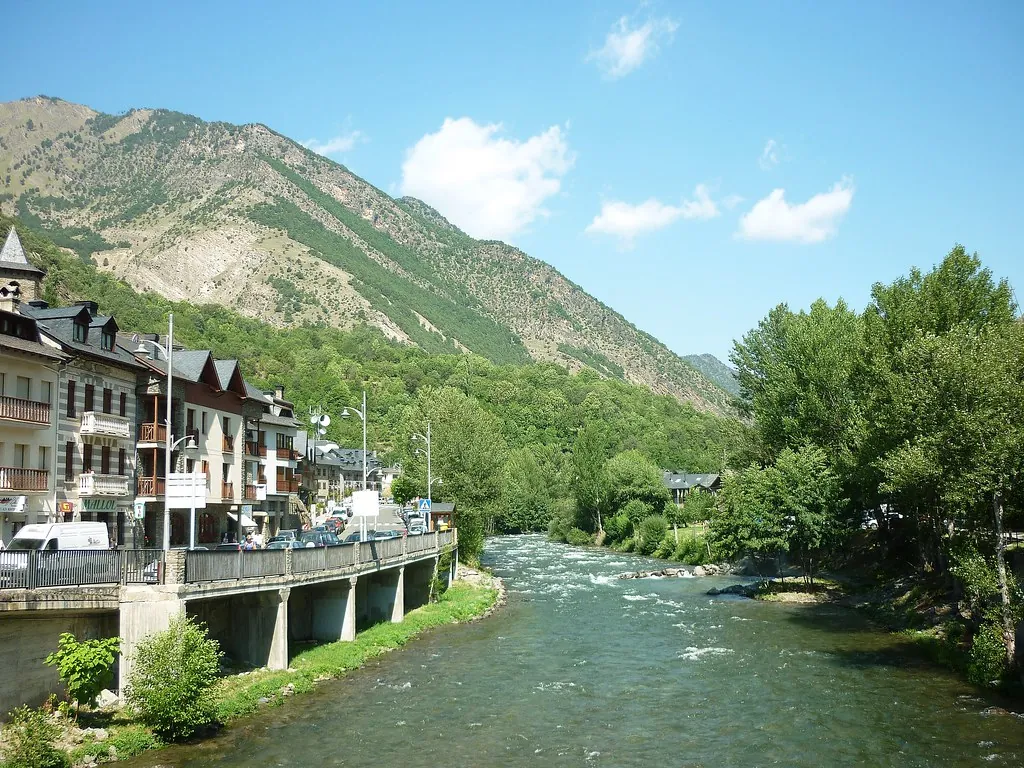
Tourism in Farrera revolves around that sense of separation. This is not a place you pass through or stumble upon by chance. The road climbs steadily from the valley and, when it ends, what remains are footpaths, forest and a handful of small hamlets scattered along the slope.
Farrera has very few residents and it shows in the scale of everything. The streets are short, the houses built of dark stone, their roofs sharply pitched to bear the weight of winter snow. The façades shift with the hours: cool tones dominate in the morning, while late light sliding down from the Pyrenees softens the stone into a muted orange.
In the main settlement stands the church of Sant Martí, an example of mountain Romanesque architecture. It is neither large nor heavily ornamented. What survives from that period is visible more in the curve of the apse and the way the stone has been laid than in decorative detail. The simplicity fits the setting.
Beyond the main village are other small nuclei such as Montesclado. There, the Romanesque church of Santa Eulàlia occupies an elevated position where the valley opens southwards. On clear days, successive ridgelines unfold into the distance. When low cloud settles, everything feels closer and quieter, as if the landscape has drawn in on itself.
Forest within the Parc Natural de l’Alt Pirineu
Much of the municipality lies within the Parc Natural de l’Alt Pirineu, the largest natural park in Catalonia. That status translates into wide stretches of continuous woodland. Black pine dominates at higher altitudes, while fir and beech thrive in more humid areas. Underfoot there is often a thick layer of needles and leaves, roots pushing through the soil in irregular patterns.
Walking through these forests, the soundscape changes from one section to the next. There are soft stretches where boots make almost no noise, then sudden patches of brittle twigs that crack sharply. With patience, it is possible to spot chamois on the slopes or large birds of prey riding thermal currents above the trees.
The paths are not always straightforward. There are gradients to contend with, stony sections and areas where mud forms after wet days. Even in summer it is sensible to wear proper mountain footwear and carry an extra layer in a rucksack. Once the sun slips behind the mountains, temperatures drop quickly.
Mountain routes from Farrera
Several routes begin within the municipality and climb towards higher ground in the Pyrenees. Some connect with mountain refuges or mountain passes that provide access to nearby summits. These are long walks, the kind that start early in the morning and end well into the afternoon.
Weather plays a decisive role here. Mist can rise from the valleys in a matter of minutes and transform the terrain, altering visibility and orientation. Before setting out, it is wise to check the forecast or ask locally about the condition of the paths.
For those who prefer gentler terrain, there are options within the forest itself. Shorter routes thread between clearings and the edges of meadows, allowing time among the trees without committing to major ascents. The experience remains the same in essence: distance from traffic, the rhythm of walking and the steady presence of the mountains.
Seasons and practicalities
Autumn is often the most rewarding time to walk in this area. The beech trees turn colour and the air tends to feel clearer after the first rains. In summer the days are long, but the midday sun can flatten the landscape and the heat becomes noticeable on climbs.
Winter reshapes the terrain entirely. Snow covers paths and slopes, and some routes are tackled with snowshoes or touring skis. Conditions change quickly at altitude, so it is important to be properly informed before heading towards higher ground.
Planning ahead is advisable in general. Services within the municipality are limited, and there is not always much activity outside weekends or specific seasons. Farrera’s appeal lies precisely in its small scale and quiet atmosphere, but that also means fewer facilities than in larger mountain centres.
When silence settles
Farrera preserves something increasingly rare in parts of the Pyrenees accessible by road: a genuine sense of remove. As evening falls and the sun drops behind the ridgelines, the forest darkens abruptly and silence returns to the valley.
At that point the village resumes its usual rhythm. A chimney begins to smoke, paths empty, and the scent of firewood lingers in the cold mountain air. Life here continues to be shaped by altitude, by climate and by the patience required to live in a remote place.
There are no grand attractions competing for attention, no crowds to disperse. What defines Farrera is its scale and its setting: a small settlement on a mountainside in Pallars Sobirà, surrounded by forest within the Parc Natural de l’Alt Pirineu. The experience is tied to light and weather, to the effort of walking and the return to stillness at the end of the day.
For travellers drawn to the quieter side of the Pyrenees, Farrera offers space, woodland and long horizons. The road leads up, then stops. Beyond it, the landscape takes over.