Full Article
about Camós
Scattered rural municipality near Banyoles; landscape of hills and forests
Hide article Read full article
A small place beside Banyoles
Some villages demand a map and a checklist. Others make sense within ten minutes of walking. Camós clearly belongs to the second group.
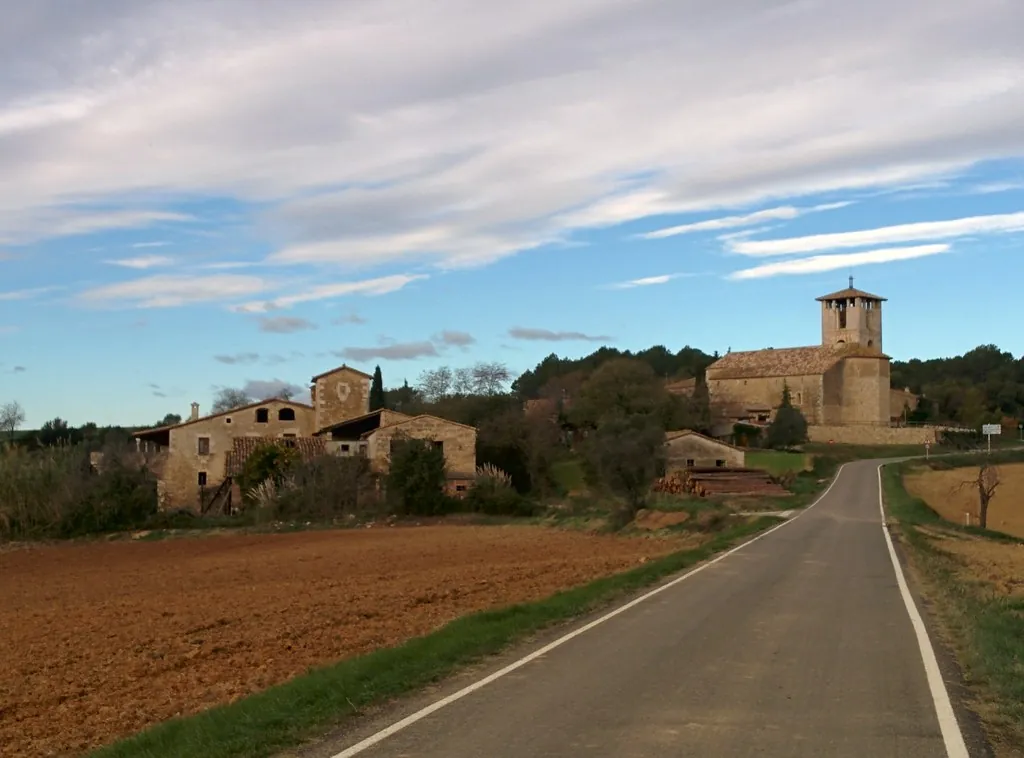
Tourism in Camós is about something simple: a small settlement next to Banyoles where daily life still moves at a village pace. It has just over seven hundred residents and lies in the comarca of Pla de l’Estany, close to Girona in Catalonia. Many people drive nearby on their way to the lake at Banyoles without realising that, a couple of secondary roads away, there is a quiet nucleus where farmland still shapes the landscape.
There are only a handful of streets, fields all around and no sign that anyone is in a rush to turn it into an attraction. That is precisely its character. Camós does not compete with larger destinations in the area. It simply continues as it is.
Streets that reveal themselves quickly
Camós is not a place where you move from monument to monument. The usual plan here is to walk for a while, look at the houses and accept that the day will be straightforward.
The streets in the main nucleus are short. Stone houses line them, some whitewashed, others with exposed masonry. Windows tend to be small. There are interior courtyards and the occasional old door that seems to have been there longer than the tarmac outside.
Details appear without any effort. An old coat of arms on a façade. A carefully built wall. A corner that feels unchanged for decades. None of these elements are grand sights. They are the kind of things noticed while wandering with no particular goal.
This is a village that can be understood quickly. A slow circuit of the centre is enough to grasp its scale and rhythm. Cars pass at low speed. Neighbours greet each other. Everyday scenes unfold without ceremony.
Sant Esteve and the heart of the village
The church of Sant Esteve is the building that gives some structure to the centre. Its origins are medieval, and parts of it recall Romanesque architecture, although the structure has been altered over time. It is not a monumental church. It is the kind of parish church that has accompanied a community for centuries.
Around it, much of the local life circulates. There may be a bench nearby. People stop to talk. Traffic remains light. It is an ordinary setting, yet one that has become less common in many places.
For visitors unfamiliar with Catalonia, the parish church in a village like this often acts as both religious and social reference point. In Camós, Sant Esteve plays that role without any grand staging. It stands at the centre of a small cluster of streets, quietly anchoring the settlement.
Fields, allotments and masías
Step beyond the nucleus in any direction and fields begin almost immediately. This is the landscape of Pla de l’Estany: agricultural plots, rural tracks and masías scattered across the territory. Masías are traditional Catalan farmhouses, usually built in stone and linked to farming activity.
Some of these country houses look very old. Thick walls. Low roofs. Courtyards where tools or agricultural machinery are still kept. Not all of them can be visited, of course, yet they form part of the scenery that surrounds Camós.
The agricultural setting defines the experience as much as the village streets do. In spring and early summer everything turns green. Later, the tones shift and the fields become drier and more golden. The transformation is gradual, tied to the farming calendar.
It is a calm landscape, best explored on foot or by bike, without paying too much attention to the clock. Rural paths link plots of land and isolated houses. There are no major landmarks competing for attention, just open space and cultivated ground.
Close to Banyoles and La Garrotxa
One of the practical aspects of Camós is its location. Banyoles is only a few minutes away by car, with its well-known lake and the usual activity of a larger town. Many people combine the two: a walk by the lake followed by a short detour towards the nearby villages.
Camós works well as part of that kind of plan. It offers contrast. After the movement around the lake, the atmosphere here is noticeably quieter.
The volcanic area of La Garrotxa is also relatively close. This comarca is known for its wooded landscapes and volcanic cones. From Camós, it can be reached without a long journey, making it feasible to include forest walks or visits to volcanic terrain within a broader route through the region.
In this sense, Camós functions effectively as a brief stop on a wider itinerary around Pla de l’Estany and neighbouring areas. It does not demand a full day. It fits naturally into a half-day or shorter visit, especially when combined with Banyoles.
Local festivals and village life
The village calendar revolves mainly around traditional celebrations. The parish of Sant Esteve marks some of them, and in summer there are usually popular festivities with activities in the street.
These are not large-scale events designed to attract crowds. They are village festivals. Music, neighbours meeting up, an atmosphere centred on the square. For travellers who happen to be in the area at the right time, they offer a glimpse of community life rather than a spectacle.
As with the rest of Camós, the scale remains modest. Celebrations follow familiar patterns found in many Catalan villages, shaped by the parish and the agricultural rhythm of the year.
How to fit Camós into a trip
Camós does not require a detailed plan. A walk through the nucleus, a loop along nearby paths and perhaps combining it with Banyoles is more than enough.
It is the kind of stop that slows down a journey. Half an hour wandering the streets can be sufficient to understand it. Add a short stroll through the surrounding countryside and the picture becomes complete.
There is no long list of must-see sights. Instead, Camós offers a pause. A small village in Pla de l’Estany where fields reach almost to the houses and daily life continues at its own pace. For some travellers, that brief change of rhythm is reason enough to turn off the main road and spend a little time here.