Full Article
about Cornellà del Terri
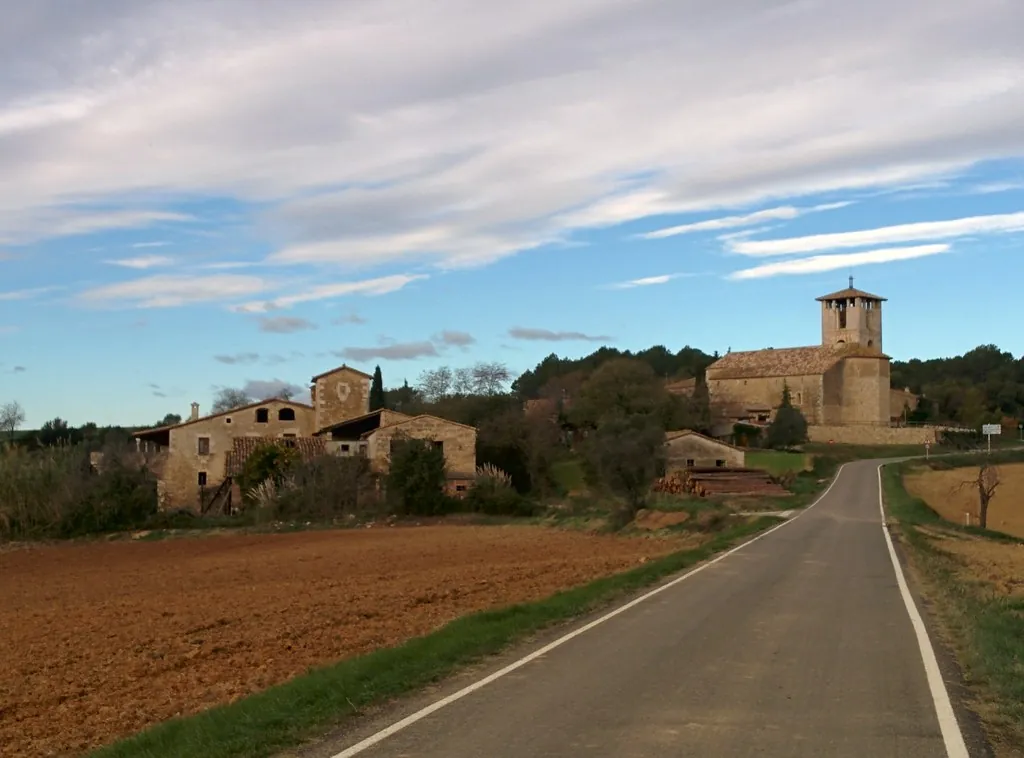
Municipality made up of several villages in the Terri valley; known for its tradition of planting the maypole.
Hide article Read full article
At eight in the morning, mist from the river curls between the poplars like a grey blanket. From the bridge in Cornellà, the water of the Terri moves quietly, almost hidden by the vegetation along the banks, while a rooster calls from one of the scattered farmhouses across the valley. This is how the village wakes, unhurried, with that early-hour stillness typical of small places in the Pla de l’Estany.
A Place Where Time Slows
Cornellà del Terri does not lend itself to rushing around. The municipality is made up of several small centres, Sant Andreu, Borgonyà, Corts, the Pujals and other clusters of houses, spread across an agricultural plain and separated by fields and narrow roads. Driving here means easing off the speed: tractors appear, the bends are gentle, and the occasional cyclist crosses the Pla de l’Estany from end to end.
Local roads run between maize fields, cereal crops and small patches of woodland. Every so often, an isolated Romanesque church comes into view, often surrounded by open grassland.
Sant Climent, in the centre of Cornellà, stands out with its sun-warmed stone, gradually softened by years of weather. Its twin-arched bell tower can be seen from a distance on clear days. Inside, it tends to stay cool even in summer, with a scent that blends wax, damp stone and old wooden pews.
When the River Powered Work
In Borgonyà, the sound of the water changes. The Terri, calm along most of its course, was once used here to drive mills and small workshops. In certain spots, stone walls and channels still hint at that past. Over time, larger industrial activities arrived. According to local accounts, there was first a paper factory and later a textile one, although today little remains beyond traces hidden in the vegetation.
Memories of that period still circulate among residents. Stories are told of people arriving from nearby areas such as Olot in the mid-20th century to work in those factories, sometimes travelling on foot along the old road with their belongings bundled together. Now the site has largely faded into ruins covered in ivy, with swifts crossing the sky in the evening, while the river continues its steady flow.
The Dance That Returns at Easter
On Easter Monday, the rhythm of the village shifts. A tall pine tree, known as the Arbre de Maig, is raised in the square, and the Ball del Cornut, a traditional dance, takes place.
The dancers, all men, wear farmer-style clothing and cardboard masks, while the sharp sound of the gralla, a traditional Catalan wind instrument, sets the pace. The origins of the dance are not entirely agreed upon. Some link it to old agricultural rites, others interpret it as a humorous take on jealousy and marriage. Whatever the explanation, for a few hours the village revolves around this ritual.
Moments during the dance often reflect how traditions pass quietly from one generation to the next. A child might watch one of the masked figures with fascination, only to recognise a familiar face beneath the disguise. The performance continues with a seriousness that contrasts with the laughter it can spark among onlookers.
Paths Along the Terri
Several walking routes begin around the municipality, following the banks of the Terri or linking nearby settlements. These are not dramatic trails with steep climbs. Instead, they pass through fields, riverside woodland and working paths still used daily by locals.
One of the most pleasant walks leads towards Sant Miquel de Sords. This Romanesque chapel appears among the trees, set back from the road. The door is not always open, but the setting alone makes the detour worthwhile: quiet surroundings, the occasional distant bell, and in summer the steady hum of insects.
For walking, early morning and late afternoon tend to be the most comfortable times. Around midday, the sun bears down strongly on the plain, and there are few shaded stretches.
What You Will Not Find
Cornellà del Terri moves to the rhythm of an agricultural village. In the main square, there is a place where people gather early in the day before heading out to work the land. Conversations often circle around the same themes: the weather, the price of cereal, whether there will be enough rain this year.
There are no shops designed for visitors, nor streets arranged for browsing. Instead, there are well-kept vegetable plots, chickens wandering through some courtyards, and tractors moving in and out of the village throughout the day.
Food at local tables remains closely tied to what is grown nearby. Calçots appear when in season, ripe tomatoes dominate in summer, and mushrooms arrive with the autumn rains.
When to Go
April and May are usually the most rewarding months to explore Cornellà del Terri. The Terri carries a steady flow of water, the fields are in full growth, and a low morning mist lingers before gradually lifting.
August can feel heavy. Heat settles over the plain, and mosquitoes from the river become noticeable.