Full Article
about Crespià
Town known for its honey fair; quiet rural setting with paleontological sites
Hide article Read full article
A village that keeps its own pace
Early in the morning, when there is still moisture on the stones, the centre of Crespià barely moves. A window opens somewhere, a wooden door scrapes lightly along the ground, and little else disturbs the quiet. At that hour it becomes clear how tourism works here. This is not a place designed for hurried visits, but a village that continues at its usual rhythm even if someone happens to be wandering its streets.
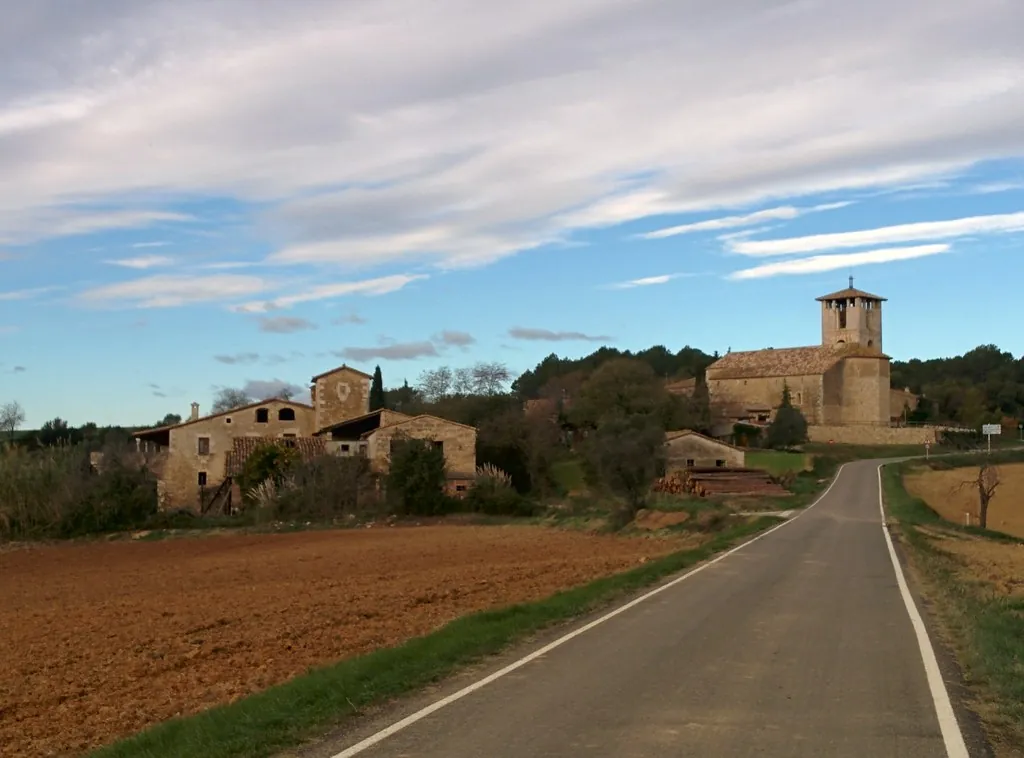
Crespià lies in the Pla de l’Estany, a few kilometres from Banyoles, in an area of open fields where agriculture continues to shape the landscape. Just over two hundred people live here. In the old quarter, houses have thick walls of pale stone and wide doorways once built to let carts pass through. In some courtyards, narrow irrigation channels are still visible, carrying water when the season calls for it.
The streets are short and gently sloping. There is no marked route or set itinerary for visitors. The experience is simple: walk, and the village gradually reveals itself through uneven façades, enclosed patios and the occasional fig tree leaning over a wall.
Sant Martí and traces of earlier centuries
The church of Sant Martí stands at one of the most visible points in the village. The current building dates back to the medieval period, usually placed around the 13th century, although it has undergone several alterations over time. From the outside, the stonework shows different tones, clear signs of construction phases from different eras.
Inside, the atmosphere shifts. The space is restrained, with wooden pews and a Baroque altarpiece that contrasts with the sobriety of the exterior. On quiet days, even footsteps echo across the floor.
Close by are several historic masías, traditional Catalan farmhouses typical of the surrounding countryside. Some remain linked to agricultural work, while others now serve as private homes. Their arched doorways and dry stone walls reflect a long-standing reliance on the land rather than on passing visitors.
The village square is small and open. It is here that neighbours tend to cross paths. By mid-afternoon, the most constant sound often comes from swallows circling above the rooftops.
Open fields and unmarked paths
Beyond the last houses, the land quickly flattens out. Cereal fields, cultivated plots and small clusters of trees define the scenery. In spring, the green is intense. In summer, when the wheat ripens, the fields turn gold and the air carries the scent of dry straw.
The rural tracks around Crespià are not designed as signposted walking routes. They are agricultural paths that connect farms or lead towards nearby villages such as Fontcoberta, Porqueres and Cornellà del Terri. On foot or by bicycle, they are straightforward to follow, though after several days of rain some stretches can become heavily muddy.
It is wise to carry water when heading out. Outside the village centre there are no visible fountains, and while the distances between villages are not vast, they can feel longer under the summer sun.
Lake Banyoles lies relatively close, about five kilometres to the south. Many people who pass through Crespià choose to continue on to the lake, particularly at dawn or towards the end of the day, when the water is still and noise is minimal.
Eating in the Pla de l’Estany
Within Crespià itself, options for eating out are very limited. Most visitors head to nearby towns for meals. Across the Pla de l’Estany comarca, the cooking is typically straightforward and rooted in local produce: grilled meats, regional embutidos, and spoon dishes based on pulses or seasonal vegetables.
Small-scale local products such as honey, homemade wine or preserves sometimes appear in direct sales or at fairs in neighbouring villages. They are not always available, yet they form part of the area’s everyday economy.
Anyone planning to spend the day in Crespià will usually find it practical to organise food in advance or bring something prepared.
Quiet traditions through the year
Local celebrations revolve around Sant Martí, the village’s patron saint, in November. The events are generally simple and centred on residents. During summer, communal dinners or informal gatherings in the square are also common once night falls and the heat begins to ease.
These are not festivals designed to attract large crowds. They function primarily as community occasions. Visitors who happen to be present observe, join for a while, and then continue on their way.
When to visit
Spring is one of the most pleasant times to walk the agricultural tracks. The air often smells of damp earth, and the fields begin to turn green.
Summer can be very hot in the middle of the day. In that season, the more comfortable option is to head out early in the morning or wait until the sun starts to drop.
Autumn brings more muted colours and a particular calm along the paths. In winter, the village becomes very quiet. On some afternoons, the wind moves through the empty streets and little can be heard beyond the brush of branches against stone.
Crespià does not present itself as a destination filled with sights or organised activities. Its appeal lies in continuity. The village maintains its routines, its fields and its modest scale. Visitors fit into that pattern rather than reshaping it. Those who arrive expecting spectacle may find very little. Those who are content to walk slowly between stone walls and open farmland will understand how tourism works here: it adapts to the village, not the other way round.