Full Article
about Esponellà
Municipality on the Fluvià river; known for its bridge and castle ruins.
Hide article Read full article
A Slow Arrival in Pla de l’Estany
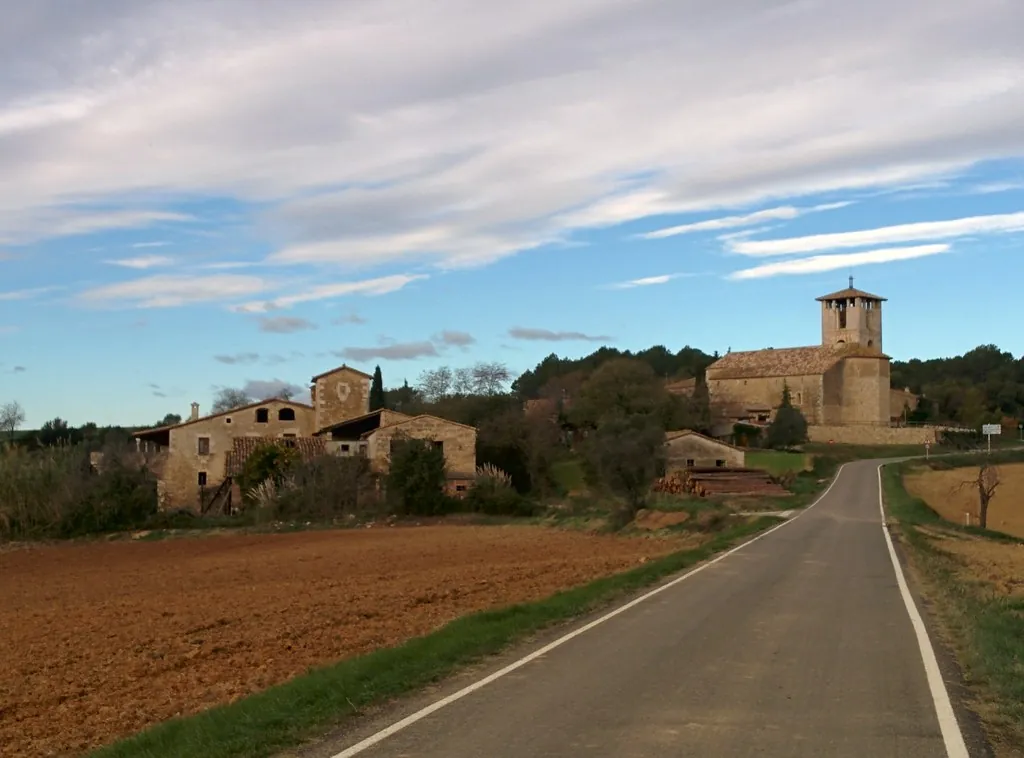
In the early afternoon, when the sun falls at an angle across the fields of Pla de l’Estany, the stone houses of Esponellà take on a soft golden tone. Silence dominates. A single car might pass slowly, or the distant sound of a tractor drifts across the fields. Tourism in Esponellà unfolds like this, unhurried and without obvious signs that anyone is visiting.
This small municipality, with around 450 inhabitants, lies just a few kilometres from Banyoles in Catalonia. The village centre remains compact. Stone houses cluster along short streets, their wide doorways opening directly onto the road. Around the built-up area stretches a patchwork of cultivated fields, holm oaks and small Mediterranean woods. Visitors do not alter the rhythm here. Daily life continues at its usual pace.
Sant Martí and the Old Streets
The bell tower of Sant Martí soon appears above the rooftops. Finding your way is simple because the village is small. A few minutes are enough to cover the main streets, where worn stone arches still frame doorways and dark iron balconies project above.
The church has Romanesque origins, although what stands today reflects later alterations. Its exterior stonework reveals different periods if you look closely. The nearby square often falls into shade by mid-afternoon, and the air cools slightly even in summer.
Wandering without a fixed route suits Esponellà better than following a marked itinerary. A simple fountain appears on one corner. Further along, a small bench stands against a wall, sometimes used by neighbours once the heat begins to ease. These modest details define the centre more than any single landmark.
Paths Through Open Fields
Step beyond the last houses and the landscape opens immediately. Dirt tracks cross cultivated plots and small areas of low woodland. The smell shifts with the seasons. Winter brings damp earth, while late summer carries the scent of dry grass and fine dust.
Many of these tracks can be explored on foot or by bicycle. Signage is not always clear, so it helps to carry a basic map or have the route on your phone. Orientation is rarely complicated because the terrain is gentle and fairly open.
On clear days, looking north, the faint blue outline of the Pyrenees sometimes appears. The view is not always sharp, yet when the mountains do emerge they give depth to the surrounding fields.
Close to Lake Banyoles
Esponellà’s proximity to Banyoles shapes the way many people visit. Some arrive after spending time by Lake Banyoles, one of Catalonia’s best-known lakes. Others use the village as a quieter base from which to explore the comarca, or county.
The contrast is noticeable. Banyoles sees more activity, especially at weekends. In Esponellà, the prevailing sound remains that of the countryside. Those in search of quiet should aim for early morning or the end of the day. As the light softens and drops lower, the paths become almost empty and the village returns to a stillness that seems to linger between the stone façades.
Cycling the Secondary Roads
Cyclists regularly use the small roads of Pla de l’Estany. Traffic is usually light, and the terrain rolls gently without major climbs. The setting encourages steady progress rather than speed.
Several quiet stretches begin in Esponellà and link with nearby villages. These are not routes designed for record-breaking times. The appeal lies elsewhere: moving through open fields, breathing in the scent of the soil and hearing the constant hum of tyres on coarse tarmac. The experience stays close to the land, with little to interrupt the rhythm.
Local Festivals and Village Life
The festive calendar follows the pattern common to many villages in the area. The festa major, the main annual festival typical in Catalan towns, usually takes place in summer. It brings together residents who live elsewhere during the year and return for the occasion.
Winter still sees celebrations linked to rural traditions. Around Sant Antoni, bonfires are lit and animals receive blessings, customs rooted in agricultural life. These events are not designed to attract large crowds. They function more as local reunions, moments when the village gathers on its own terms.
Getting There and Choosing the Moment
The simplest way to reach Esponellà is to travel from Girona to Banyoles and continue along a local road. The drive is generally short if traffic is light. Public transport usually involves reaching Banyoles first and then covering the final stretch by road.
August can bring intense heat in the middle of the day. Early walks or outings at dusk change the experience considerably. The light softens, temperatures ease and the village settles back into the quiet that seems to hover among its stone houses.
Esponellà does not reinvent itself for visitors. Its appeal rests in continuity: short streets, fields stretching outwards, seasonal changes in scent and colour. A few hours are enough to see the centre, yet the surrounding tracks invite a slower pace. The village remains close to Banyoles and within easy reach of Girona, but it keeps its own rhythm, steady and understated in the heart of Pla de l’Estany.