Full Article
about Palol de Revardit
Scattered municipality with a restored castle; quiet, wooded surroundings
Hide article Read full article
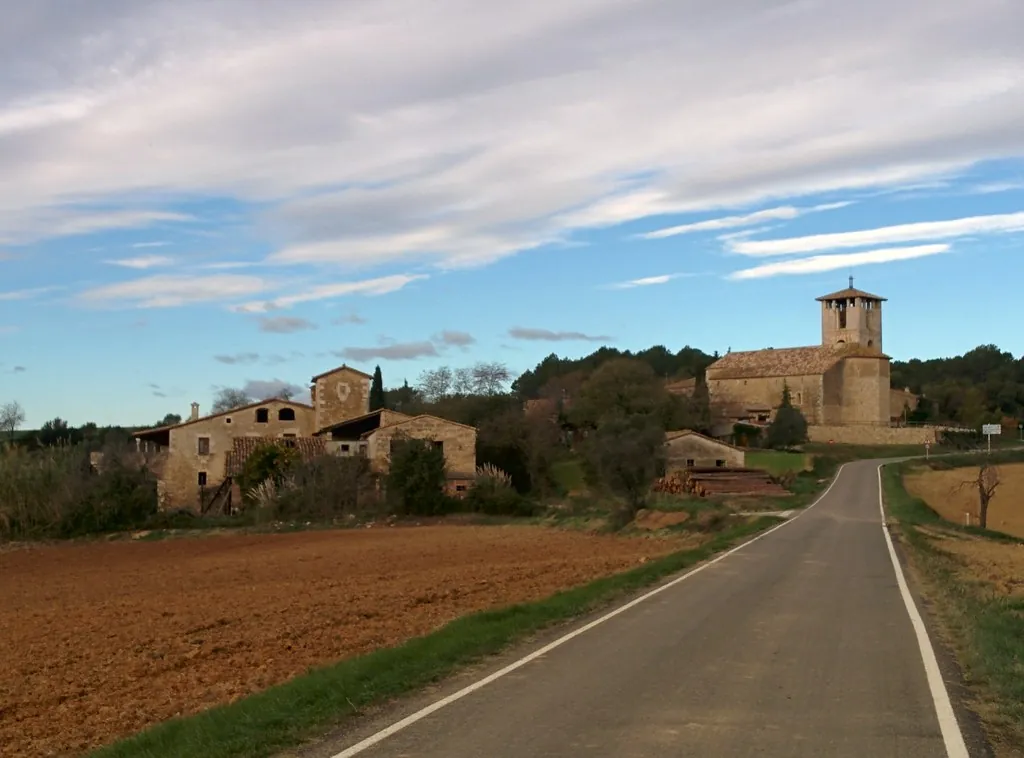
The road into Palol de Revardit is a straight line of grey asphalt cutting through fields. At dawn, the air is cool and carries the mineral scent of irrigation water hitting dry soil. A tractor moves slowly in the distance, its sound a low, steady hum that fades as you pass the first houses. These are not arranged for a postcard; some have new windows, others show faded shutters peeling in the sun. Lake Banyoles is a presence to the east, a known body of water just a few kilometres away, but here the land feels distinctly dry, planted, and private.
Life here is measured in hectares and seasons. Around 450 people live in the municipality, most in scattered masías or in the quiet cluster of houses near the church. You don’t come for sights; you come for a particular quality of light in the evening, or for the deep silence of a midday Sunday when everyone is indoors.
The Weight of Stone and Field
The church of Sant Andreu sits heavily among the homes, built from a rough, local stone that varies in colour from grey to a warm beige. Its medieval origins are clear in the lower sections of the walls—blocks larger, less uniform. Later additions use smaller, smoother stone. The bell rings on the hour with a flat, metallic tone that seems to get absorbed by the fields.
The masías are the true architecture here. They are working buildings: long, low silhouettes with tile roofs that click as they cool in the evening. Look for the arched doorways wide enough for a cart, and the external stairs leading to upper floors. Many still have their old era, the circular threshing floor of packed earth now often used to park a car. Walking the paths out of the village, you’ll see dry-stone walls holding back the land, their crevices filled with woolly lichen that feels soft and damp to the touch.
This landscape is one of horizontals. Fields of maize or alfalfa stretch out, interrupted by solitary holm oaks whose shadows are sharp and short at noon. In late September, after the harvest, the soil turns a pale, dusty gold and the air smells of straw and dry seed heads.
Walking the Working Paths
The rural tracks around Palol are made for tractors, not hikers. They are unpaved, often deeply rutted, and they connect farms, not viewpoints. This is their value. You walk where people work. A few connect to wider itineraries across the Pla de l’Estany, and it’s possible to link them to a walk around Lake Banyoles if you plan a longer route.
Go early. By ten in summer, the sun is direct and relentless; shade exists only in the lee of a farmhouse wall or under those occasional oaks. After rain, avoid the low-lying tracks—the clay here turns to a slick, sticky mud that clings to boots. A practical loop can be made by starting at the church, heading west past several masías, and circling back along a slightly higher track that gives a view across to Banyoles.
The Pull of Banyoles
Palol itself has little in the way of public life. There’s a bar where older men gather in the morning, but for a meal or to buy groceries, everyone drives to Banyoles. The relationship is practical and longstanding. The food in this area reflects that: straightforward plates of grilled local sausages, stews like escudella, and vegetables from nearby plots. It’s filling, seasonal, and served without fanfare.
This isn’t a place you visit for its culinary scene. You come back to a rented farmhouse with supplies from Banyoles’ market, you cook while watching the light leave the fields, and you understand that dinner here is a domestic act.
Marking Time: The Festa Major
For a few days in summer, usually around late July or early August, the Festa Major changes the soundscape. Plastic chairs appear in the square near the church. Tables are set end-to-end for a communal dinner that lasts into the warm night. The music is local cover bands or recorded sardanes, and it echoes between the stone walls until late.
Other dates follow the Catalan calendar—Sant Andreu’s day, Christmas gatherings—but these are for families and those who have moved away and return for the occasion. They feel internal. If you’re staying nearby during one, you’ll hear it but likely not be part of it; it’s a neighbour’s conversation drifting over a garden wall.
A Practical Approach
You need a car. From Girona, take the road to Banyoles; Palol is signed off to the right shortly before you reach the lake town. The drive takes about twenty minutes and shows you exactly what this plain is: agricultural land, orderly, flat.
Parking is never an issue except perhaps during the Festa Major nights, when cars line the main street. For walking, park considerately near the church or at a track entrance without blocking a gate.
Come in spring for the greenest fields and wildflowers along the path edges, or in autumn for that ochre light and quieter atmosphere. Summer demands early mornings. Winter can be starkly beautiful but truly quiet—some businesses in Banyoles may have reduced hours.
Palol de Revardit doesn’t offer an experience. It offers a context: stone walls warming in the sun, the sound of irrigation sprinklers starting up at dusk, and roads that lead from one farm to another. You either find something in that rhythm or you keep driving toward the lake.