Full Article
about Vilademuls
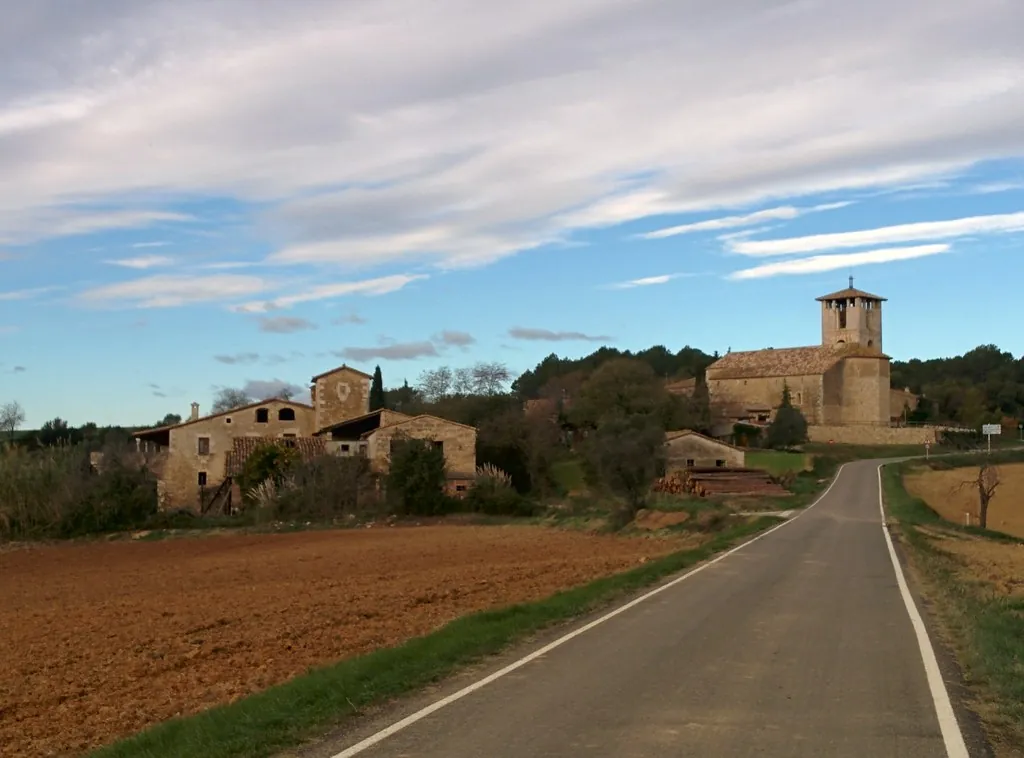
Large municipality with many small hamlets; rolling rural landscape
Hide article Read full article
A place that reveals itself when you stop
There is a certain kind of place that barely registers when seen from a car window. It looks uneventful at first glance, somewhere you pass through without much thought. Yet those are often the places that change once you step out and walk for a while. Vilademuls fits that description well.
Located in the Pla de l'Estany, not far from Banyoles, it marks a subtle but clear shift in atmosphere. Traffic thins out, fields take over, and time seems to move at a different pace. The municipality has around a thousand inhabitants and retains a distinctly rural feel. There are no modern housing developments or streets designed with tourism in mind.
Daily life still revolves around practical routines. Tractors move along dirt tracks, neighbours repair stone walls, and someone loads firewood into an ageing van. It is an environment that has not been reshaped to meet visitor expectations, and that is precisely what defines it.
A patchwork of small settlements
Vilademuls does not follow the familiar pattern of a single village clustered around a central square. Instead, it spreads out as a network of small settlements and scattered farmhouses.
Moving through the area means linking one group of houses to another via secondary roads and agricultural paths. At times it feels almost empty, then suddenly a bell tower appears, or a handful of houses gathered around a bend. From ground level it can feel fragmented, but from a higher vantage point the layout makes more sense, like pieces of a larger whole.
The landscape is mostly flat and fertile. Fields of cereals dominate, with occasional vegetable plots and rows of trees marking boundaries between properties. It is not a dramatic setting in the way mountains or cliffs might be, but it carries a steady calm that suits unhurried walks.
Stone buildings and rural churches
Several old churches are scattered across the municipality, each tied to one of the small population centres. The church of Sant Esteve, of medieval origin, is often the clearest reference point on arrival. It is not presented as a standalone monument but exists as part of everyday life.
Other small rural churches appear throughout the area. They are simple stone constructions, built for durability rather than display. Often, the most interesting part is not stepping inside but sitting outside for a moment and looking at the surrounding landscape.
The farmhouses, known locally as masías, also play an important role in shaping the character of Vilademuls. These are large buildings with thick walls and sloping roofs, some still linked to agricultural activity. Others have been restored over time, though many retain their original appearance. Together, they reflect a way of life closely tied to the land.
Walking through Pla de l'Estany
Vilademuls works well for those who enjoy walking without a strict plan. Several marked rural paths connect the different settlements and cross open countryside.
These are not demanding routes or long-distance treks. They are gentle walks, the kind where conversation comes easily, where it makes sense to pause for a photo or simply listen to the wind moving through the trees. The experience is defined less by reaching a destination and more by the pace itself.
Relatively close by runs the route of the Carrilet, a former railway line between Girona and Olot that has been converted into a greenway. It is widely used by people on foot and by cyclists, as the route is smooth and easy to follow. Its presence adds another option without changing the overall feel of the area.
Close to the lake of Banyoles
Another aspect of Vilademuls is its proximity to the lake of Banyoles, just a few kilometres away. The shift from farmland to water is quick, offering a different setting without much effort.
The lake is used throughout the year for sport and for walks. Some days bring more activity, though the size of the area means quieter corners are usually available. It provides a contrast to the stillness of the surrounding fields, without feeling disconnected from them.
A place that keeps its own pace
Vilademuls is not somewhere people arrive expecting major monuments or a long list of attractions. It suits a different kind of visit, one centred on slowing down, walking for a while, and observing how rural life unfolds in this part of Girona.
Sometimes that is enough. A secondary road, open fields, and a couple of unhurried hours. In Vilademuls, that simple plan feels entirely appropriate.