Full Article
about La Vilella Baixa
Known as the New York of Priorat for its tall houses above the ravine
Ocultar artículo Leer artículo completo
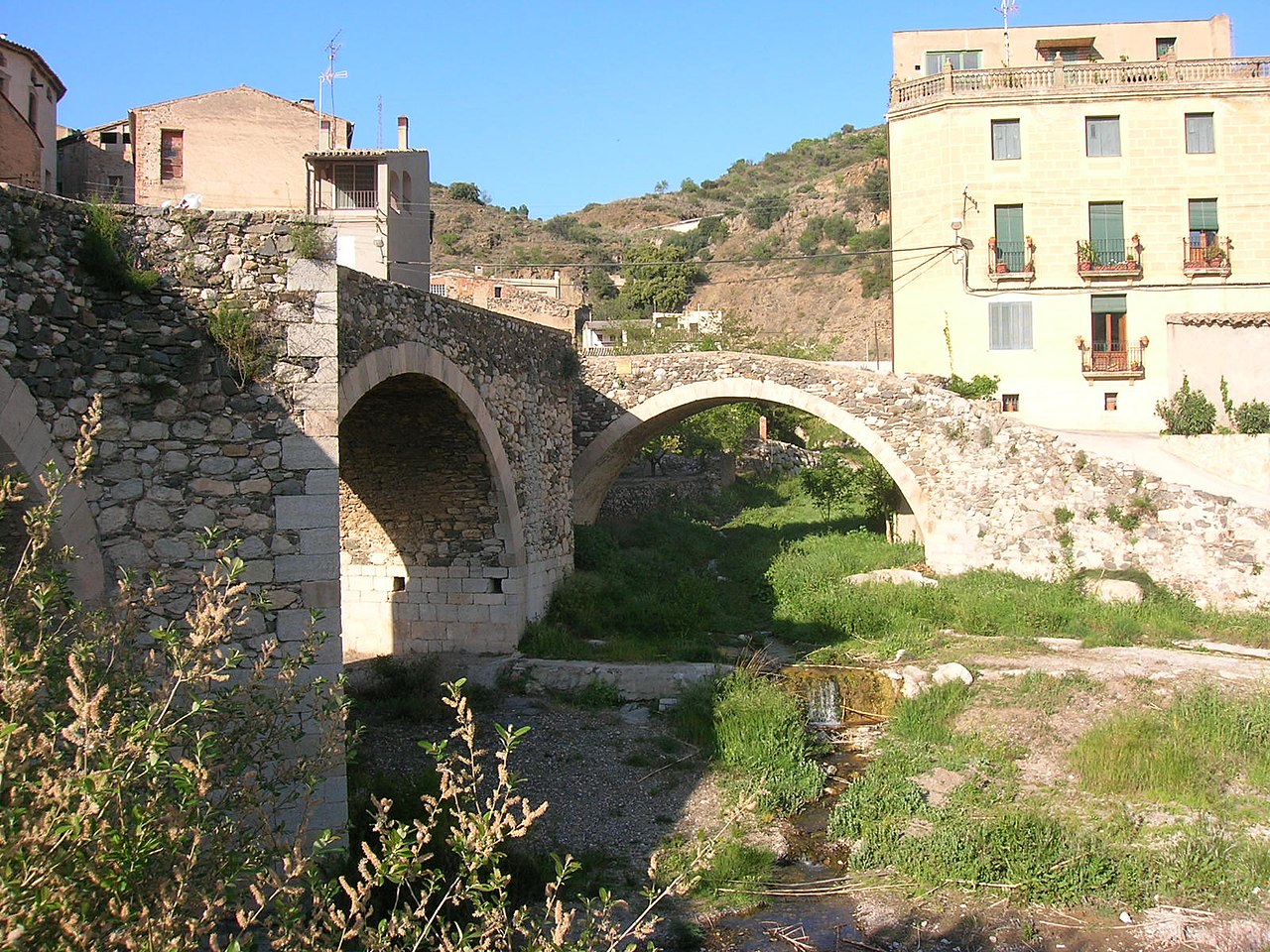
The stone bridge is only 17 metres long, yet it feels like a catwalk suspended above a geological textbook. From its parapet you look straight down a ravine of near-black slate – the same llicorella that gives Priorat reds their ferrous bite – while houses the colour of burnt cream appear to climb the opposite cliff on top of one another, New-York-tenement style, but built in 1743 not 1943. This is La Vilella Baixa, population 188, administrative runt of its own municipality, and the sort of place cartographers once forgot. Modern visitors tend to remember it chiefly because the road ends here: the only way forward is on foot, down terraced rows of garnacha and cariñena that drop 200 m in the space of a kilometre.
Geography that dictates everything
The village sits at 218 m above sea level, low enough for the Siurana river to have gnawed a cleft, high enough for nights to stay ten degrees cooler than Reus on the coast 40 km away. That diurnal swing is what concentrates sugar and skin colour in the grapes, and it explains why every second doorway here used to lead into a cellar. Some still do: look for the iron-barred windows set below street level on Carrer del Raval – improvised vents for fermentation vats long since replaced by stainless steel in co-ops down the lane.
The slate walls absorb midday heat and release it after dusk, so even in late October T-shirts suffice until midnight. Summer, however, is relentless. Shade is rationed to the width of alleyways that rarely exceed two arm-spans; by 14:00 the stone turns too hot to lean against. Come prepared with water, because the solitary grocery shuts for siesta (14:00–17:00) and there is no public fountain. Winter reverses the bargain: bright, sharp days perfect for walking, but the single access road can ice over where it corkscrews beneath the Ermita de Sant Antoni. Chains are advisable from December to February.
A five-street museum of work-arounds
No one visits for monuments. The parish church, closed except for Saturday mass, is a 16th-century rebuild scarred by 1830s artillery during the First Carlist War. Its bell, however, still rings the quarter-hour, a reminder that time was once measured by hand-cranked weights. More eloquent are the domestic details: slate roof tiles no thicker than a pound coin, held in place by their own weight; wooden balconies no wider than a dinner tray, sized for drying almond husks rather than Instagram selfies.
Peer through the grating opposite the bakery and you’ll see a subterranean corridor once used for mule-drawn sledges. The gradient allowed barrels to roll downhill to the river, where flat-bottomed boats ferried wine to Tarragona before the railway arrived. That water traffic vanished a century ago, yet the cooper’s mark – an inverted anchor – is still stamped into lintels along Carrer de Baix.
Wine without the lecture
Serious tasters base themselves in neighbouring Gratallops or Scala Dei, where Michelin-plated restaurants offer paired menus at £110 a head. La Vilella Baixa provides the antidote: walk into the cooperative on Carrer Major any weekday before noon, hand over three euros, and you’ll be given a 50 cl porró of last year’s Vi de la Vilella plus a plastic cup. The wine is young, unoaked, purple enough to stain your tongue, and tastes of crushed blackberries and graphite. Buy a second fill, wedge yourself against the west-facing wall when the sun drops, and you have the same view that once greeted French merchants in 1893, minus the river tariffs.
If polite barrel rooms are required, drive eight minutes to Clos Figueras. The owner, a former Montreux jazz promoter, speaks perfect English, keeps a shaded picnic lawn, and will sell you his flagship wine for £22 – half the London retail price. Book ahead; Saturday slots fill first.
Walking routes that punish, then reward
The GR-174 footpath skirts the village, linking Falset to the Siurana reservoir. A 6 km circuit starts by the football pitch (a walled scrap of riverbed where goals have no nets) and climbs 250 m through almond terraces to the ridge. From the top you can identify every hamlet in the comarca by its church tower; on clear days the Ebro delta glints 70 km south-east. After rain the descent turns into a polished slide: boots with tread are essential, and walking poles save knees. Carry a jacket regardless of season – altitude converts a breeze into a chill remarkably fast.
Mountain-bikers use the same tracks; expect to stand aside while Catalans in full body-armour rattle downhill. The village garage will pump tyres for 50 cents but carries no spare inner tubes – bring your own.
Where to sleep, what to eat
Accommodation is limited to three guest-houses, twelve rooms in total. The newest, Hostal la Granadella, occupies a former freight depot across the bridge; rooms have slate sills thick enough to balance a coffee cup outside the window while you sit in bed. Doubles from £70 including a breakfast of tomato-rubbed pa amb tomàquet and local olive oil sharp enough to make you cough. Mid-week discounts of 20% are standard November–March.
For dinner you have two choices: the cooperative bar serves butifarra beans and fried eggs for €9 until 22:00, or you drive to Falset where El Celler de l’Àspic offers slow-cooked wild boar at city prices. Vegetarians do better staying in for coca de recapte – order before 11 a.m. from the bakery and they’ll slide a tray into the wood oven when the bread comes out.
Arrival and the awkward truth
Reus airport, 51 minutes away, has Ryanair flights from London-Stansted and Manchester May–October; outside those months Barcelona is the fallback, doubling transfer time. Car hire is non-negotiable – the daily bus from Tarragona times its arrival to allow thirty minutes’ shopping, then leaves. Camper-vanners prize the free riverside aire, but spaces are gone by 18:00 in April; arrive earlier or you’ll reverse half a kilometre to turn round. Vehicles over 8 m should approach from Gratallops, not through the village itself, where one tight hairpin is gouged with alloy scars testament to over-confidence.
Easter and the September harvest weekend see every room booked by wine-trade Spaniards; prices jump 40% and the silence that defines the place is replaced by clinking crates at 02:00. Conversely, January can feel too quiet: the bakery shortens hours, the bar may close if the owner’s grandmother is ill, and the sun disappears behind the cliff at 16:30. Aim for late April or mid-October, when daylight lingers, temperatures hover round 20°C, and the cooperative still has last year’s vintage to shift before bottling starts again.
Leave before checkout and you’ll miss the smell of fermenting grapes drifting up the ravine at dawn – a reminder that La Vilella Baixa has never really been forgotten, merely left to get on with the single task its geography demands: turning stubborn rock into drinkable proof that even the margins can deliver something memorable.