Full Article
about Pradell de la Teixeta
Natural pass between Baix Camp and Priorat with lush forests and quiet.
Hide article Read full article
Understanding Where You Are
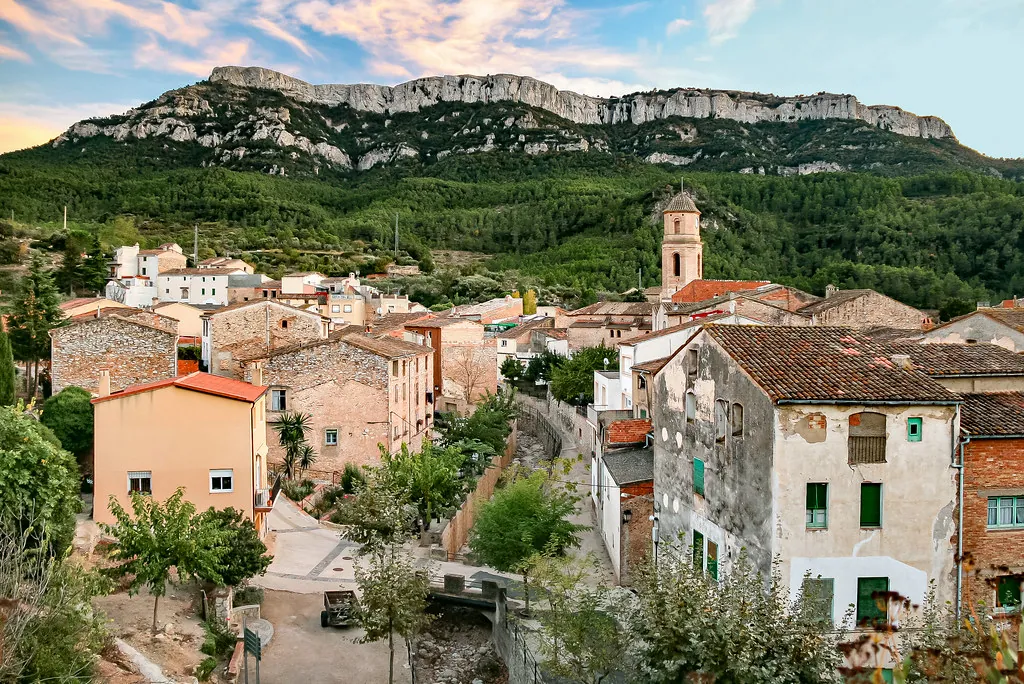
Tourism in Pradell de la Teixeta begins with its setting. The village lies in the central part of the comarca of Priorat, in Catalonia, on the inland slope of the Prelitoral mountain range at just over 460 metres above sea level. Around it stretch terraced hillsides, patches of Mediterranean woodland and agricultural tracks that link scattered masías, traditional rural farmhouses, with their plots of land.
With around 182 inhabitants, Pradell remains on the scale of rural settlements that never expanded dramatically. For centuries its life has been tied to vineyards, olive trees and dry farming. The surrounding landscape is not accidental scenery but the result of continuous work, generation after generation shaping difficult slopes into cultivable terraces supported by dry-stone walls.
The name of the village refers to yew trees, teixos in Catalan, which according to local tradition were once more common in these hills. They are now rarely seen in the area, yet the place name preserves that botanical memory. As in much of Priorat, what can be seen today is the outcome of long agricultural transformation rather than untouched terrain.
The international reputation of Priorat wine tends to focus attention on better-known villages in the region. Pradell sits slightly outside that spotlight. For visitors, this means the agricultural structure that has defined the comarca for centuries remains clearly visible in everyday life.
Parish Church and Stone Streets
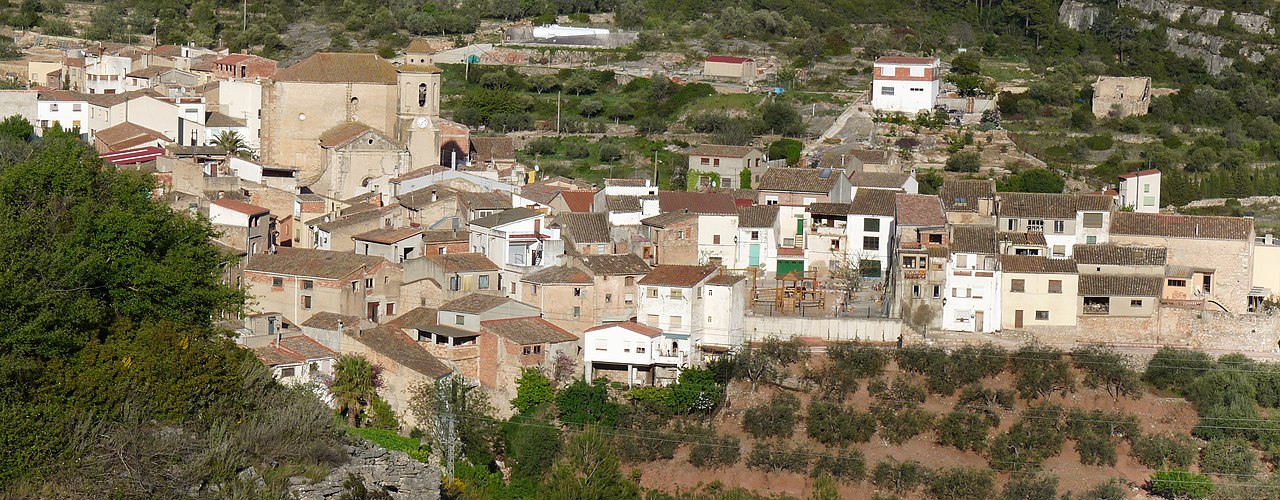
The parish church of Sant Andreu occupies one of the central points of the village. The current building dates from the 16th century and was later remodelled, probably during the 18th century, which was common for rural parishes in the area. Its architecture is sober, in keeping with a small community. Inside, devotional elements reflect the religious life that has marked the village over time.
The urban layout follows the natural slope. Narrow streets rise and fall with the terrain, creating short ascents and small changes in level. Many houses retain masonry walls and doorways framed with stone voussoirs, typical construction solutions in historic Priorat. Subtle alterations are visible on façades: a window inserted at a later date, an added storey, or a former animal enclosure converted into living space. These details hint at gradual adaptation across generations rather than planned expansion.
Beyond the houses, the most distinctive features of Priorat’s agricultural landscape become clear. Vine terraces climb the hillsides, held in place by dry-stone margins built without mortar. This technique, passed down over centuries, made it possible to cultivate steep ground and remains one of the defining characteristics of the territory.
Among the vineyards stand olive trees and almond trees. The appearance of the landscape shifts with the seasons. In winter, almond blossom arrives early and lightens the slopes. In summer, the vine dominates the view.
Paths Across the Priorat Landscape
Agricultural tracks lead out from Pradell towards other parts of the comarca, including Bellmunt del Priorat and the area of the Cartuja de Escaladei, a historic Carthusian monastery that played an important role in the region’s past. Some of these routes follow older paths used for decades to travel between villages or to reach cultivated plots.
These are straightforward routes along tracks and footpaths without major technical difficulty. Along the way it is common to come across old springs, small rural constructions and natural viewpoints that help make sense of Priorat’s geography. The comarca is characterised by narrow valleys and intensively worked slopes, with villages that adapt closely to the contours of the land.
The presence of the vine is constant. Many holdings today are organised around cooperatives or small family-run wineries, reflecting a strong wine-making tradition across the comarca. Although Pradell does not occupy the same international profile as some neighbouring villages, viticulture remains a visible and active part of daily life.
Walking these paths offers a way to read the landscape. Dry-stone margins, modest farm buildings and cultivated terraces show how agriculture has structured both the economy and the physical environment. The terrain itself explains why terraces were necessary and why settlements are compact, shaped by the relief rather than imposed upon it.
Local Traditions and the Village Calendar
As in many small municipalities, the festive calendar marks the moments of greatest activity. The festa major, the main annual festival, usually takes place in summer. At that time, some of those with family ties to the village return for a few days. Popular events and religious celebrations linked to the parish are organised during these dates.
Sant Andreu, the patron saint of the village, is also commemorated towards the end of autumn. These celebrations are local in scale and closely connected to community life rather than large public spectacles.
For the rest of the year, the rhythm is calm. A walk through the streets, a look at the dry-stone margins on the nearby slopes or a stroll along one of the rural paths offers insight into how this corner of Priorat has shaped its landscape over time. The interest here lies in continuity rather than in major monuments.
Pradell de la Teixeta does not present itself through grand landmarks or headline attractions. Its appeal comes from understanding how geography, agriculture and community life have interacted over centuries in this part of Catalonia. The terraces, the church of Sant Andreu, the network of tracks leading towards Bellmunt del Priorat and the Cartuja de Escaladei all form part of a setting where daily activity and historical layers remain closely intertwined.
In a comarca often associated with the global success of its wines, Pradell offers a quieter perspective. It allows visitors to observe the agricultural framework that has long sustained Priorat, visible in the slopes above the village and in the structure of the settlement itself. Here, the landscape tells its story through stone, vine and the steady continuity of rural life.