Full Article
about Biosca
Small medieval town dominated by the ruins of its hilltop castle.
Hide article Read full article
Early in the morning, while there is still a trace of cool air, Biosca sounds like little more than wind moving across the fields. A car passes now and then on the road, and silence quickly returns. From the first houses you can see the plain of La Segarra stretching out in every direction, parcels of cereal crops shifting in colour with the seasons.
Tourism in Biosca begins without grand landmarks or busy streets. This is a small municipality, with around 185 inhabitants, and the landscape carries more weight than the village itself. The streets are short and paved in pale stone. Within minutes, they lead back out to open country. Here the constant reference point is the horizon: wheat and barley fields, the occasional dry-stone wall, agricultural tracks running straight towards another tiny settlement.
Santa Maria at the Heart of the Village
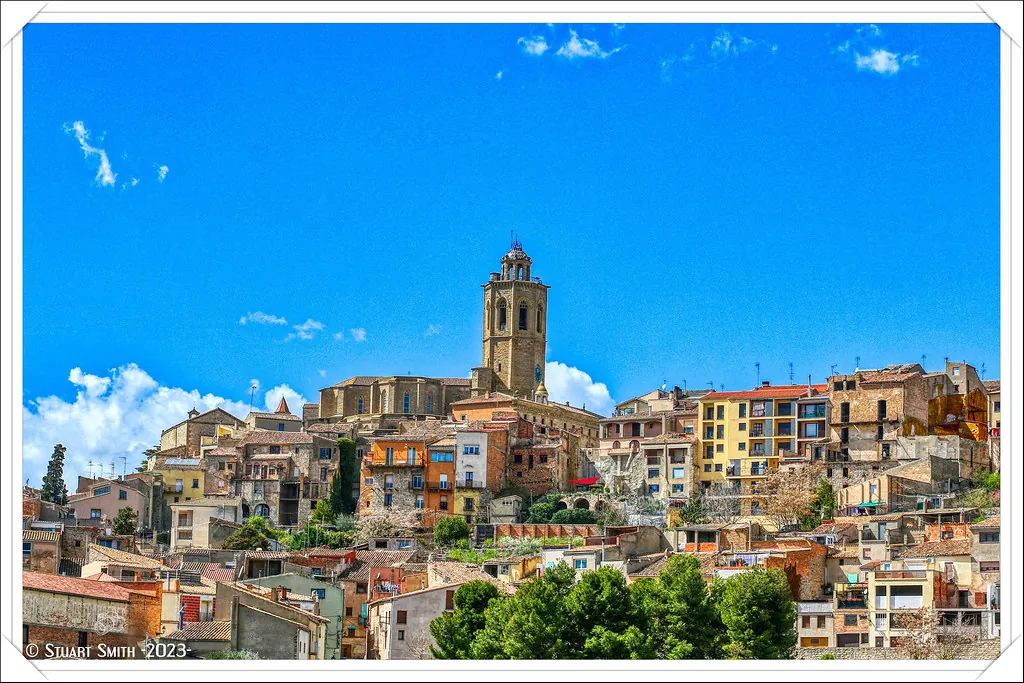
The clearest outline in Biosca is the church of Santa Maria, of Romanesque origin. Its grey stone walls take on different tones as the light changes. In the morning they seem cool and muted. Towards evening they shift to a warmer shade, almost orange.
The building is sober in style. There is nothing superfluous. A semicircular apse, compact volumes and a bell tower that can be seen from the surrounding fields define its shape. The tower becomes a reference point when returning on foot along the farm tracks, guiding the way back to the cluster of houses.
Homes gather around the church. Low doorways, small windows and walls that combine old stone with more recent repairs give the centre a lived-in feel. The whole village can be explored at an unhurried pace in about half an hour. It rewards slowing down and noticing details: a worn wooden door, footsteps echoing along a narrow street, the smell of firewood in winter.
Across the Cereal Plains
Beyond the houses, space opens up in every direction. In this part of Catalonia, La Segarra reveals itself as wide plains, limited shade and direct, unfiltered light. In spring the fields turn green and the wind moves through young ears of grain like water. In summer the landscape becomes golden and the heat intensifies from midday onwards.
A network of rural paths links farms and neighbouring villages. Some are dirt tracks, others narrow strips of asphalt, with very little traffic. Walking or cycling here is straightforward because the terrain rolls gently rather than rising steeply. In the hotter months it makes sense to set out early. By mid-afternoon the sun falls directly overhead and there are very few trees for shelter.
On clear days birds of prey can be seen gliding above the fields. Occasionally small steppe birds rise suddenly from the ground when someone approaches too closely. These brief movements are often the only sign of life in an otherwise still panorama.
The sense of scale is constant. Fields extend far beyond the last house, and the sky feels large and unobstructed. Changes across the year are read in colour and texture: the first shoots, the full height of the cereal, the cut stubble after harvest.
Food Rooted in the Land
Cooking in this area revolves around what the land and nearby livestock provide. Cured embutidos, dried pulses, olive oil and honey appear frequently on tables across the comarca, the wider district to which Biosca belongs. Flavours are direct and uncomplicated, shaped by local produce rather than elaborate preparation.
In a village of this size there is little in the way of hospitality businesses. Many people who pass through Biosca choose to eat in nearby towns, then return for a walk along the tracks or to sit for a while in the square as evening falls. The rhythm is unhurried. Conversation carries easily in the open air, especially once the heat of the day subsides.
Summer Festivities and the Agricultural Year
Like many small Catalan villages, Biosca usually celebrates its festa major in summer, generally around August. For a few days the pace shifts. Relatives arrive, activities take place in the square and nights last longer than usual. The same streets that feel almost empty at dawn fill with voices and movement.
For the rest of the year, Biosca returns to its calm routine. Life follows the agricultural calendar: sowing, the growth of cereal crops, the harvest. These changes are more visible in the fields than in the streets. A visitor may notice the difference not in events or schedules, but in the colour of the land and the activity on the surrounding plots.
The link between village and landscape remains close. Work in the fields shapes the year, even if much of it happens beyond the immediate view of the centre.
When to Visit
Spring and early autumn are often the most pleasant times to walk in the surrounding countryside. Temperatures are mild, and the light in La Segarra has a clarity that emphasises the gentle contours of the terrain.
Summer visits are possible, though early starts are advisable. After mid-morning the heat becomes intense and shade is scarce. In winter the cold is noticeable, especially when wind blows in from inland areas. Clear days, however, bring very open skies.
After several days of rain, some dirt tracks can become muddy. It is better to wait until they have dried out a little before setting off. The landscape is easier to enjoy when each step does not require careful attention to the ground.
Biosca does not present a long list of attractions or packed itineraries. Its appeal lies in proportion and quiet: a Romanesque church at the centre, a handful of streets, and an expanse of cereal fields stretching towards the horizon. The experience is shaped less by scheduled sights than by light, weather and the steady presence of the plain of La Segarra.