Full Article
about Estaràs
Small rural municipality with castles and fortified houses in its outlying hamlets
Hide article Read full article
The morning sun catches the pale stone of the church of Sant Pere in Estaràs. At that hour the village is still half asleep. A shutter lifts somewhere, a garage door opens, and in the distance a tractor heads out towards the fields. The thick church walls, pierced by narrow windows, have a sober, practical air. Here, stone has always been more about function than decoration.
In the square, faint marks on the paving reveal years of traffic: carts, animals, farm machinery. Today life moves at a slower pace. With just over a hundred residents, Estaràs remains closely tied to agricultural work and to a calendar that still depends on sky and soil.
A Small Village in a Sea of Cereal
Estaràs sits in the gently rolling landscape of La Segarra, a comarca in inland Catalonia. The scenery shifts clearly with the seasons. In spring, fields turn green and the wind ripples through the cereal as if it were water. By summer, everything leans towards gold. Dust rises from dirt tracks when a car passes.
The village centre is compact. Stone houses line short, slightly irregular streets. Some façades have wrought-iron balconies. Wide doorways, once used for animals or farm tools, hint at a more agricultural past. You can walk the whole place in five minutes, yet small details keep catching the eye: a rebuilt dry-stone wall, a bench in the shade, a flowerpot hung beside an old wooden door.
Silence is part of the atmosphere, though not complete. Larks break it in bursts of song. At times, the dry hum of machinery carries across from nearby fields.
Estaràs does not present itself with grand monuments or busy avenues. Its appeal lies in its scale and in the way daily life remains visible. Fields begin almost at the edge of the last houses. The boundary between village and countryside feels thin.
Walking Out into the Open
Several streets lead away from the church and end in rural tracks. There is no extensive network of signposted trails, yet numerous agricultural paths make it easy to leave the village within minutes.
Walking here is straightforward. The horizon opens up. Fields stretch wide. Few visual obstacles interrupt the view. On clear days, other villages in the comarca appear in the distance, small clusters of rooftops on low rises.
Spring brings colour to the margins of the tracks. Poppies and other wildflowers line the edges. Later in summer, the ground hardens and crunches underfoot. Long stretches offer little shade, so water and protection from the sun are advisable.
Open farmland also attracts birdlife. Kestrels can often be seen hovering mid-air, scanning the ground below. Partridges dart between embankments. Stone-curlews blend into the earth tones so well that spotting them requires patience. The landscape may appear simple at first glance, yet time and attention reveal movement and life.
There are no dramatic peaks or dense forests here. The interest comes from space, light and the steady rhythm of cultivated land.
Everyday Life in La Segarra
La Segarra remains a comarca where agriculture sets the pace. Wheat and barley dominate the fields, with almond trees in some plots. This modest economy shapes what appears on the table.
Meals tend to be hearty. Stews, dried pulses and meats roasted slowly are common. The cooking changes with the seasons. In autumn, local mushrooms often appear when the year has been wet enough. Winter brings denser dishes, eaten slowly, often during family gatherings or local celebrations.
Food here reflects availability rather than fashion. The link between land and kitchen feels direct. What grows in the surrounding fields influences what is served at home.
Daily life follows a rhythm that does not hurry. Work in the fields, maintenance of houses, and small social encounters in the square structure the week. For visitors, this pace can feel markedly different from that of larger towns or cities.
Nearby Towns and Short Drives
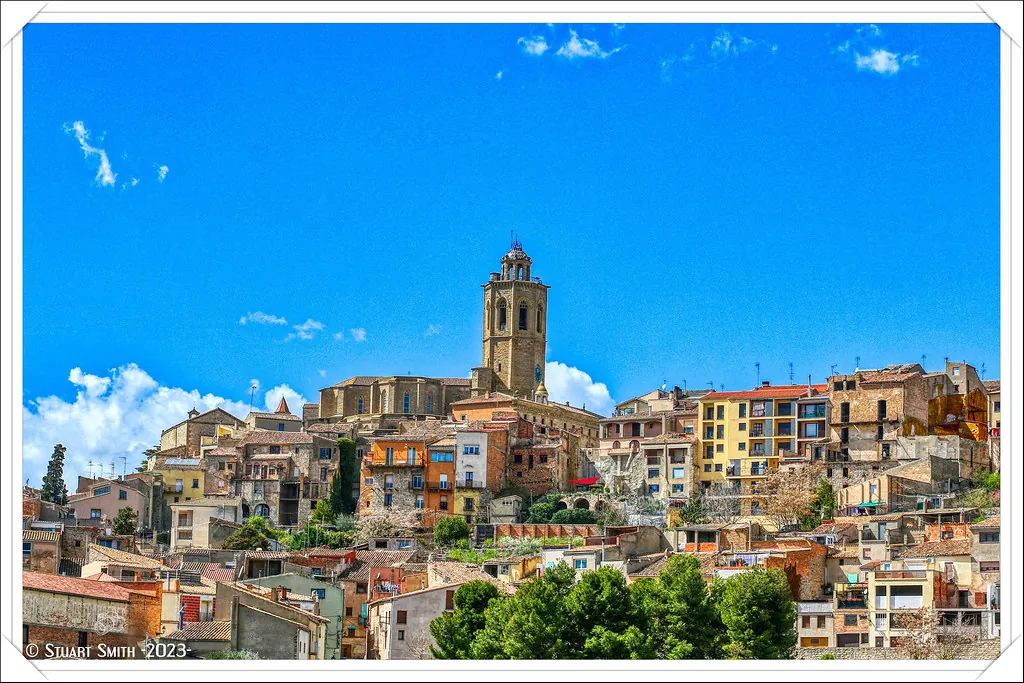
Estaràs lies close to other settlements in La Segarra that help complete the picture of the comarca. Torà, for example, has more movement and a historic centre with a medieval layout. Its streets and buildings provide a contrast to the smaller scale of Estaràs.
Cervera, somewhat larger, gathers historic buildings and services that small villages do not have. It functions as a local hub in a way that Estaràs does not attempt to.
Travelling between these places is straightforward by car. Secondary roads cut through open fields. On days with little traffic, the drive itself becomes part of the experience. The same wide horizons and changing colours accompany the journey from one village to another.
These short routes underline how dispersed the settlements of La Segarra are. Each sits on its slight elevation or beside its fields, connected by roads that cross cultivated land.
When to Go
Spring is often the most rewarding time to visit. Temperatures are mild, cereal fields are green, and the days grow longer. The countryside feels active without being harsh.
Summer brings a very clear light. At midday the heat can be intense, and the streets become almost empty. Activity shifts towards early and late hours, when temperatures are more bearable.
In August, the fiesta mayor usually takes place. During those days, the square becomes livelier than usual. For a short period, the village recovers a bustle that barely appears during the rest of the year.
Outside these moments, Estaràs is much as it seems on arrival: a small village in La Segarra, surrounded by open fields, moving at an unhurried pace. The main attraction is simple. A walk along a rural track, the sound of wind passing through cereal, and the play of light across stone are often enough.
Estaràs does not rely on spectacle. Its character comes from continuity. Agriculture continues to shape the landscape. Houses remain closely tied to their past uses. The church of Sant Pere still anchors the village centre each morning as the sun rises over the fields.
For those curious about inland Catalonia beyond its cities and coastline, Estaràs offers a clear, unembellished glimpse of La Segarra. Here, the horizon feels close and wide at the same time, and time follows the seasons rather than the clock.