Full Article
about Ivorra
Known for the Santuario del Santo Dubte and the eucharistic miracle; quiet village
Hide article Read full article
First light over a quiet village
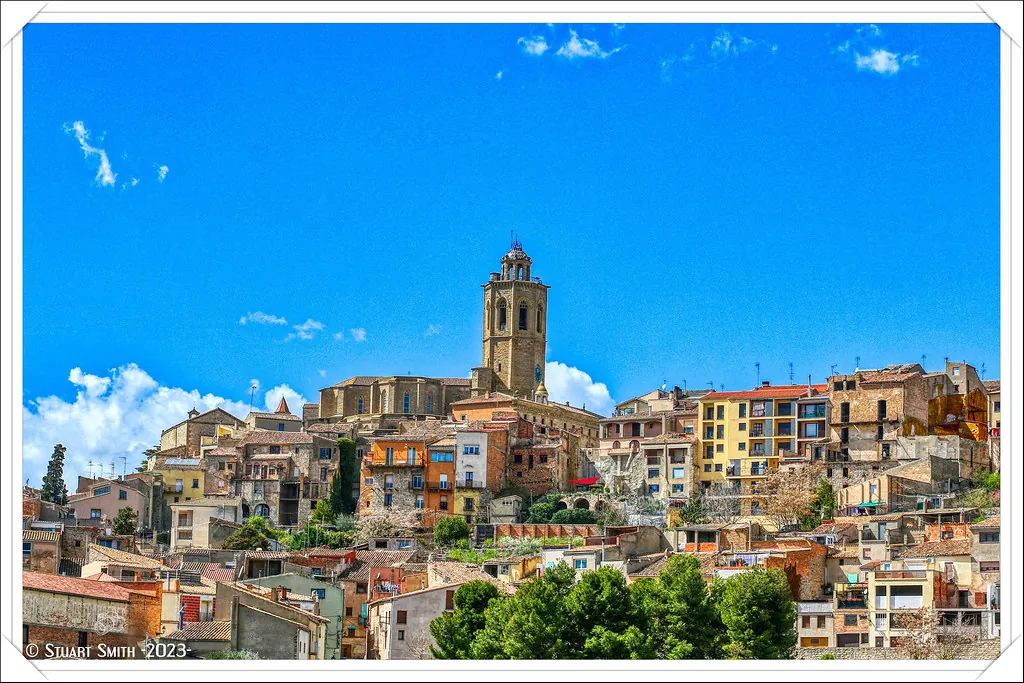
Early in the morning, as the sun begins to rise above the low hills of La Segarra, the pale stone of Ivorra reflects a soft, almost dusty light. There is no steady traffic, no background hum. Just the occasional distant engine out in the fields and the metallic rattle of a shutter being lifted.
In the main square, a stone fountain and a handful of benches face simple façades. The shadows stretch across them for a while, then fade by mid-morning. It is a small place, with barely a hundred residents, and everything here feels scaled to that size.
For those looking into tourism in Ivorra, what they find is a compact village in inland Catalonia, sitting just over five hundred metres above sea level. It is surrounded by cereal fields that ripple in the wind for much of the year. The layout is tight: short streets, stone houses, tiled roofs. Many buildings still show traces of repairs or layers of whitewash that have shifted in tone over time.
Sant Dubte and a story the village still tells
At the centre stands the parish church, dedicated to Sant Dubte. Parts of the building date back to the Romanesque period, probably the 12th century, and it follows the restrained style typical of rural churches in this part of Catalonia.
The entrance is plain, with arches that carry little decoration. Inside, the same simplicity continues: exposed stone, pale walls, and very few ornamental features.
The name of the saint is tied to a long-standing local tradition linked to an old Eucharistic story. It is something residents still mention when speaking about the church. Visitors often only hear it if someone from the village takes the time to explain it slowly, passing on a piece of local identity that is not immediately visible.
At certain times of day, the bell still rings out across the area. The sound carries easily over the open valley that surrounds the village, marking the rhythm of daily life.
Short streets and traces of rural work
Ivorra can be walked in a short time. Some streets open into small courtyards, others end in wide doorways that were once used to store carts or shelter animals. Several houses still have heavy wooden doors with dark iron fittings, worn down by decades of use.
On the edges of the village, the agricultural past becomes more visible. There are pens, sheds and dry-stone walls, some partly overtaken by grass or brambles. Even so, they still show how work was organised here.
La Segarra has long been a cereal-growing region, and that logic continues to shape the surroundings. There are threshing floors, simple storage spaces, and open land that begins almost as soon as the last house is left behind. The transition from village to farmland is immediate.
The changing landscape of La Segarra
The scenery around Ivorra shifts noticeably with the seasons. In spring, green covers the hills and wildflowers appear along the edges of paths. By summer, the tones turn dry and golden. When the wind picks up, the cereal fields move in broad waves that stretch across the horizon.
Among the crops, there are olive trees, some almond trees, and small patches of holm oak. Walking along the agricultural tracks, many of them made of compacted earth, it is common to come across old field huts built from local stone. These were once used by farmers during long working days.
Silence is one of the defining features here. It is only broken occasionally by a tractor during the working season or by birds crossing the open sky.
Paths linking the villages of the comarca
Rural tracks lead out from Ivorra towards other nearby settlements in the comarca, a local administrative region. These are straightforward routes, without major climbs, crossing farmland and gentle rises.
On foot or by bicycle, they offer a clear sense of the scale of this territory. Villages are small and separated by several kilometres of cultivated land, each one appearing gradually in the distance.
Some of these paths connect to longer routes that pass through places such as Torralba or Guissona, where there is more activity and a wider range of services.
If walking in summer, it is best to avoid the middle of the day. Shade is scarce, and the heat in La Segarra can become intense from midday onwards.
A quiet pause in La Segarra
Ivorra is not a place of large urban routes or a concentration of monuments. It works better as a calm pause within a wider journey through La Segarra, a region where many villages share the same atmosphere of pale stone, open fields and long stretches of quiet.
A few kilometres away, Cervera offers a much larger historic centre. There are cobbled streets, the old university, and several civil buildings that reflect the city’s importance over past centuries. From there, it is possible to continue exploring castles, towers and other scattered settlements across the comarca.
Back in Ivorra, everything returns to a smaller scale: a modest square, an old church, and fields of cereal extending in every direction. Sitting for a while on a bench is often enough. The wind moves through the crops, the light shifts across the stone, and the pace of the place becomes clear without needing to go any further.