Full Article
about Les Oluges
Municipality made up of two castle villages; medieval atmosphere
Hide article Read full article
A small village shaped by the land
At eleven in the morning, light slips low through the window of a masía and catches the rough stone wall, still marked by old traces of limewash. Outside there is barely a sound, perhaps a blackbird and the distant hum of a tractor. That quiet rhythm defines tourism in Les Oluges, a small municipality in La Segarra where the day still follows the pace of the fields.
The village gathers around a handful of calm streets. Life here does not revolve around shop windows or packed terraces, but around the farmland that surrounds the centre. The landscape is open, with cereal crops stretching in every direction and stone houses that have faced the same horizon for decades.
Les Oluges does not exist for tourism. What it offers is simpler: a small rural community, wide skies and the sense that time moves more slowly here than in other parts of Catalonia.
Around Sant Bartomeu
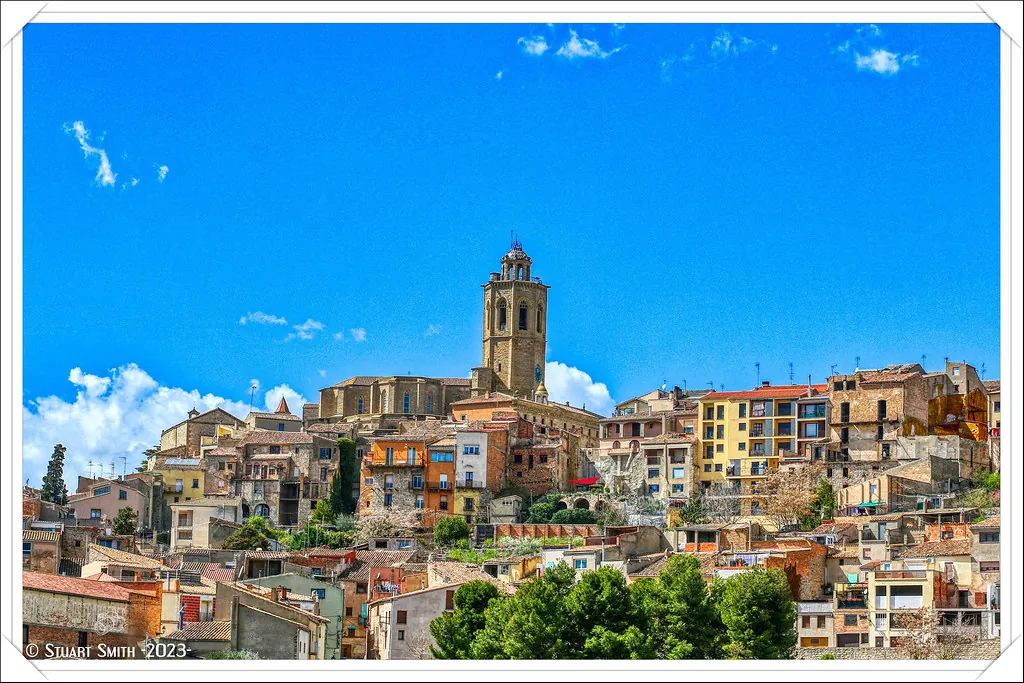
A short walk through the centre leads to the church of Sant Bartomeu. The building is sober in style, with thick walls and muted tones. It stands quietly in the middle of the village. Some sections retain Romanesque features, although the structure as a whole has changed over time.
The houses nearby follow a similar logic. Wide doorways once used to store machinery or old carts open onto the street. Iron balconies have darkened with age. In some patios, washing still hangs out to dry. Beneath certain homes there are cellars dug into the earth. In summer they keep a coolness that can be felt even from the threshold.
By mid-afternoon, light enters the short streets from the side and throws sharp shadows across the façades. The effect is simple but striking, especially when the village is almost silent.
Tracks through cereal country
Beyond the last houses, agricultural tracks begin. These are broad dirt roads of pale earth that cut across fields of wheat and barley. In spring, small wildflowers appear along the margins and occasional almond trees break the flat line of the horizon.
La Segarra is known for its open landscape. When the wind moves through the cereal, it produces a constant dry rustle, like paper brushing against itself. Autumn changes the palette to denser ochres and yellows.
It is best to explore this area unhurriedly and to avoid the central hours of summer. The sun can be intense and there is very little shade outside the village itself. Conditions are gentler in spring, when the light is softer and the fields still hold some green.
The terrain suits cycling. Slopes are generally gentle, which makes for steady progress along the tracks. After rain, however, mud can make the dirt roads far more difficult to navigate.
Masías and unmarked paths
A few minutes from the centre, scattered masías come into view. Some are still inhabited. Others stand with closed gates and walls that have lost part of their render. Despite their different states of repair, they share the same construction logic: thick stone walls, small windows and agricultural outbuildings attached to the main structure.
Many of the tracks are not signposted. Some lead to private properties or to fields that are actively being worked. An up-to-date map or GPS is useful to avoid straying where access is not appropriate. The area remains primarily agricultural, and that shapes how it should be approached.
In winter, silence deepens further. Late afternoon can feel almost completely still, especially when fog settles over the fields. The outlines of the landscape soften and the village seems to withdraw into itself.
Festivities and everyday life
The main festival is usually held around Sant Bartomeu at the end of August. During those days, the square becomes livelier. Religious events take place alongside gatherings between neighbours and simple activities organised by the people of the village. It is a moment when the quiet routines shift slightly and familiar streets fill with conversation.
For the rest of the year, life remains calm. Les Oluges is not a place of constant activity, and that is part of its character. Even at Christmas, celebrations retain a local scale. One of the traditions that still appears is the Tió, a well-known Catalan custom in which children take part in a festive ritual centred on a wooden log. In Les Oluges it is organised mainly for the families who live here all year round.
The overall impression is of continuity rather than spectacle. Daily life carries on with few interruptions, marked more by agricultural seasons than by visitor numbers.
The wider landscape of La Segarra
Les Oluges lies close to other historic settlements in La Segarra. Within a few kilometres, the same pattern repeats itself: gentle hills, cereal fields and compact villages that appear suddenly in the middle of the plain.
In autumn, some nearby areas with slightly more tree cover attract those who head out to look for mushrooms. There are no marked routes for this. Caution is advisable, along with respect for agricultural land and private property.
The journey from Lleida typically heads towards Cervera before continuing along regional roads. The drive crosses much of La Segarra, with long straight stretches between fields. The approach itself gives a clear sense of the region’s scale and openness.
If silence is the goal, early morning tends to work best. In August, heat bears down and the landscape becomes very dry. Spring offers a different atmosphere, with softer light and fields that have not yet turned fully golden.
Les Oluges does not compete with larger destinations in Catalonia. There are no grand monuments or busy promenades. Instead, there is Sant Bartomeu at the centre, dirt tracks leading through wheat and barley, and masías scattered across a wide plain. Sometimes it is enough to sit for a while in the square and listen as the afternoon passes.