Full Article
about Montornès de Segarra
Quiet village with a modernist church and cemetery in Mas de Bondia.
Hide article Read full article
Early in the morning, when there is still a trace of cool air even in summer, Montornès de Segarra sounds like open countryside. A car passes along the local road, a dog barks behind a metal gate and, all around, cereal fields stretch as far as the eye can see. The village appears almost suddenly: a cluster of stone houses gathered around the church, with barely any transition between asphalt and farmland.
Montornès de Segarra lies in the comarca, or county, of La Segarra, about twenty kilometres from Cervera and somewhat further from Lleida. Here, the landscape sets the tone. It feels less like arriving in a town and more like crossing a brief interruption in the middle of an agricultural plain that continues to function much as it always has.
Around the Church of Santa Maria
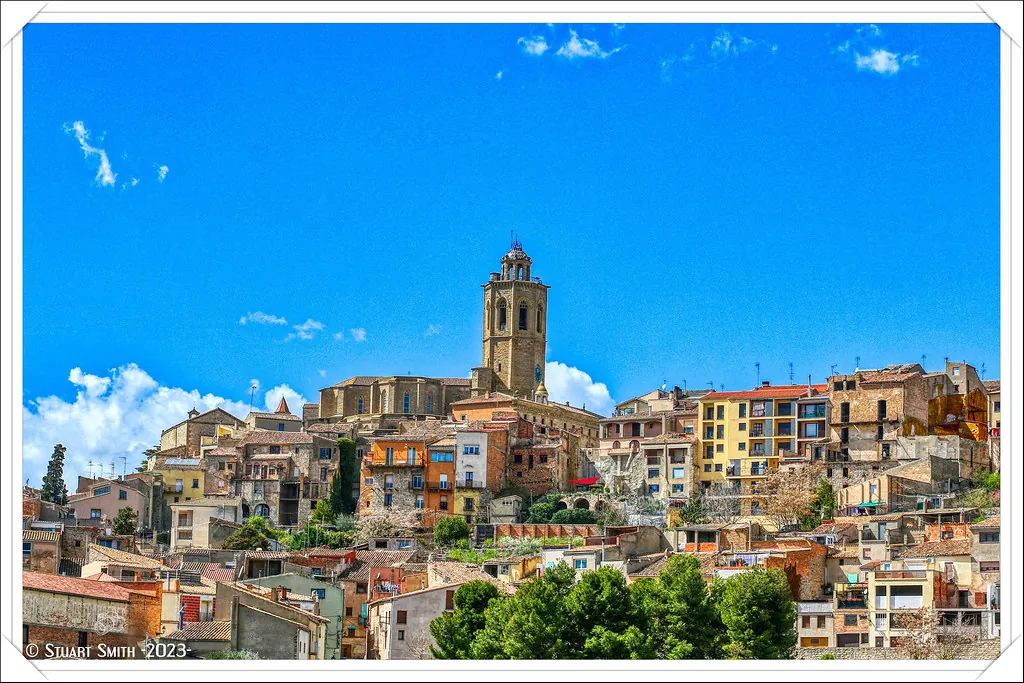
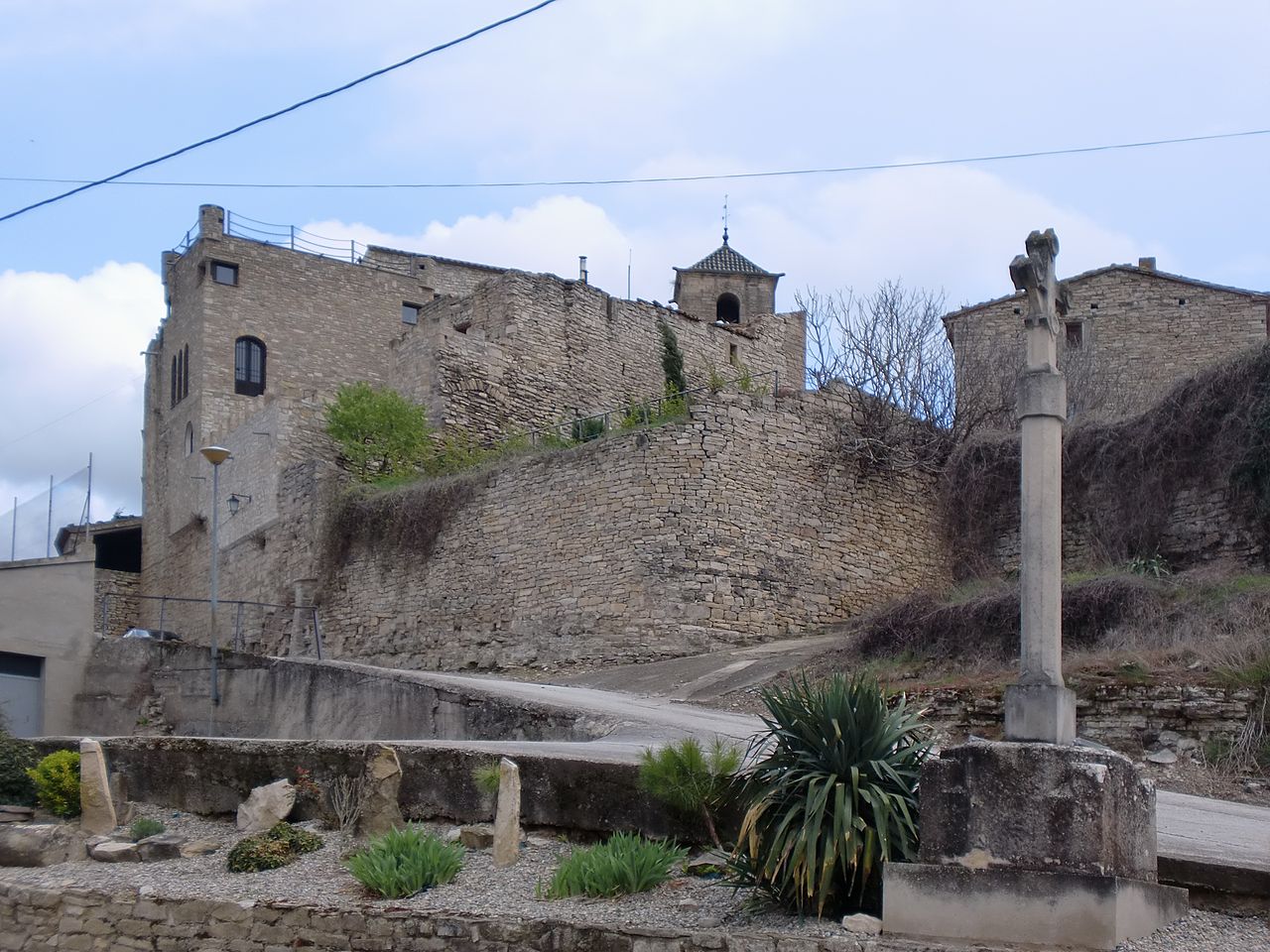
The parish church of Santa Maria marks the centre of the village. It is a sober stone building, with a brick bell tower rising above the low rooftops. When the sun falls from the side, the wall takes on an ochre tone that contrasts with La Segarra’s wide, open sky.
A handful of short streets cluster around it. Some are barely a stretch between one corner and the next. There are broad doorways belonging to old houses, a few framed with worn stone voussoirs, and dry stone walls that still divide small yards or vegetable plots.
In truth, Montornès de Segarra can be walked without noticing how quickly it passes. In less than an hour, most of it is behind you. It is worth slowing down. Details reveal themselves only when you stop: an old wooden door, a neat pile of firewood stacked against a wall, the sound of wind slipping past television aerials on the rooftops.
There is no sense of spectacle here. The appeal lies in the ordinary rhythm of a small rural settlement, shaped by farming and by the seasons.
A Landscape of Cereal and Sky
The surroundings of Montornès de Segarra are overwhelmingly agricultural. Gentle hills roll outwards, divided into long, straight plots. In the distance, a patch of pine trees breaks the line of the fields. In summer, the cereal ripens and the landscape turns golden. When the wind blows, the heads of grain move in unison, like the surface of slow water.
From slightly elevated points within the municipal area, the horizon opens up widely. On clear days, shallow valleys can be seen descending towards the Llobregós area, with scattered pine woods punctuating the fields.
The light at the end of the day is often the most striking. The sun drops low, stretching the shadows of small agricultural sheds and tracing the relief of the terrain. Dawn also brings calm, though in winter the cold here is noticeable and lingers.
This is not dramatic scenery in the conventional sense. It is expansive, understated and closely tied to cultivation. The fields are working land, and the changing colours through late spring and early summer reflect the cycle of growth.
Rural Tracks and Open Space
Dirt tracks lead out from the village, crossing the fields and connecting to scattered masías, traditional Catalan farmhouses. Some are still inhabited. Others remain only as walls with a roof partly collapsed.
These routes are simple and unmarked, intended more for agricultural work than for leisure walking. Even so, they offer something very clear: space. There is no steady traffic, no background hum. Only the sound of field birds and, from time to time, a tractor in the distance.
For those setting out on foot or by bicycle, it is wise to carry water and sun protection. In summer, shade is scarce. Distances can be deceptive, as everything appears closer than it is until you start walking.
The sense of openness defines the experience. The fields extend in every direction, and the sky feels proportionally large. It is easy to understand how the rhythms of planting and harvest shape daily life here.
Everyday Life and the Wider Area
Montornès de Segarra is small, and daily life often revolves around nearby towns. For shopping or for sitting down to eat with more choice, many residents head to Cervera or Guissona, both relatively close by car.
In these towns it is easier to find products from the comarca: cured meats, goat’s cheese and bread made with flour from cereal grown in La Segarra itself. The connection between the fields around Montornès and what appears on the table is direct and visible.
Public transport in this part of La Segarra is limited, so having a car makes getting around far simpler. The usual approach is by road from Cervera, along local routes that cross fields and small pine woods.
Festivities and the Local Rhythm
The main village festival, known in Catalonia as the festa major, is usually held in summer, generally between July and August, although the exact dates can change from year to year. Activity centres on the church and the small square nearby. Celebrations are simple and closely linked to the residents of the village and to those who return during those days.
At other times of the year, gatherings related to agricultural work take place, including activities connected to the harvest or farming meetings. These events tend to be local in character, shaped by the needs and interests of the surrounding countryside.
The calendar here still follows the fields. Sowing, growth and reaping remain reference points.
When to Pass Through
To see the landscape at its most characteristic, late spring and early summer are a good time. The cereal stands tall, and the colour of the fields shifts from week to week. By August, the heat at midday can be intense, so setting out early or waiting until later in the afternoon is often more comfortable.
Montornès de Segarra does not offer grand monuments or a long list of sights. What it provides is something quieter: silence, long horizons and the sense of being in a place where the pace is still marked by the harvest. Even a brief stop on the road is enough to grasp that rhythm.