Full Article
about Sanaüja
Historic town with castle and medieval bridge over the Llobregós
Hide article Read full article
A Hilltop Village in La Segarra
Some places appear on tourist maps with arrows, icons and numbered routes. Others, such as Sanaüja in the comarca of La Segarra, do not. You arrive by car, park without much thought, and the first thing you notice is the quiet. It is not a solemn hush, more the everyday silence of a village where people get on with their own routines and time seems to move at a different pace.
Sanaüja has around four hundred inhabitants and stands on a small hill overlooking the valley of the river Sió. The surrounding landscape sets the tone. Cereal fields stretch out in every direction, changing colour as the year turns. In spring the countryside leans towards green. By summer it becomes a broad sweep of gold, as if the land had been repainted in a single shade.
There are no grand monuments or staged viewpoints designed for photographs. What matters here is understanding how the village fits into this agricultural corner of La Segarra. Many settlements in the comarca grew around a church, a handful of streets and the paths that once linked them to neighbouring communities. Sanaüja follows that same pattern, shaped more by practical needs than by display.
Traces of Walls and a Romanesque Core
The old quarter of Sanaüja still preserves parts of its former defensive walls. Do not expect a complete circuit or anything monumental. Instead, there are scattered stretches and gateways that help you imagine what it must have felt like to enter the village centuries ago.
The streets are narrow and slightly irregular. In some, a car passes carefully; in others, it simply does not fit. Stone houses line the way, with old doorways and the occasional window that seems older than the paving beneath it.
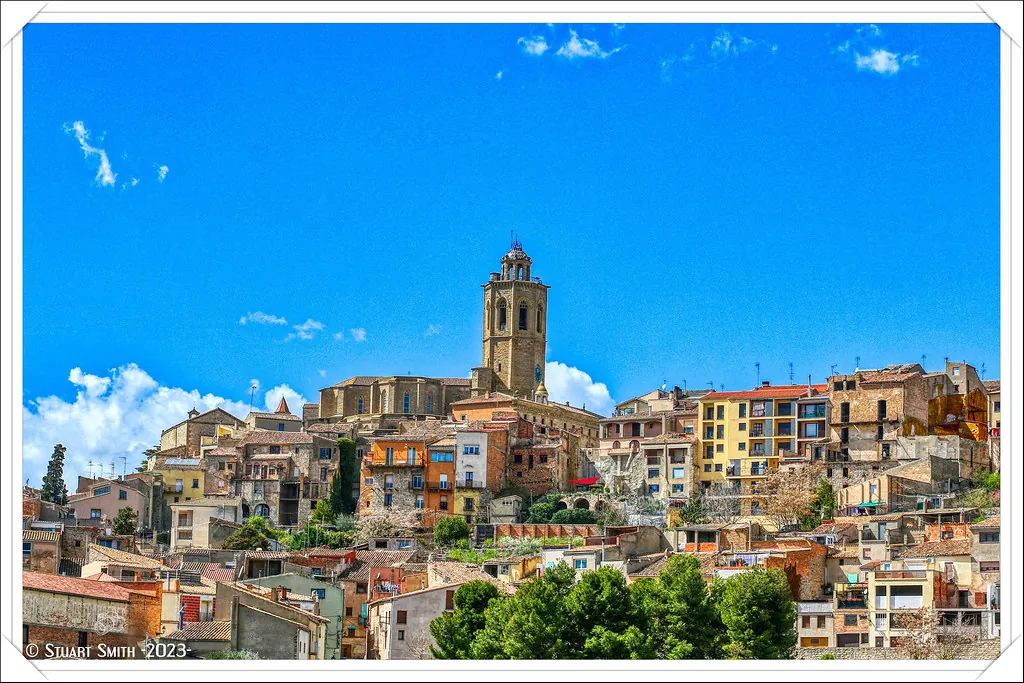
At the centre stands the church of Santa María. Its base is Romanesque, a medieval architectural style common across Catalonia, although later additions have altered the building over time. That layering is typical of villages in the area, where churches were adapted rather than rebuilt from scratch. The bell tower rises above the rooftops and acts as a point of reference when approaching from the road.
One of the traditional entrances to the village is the Portal del Raval. It does not overwhelm with scale, yet it clearly marks the sensation of crossing into a defined space. In the past, controlling access was practical rather than decorative. Gates and walls served a purpose, and even the fragments that remain today make that easier to grasp.
Climb towards the upper part of the village and the views open out over the Sió valley. On clear days there is a wide sweep of farmland in sight, and in the distance the first ridges that signal the Pre-Pyrenees. The scene shifts noticeably with the seasons, depending on the state of the crops and the light.
Rural Tracks and Open Horizons
Beyond the last houses, Sanaüja is surrounded by agricultural tracks. These routes have been used for generations to move machinery, travel between fields and reach scattered masías, the traditional Catalan farmhouses dotted across the countryside.
This is not a heavily waymarked walking area, so it is sensible to carry a map or GPS if you prefer to roam without a fixed plan. Even so, getting completely lost is unlikely. Most paths eventually lead to another village in La Segarra or reconnect with the main road.
The terrain is open and expansive. That brings one clear advantage, broad views across the fields, and one drawback, very little shade. In summer the sun can be intense. Walking or cycling is more comfortable in the morning or towards the end of the day.
With a bit of luck, birds of prey can be seen circling above the crops. Flocks of sheep sometimes move slowly from plot to plot. This is the everyday landscape of the comarca, shaped by agriculture rather than tourism.
Food Rooted in the Land
The cooking in this part of inland Catalonia reflects what the land provides. Cereal crops, pulses, meat and cured sausages form the backbone of many dishes. The recipes tend to be substantial and slow-cooked.
In many homes, traditional preparations are still part of the calendar. Escudella, a hearty winter stew typical of Catalonia, appears during the colder months. Meat stews simmer gently for hours. Dishes linked to the matanza del cerdo, the traditional pig slaughter that supplied families with preserved meats for the year, remain present in some villages as a family custom.
This is not a cuisine designed to surprise with unusual combinations. The focus is on familiar flavours, good bread and plates that leave you ready for a long pause afterwards. It reflects the rhythms of rural life, where meals have long been tied to the agricultural cycle.
A Quiet Base for Exploring La Segarra
Sanaüja works well as a calm base from which to explore the wider comarca of La Segarra. A short distance away lies Cervera, a larger town with a historic centre that rewards an unhurried walk.
In the surrounding area there are other small villages with Romanesque churches, castle remains or isolated chapels standing among fields. Individually, these sights may not feel spectacular. Together, they help explain how this inland part of Catalonia took shape over centuries, through farming communities connected by tracks and shared traditions.
Sanaüja is the kind of place you do not reach by accident. It requires a deliberate detour into the countryside. That may be precisely why time spent here, wandering its streets or looking out over the Sió valley from higher ground, carries a certain clarity. The appeal lies less in ticking off landmarks and more in adjusting your pace. In a village of around four hundred people, set among cereal fields that change with the seasons, slowing down is not an activity. It is simply how things are done.