Full Article
about Sant Guim de Freixenet
Town that grew up around the railway station; Modernist winery (Sindicato)
Hide article Read full article
A landscape shaped by cereal fields
Any look at Sant Guim de Freixenet begins with the wider setting of the Segarra. This is an agricultural plateau, open and dry for much of the year, where long horizons stretch across fields of cereal. Villages sit at a distance from one another, separated by farmland and small patches of woodland. At around 700 metres above sea level, Sant Guim de Freixenet gathers just over a thousand residents spread across several small settlements.
The shape of the municipality reflects this rural past. It is not a compact village with a single centre. Instead, it grew along country roads, near railway points and around former agricultural holdings. The connection with the land is not something preserved for visitors. It remains part of everyday life, visible in how the territory is organised and used.
Buildings that reflect rural life
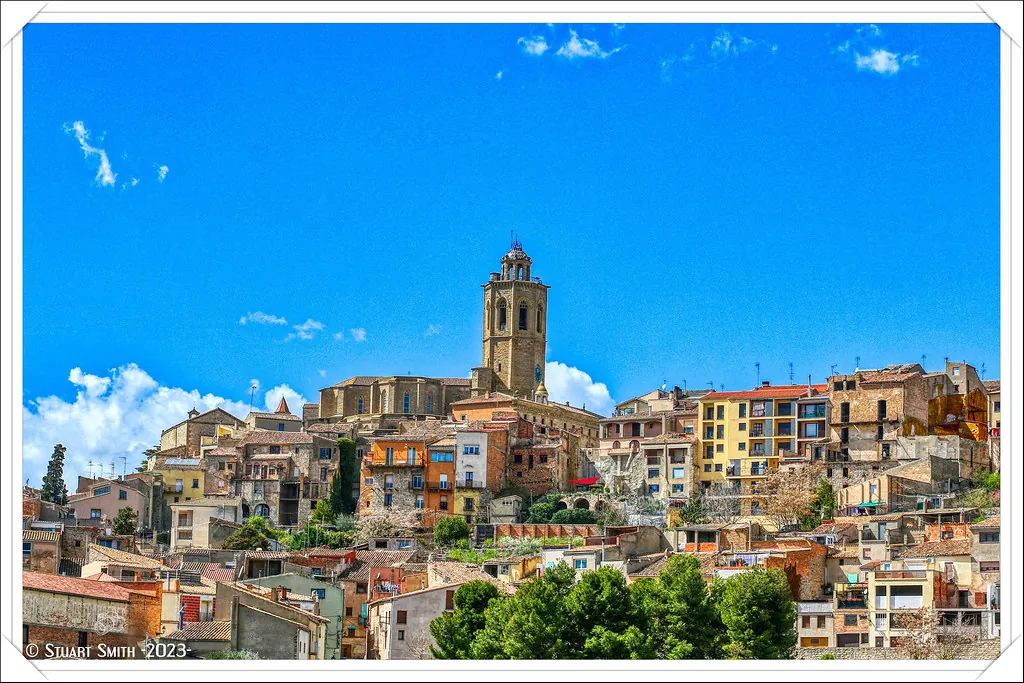
The parish church dedicated to Sant Guim has medieval origins, although what stands today includes later alterations. Its exterior is plain, built in stone, with a bell tower set at one corner of the structure. From the area around the church, the defining features of the Segarra landscape become clear: open fields, wide views and very little in the way of dramatic relief.
In the older parts of the settlement, streets retain stone houses with arched doorways made from voussoirs and interior courtyards. These were homes designed with agricultural work in mind. Many once incorporated storage spaces, animal pens or areas for tools. There is no enclosed historic quarter as such, but these buildings are easy to recognise when walking slowly through the centre.
Beyond the main nuclei, several old masías, traditional rural farmhouses, are scattered across the surrounding land. Some show defensive features such as thick walls, minimal openings and raised entrances. This kind of architecture was common in rural areas that faced periods of conflict or banditry during the early modern period. They add another layer to understanding how people adapted to both the environment and the uncertainties of the time.
Traces of a wider history
Sant Guim de Freixenet is also linked to the so-called itinerary of the Western Schism, a major religious conflict in the 14th century when rival popes divided loyalties across Europe. In the Segarra, different positions were taken during that period. Within the municipality, it is common to find information panels explaining the episode and its impact on the region.
There is no large monumental complex associated with this history. Instead, these references help place the area within a broader narrative. They offer context, showing that even a rural territory like this was not isolated from the tensions and decisions shaping medieval Europe.
Walking the agricultural landscape
The surroundings lend themselves to walking along agricultural paths. Many routes link plots of cereal crops where wheat, barley and oats are grown. The appearance of the land changes noticeably with the seasons. In spring, the fields bring more colour, while in summer the dominant tones return to ochre as the land dries out.
Dry stone walls mark the boundaries between fields and form part of the traditional landscape. They are a constant presence when moving through the area. Not all paths are signposted, so it helps to rely on a map or to follow the most obvious tracks connecting nearby settlements.
Small holm oak groves and areas of low scrub appear here and there. These spots provide some variation within the open terrain and make it possible to see common bird species associated with farmland. The overall impression remains one of space and simplicity, shaped by cultivation rather than dense vegetation.
Food and local traditions
The local cooking follows the logic of inland Catalan regions. Dishes are straightforward and built around the needs of long working days. Legumes, grilled meats and seasonal vegetables form the basis of the cuisine. During winter, black truffle has a presence in the Segarra and is increasingly tied to the rural economy of the area.
Local celebrations tend to centre on the main festival dedicated to San Simón. As in many small villages, these events combine religious elements with music and opportunities for neighbours to gather. Throughout the year, some local groups organise cultural activities linked to the history of the territory or to agricultural life.
Understanding Sant Guim de Freixenet
Sant Guim de Freixenet does not revolve around major monuments or singular attractions. Its interest lies in offering a clear view of how an inland cereal-growing region of Catalonia functions. The layout of the settlement, the masías in the surrounding countryside and the wide agricultural landscape all contribute to that understanding.
A slow walk through its streets and paths is enough to grasp the rhythm of the place. The fields, the buildings and the distances between them tell the story without needing much explanation.