Full Article
about Sant Ramon
Known as the “Escorial of la Segarra” for its vast baroque sanctuary
Hide article Read full article
A Small Village on the Segarra Plateau
Sant Ramon, in the comarca of La Segarra, is small even by the standards of this part of Lleida province. It has around 480 inhabitants and stands on an agricultural plateau more than 600 metres above sea level. Any visit to Sant Ramon begins with an understanding of this setting: an expanse of open land that defines much of inland Catalonia.
La Segarra is known for its broad cereal fields, straight tracks running between plots and settlements that grew in connection with farming and old inland routes linking different parts of Catalonia. The landscape around Sant Ramon reflects that history clearly. Agriculture, particularly cereal cultivation, still shapes the rhythm of daily life and the appearance of the land.
Large plots stretch out in every direction, broken only by occasional holm oaks or small clumps of woodland. The scenery is austere and very characteristic of the comarca. The changing seasons are most visible in the colour of the fields: bright green in spring, golden as summer arrives, then more muted tones after the harvest.
The Sanctuary and the Birth of the Settlement
The name Sant Ramon refers to San Ramón Nonato, a religious figure closely associated with this place. The sanctuary dedicated to the saint, built between the 17th and 18th centuries and later altered, explains the origin of the present-day village.
For centuries, this sanctuary was a pilgrimage site on the inland route between Lleida and Barcelona. Travellers moving across Catalonia would pass through this part of La Segarra, and the religious building gradually attracted houses, inns and agricultural outbuildings around it. The current urban nucleus grew from that process.
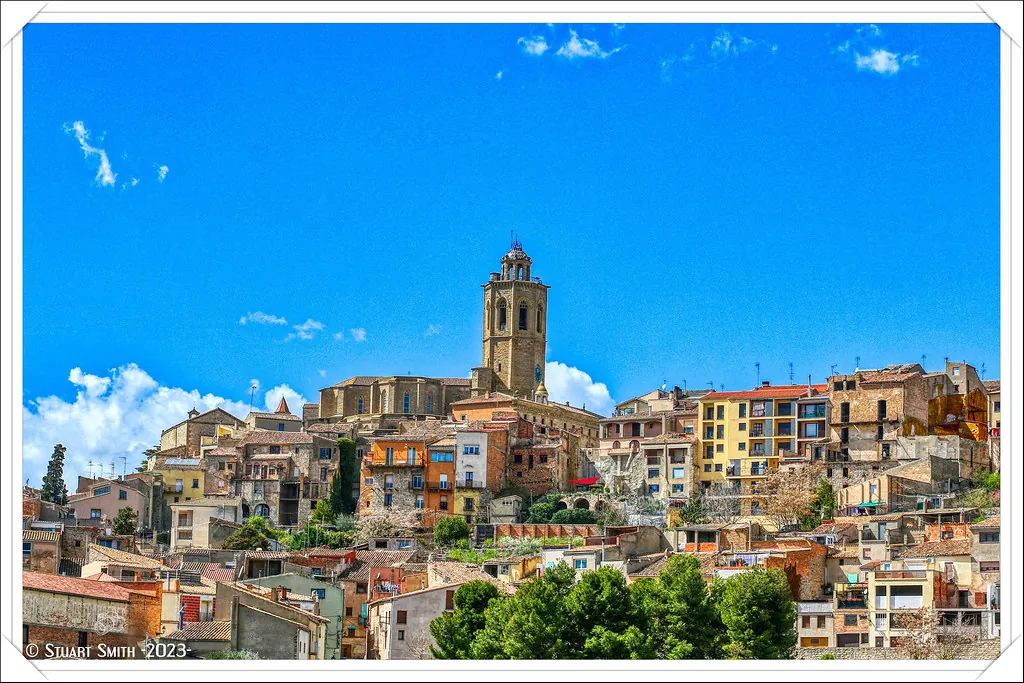
The architectural ensemble remains sober, in keeping with the interior of Catalonia. There are no elaborate decorative displays. Stone walls, compact volumes and modest squares define the village. These spaces function more as thoroughfares than as monumental settings. The parish church forms part of the same atmosphere, with a discreet presence within the village fabric.
Sant Ramon does not present itself as a place of grand landmarks. Its significance lies instead in how clearly it reflects the rural and religious history of this stretch of inland Catalonia.
Streets Shaped by Agriculture
The urban centre is small and can be explored in a short time. Its streets preserve a number of traditional stone houses. Many feature wide gateways designed for carts, along with spaces once used to store grain or tools. Even where renovations have taken place, the agricultural logic behind the buildings remains visible.
Construction here was practical. Homes and workspaces were closely linked, and façades were designed to serve the needs of farming families rather than to impress. That functional character still defines the feel of the village.
Daily life concentrates in the main square. From this point, several short streets lead out towards rural tracks and local roads. The transition from village to open countryside happens quickly. A few minutes’ walk is enough to move from stone façades to wide fields.
The Landscape of La Segarra
Much of what makes Sant Ramon interesting lies beyond the built-up area. The surrounding landscape of La Segarra is gently undulating. Small rises in the terrain, known locally as tossals, provide vantage points from which the structure of the countryside becomes clear.
From these slight elevations, long agricultural plots extend across the plateau. Scattered masías, traditional Catalan farmhouses, appear at intervals. Some are still inhabited as private homes, while others have stood empty for years. Together they form part of a historic network of agricultural exploitation that organised life in this region for centuries.
The sense of openness is striking. Fields dominate the view, and the horizon often feels close to the sky. In spring and summer, birds of prey are commonly seen circling above the crops. Kites and harriers are among the species associated with these open cereal landscapes, sharing the space with other birds linked to arable farmland.
The landscape does not rely on dramatic contrasts. Its interest lies in repetition, subtle shifts in elevation and the way light interacts with the fields over the course of the year.
Quiet Tracks and Gentle Routes
Several rural tracks leave from the edges of the village, allowing for walks or cycle rides between the fields. These are not signposted routes in every case. Many follow traditional agricultural paths that connect different plots and small rises in the terrain.
The routes are straightforward and involve no major changes in altitude. The emphasis is less on physical challenge and more on the experience of space. The broad horizons and the regular geometry of the fields create a calm environment for unhurried exploration.
As the village is small and the surrounding area sparsely populated, the atmosphere is generally quiet. Movement along these tracks often means sharing space only with occasional farm vehicles or local residents going about their work.
Nearby Towns in La Segarra
Sant Ramon lies relatively close to other towns in the comarca with greater historical weight, such as Guissona and Torà. These places contain medieval remains, more complex urban layouts and examples of Romanesque architecture. Visiting them helps to place Sant Ramon within the wider historical context of La Segarra.
Together, these towns illustrate different layers of the region’s past. Sant Ramon is closely tied to its sanctuary and its agricultural setting, while Guissona and Torà show additional aspects of medieval and Romanesque heritage within the same comarca.
Practical Considerations
Sant Ramon is small and a visit is usually brief. It is worth setting aside time to walk along the rural tracks that leave the village and to observe the agricultural landscape that defines this part of La Segarra. The experience is closely linked to the plateau, the cereal fields and the subdued architecture shaped by centuries of farming life.
With a car, Sant Ramon can easily be combined with other villages in the comarca over the course of a single day. The appeal lies in understanding how settlement, agriculture and pilgrimage routes have interacted in this inland area of Catalonia, and in taking the time to appreciate a landscape whose character reveals itself gradually rather than all at once.