Full Article
about Torà
Town with a medieval tower and the Brut i la Bruta festival tradition.
Ocultar artículo Leer artículo completo
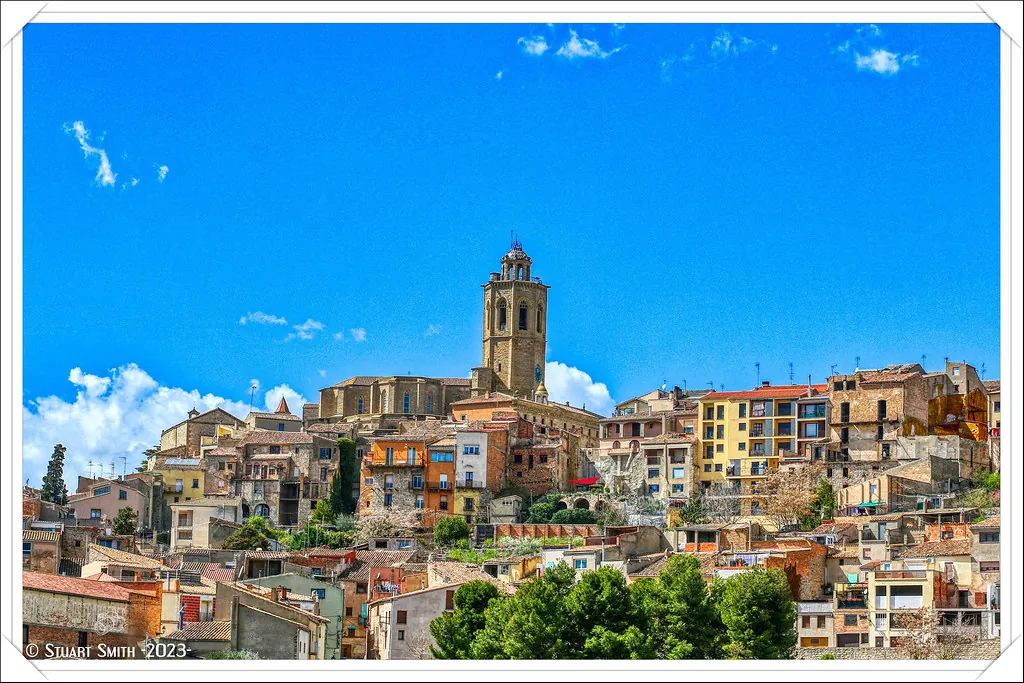
The first thing you notice is the sky. From the C-1412 the road lifts gently, wheatfields roll back, and Torà appears as a dark slate ridge against a dome of light that feels twice the size of anywhere on the coast. At 448 metres above sea level the air is thinner, cleaner, and the village bell tolls across dry stone walls as if to remind the fields who’s in charge.
Torà is not dramatic. It has no cliff-top castle, no river gorge, no Instagram-famous plaza. What it does have is continuity: the same families growing cereals since the Reconquest, the same baker firing the wood oven at 04:30, the same August fiesta that empties the granaries and fills the streets with giants and drums. For visitors schooled on coastal Catalonia, the discovery is less about sights and more about tempo—days measured by the angle of sun on barley rather than opening hours.
A Walkable Fortress
Park by the football pitch at the entrance; the old core is sealed to traffic narrower than a Citroën. Enter through Portal del Castell, the medieval gate still wearing its portcullis groove, and you are inside a grid built for defence, not tourism. Alleyways zig-zag so archers could pick off attackers; nowadays they give shade in July and a place to gossip in January. Sant Gil church squats at the top, its Romanesque bones hidden behind 18th-century stucco, but the bell-tower is original and you can climb for 2 € (ring first—the sacristan keeps the key in her apron pocket).
The circuit takes forty minutes if you dawdle. You’ll pass stone balconies forged in local iron, a fragment of wall where 14th-century arrow slits frame modern wheat silos, and the tiny Museu de la Segarra—one room, free entry, stuffed with threshing sledges and a 1940s radio that still picks up Radio 4 on a clear night. Labels are Catalan only; the custodian, Pere, will switch to slow, precise English if you arrive before noon and compliment his allotment.
Outside the walls the landscape opens like a Breugel. Brown tracks stitch green-and-gold squares of barley, oats and almond. Every kilometre or so a Romanesque hermitage pops up—Sant Martí de la Morana, Sant Pere dels Arquells—each the size of a Surrey village church, locked except on patron-day, but useful as way-markers for cyclists. Roads are tarmac until they aren’t; download the SEGARRoutes GPX before leaving coverage.
Pedal, Plate, Pause
Flat terrain makes Torà ideal for fair-weather cycling. A 25-km loop east to Guissona and back passes three hermitages and one petrol station that sells lukeworn Coca-Cola and tractor batteries. Hire bikes at Hotel Sant Guim for 15 € a day; helmets included, padded shorts not. Summer sun is relentless—carry two litres of water and start at 08:00 or you’ll bake like the local almonds.
Walking options are gentler. The old laundry path follows an irrigation ditch south to the ruins of Torre d’en Galí, a 13th-century watchtower now occupied by storks. Allow ninety minutes return, plus time to pick wild thyme. After rain the clay sticks like Cotswold bridle-path mud; trainers suffice, boots overkill.
Hunger is solved in three streets. Gòtic de Tora (closed Tuesday) does a three-course lunch menu for 16 €: start with pa amb tomàquet, move on to rabbit stew with potatoes grown three fields away, finish with crema catalana blistered under a blow-torch. Vegetarians get escalivada (smoky aubergine and pepper) and a lecture on the superiority of local oil. Wine is house cava—clean, appley, half the price of prosecco. Card payments accepted, but the owner prefers cash so he can pay the veg man on Thursday. Book at weekends; neighbouring villagers drive in.
Evening choice is narrower. Bar Centre opens at 19:00 for crisps and beer, but the kitchen shuts when the cook’s husband finishes dominoes. Picnic shoppers should stock up before 14:00 Saturday; the bakery (Ca la Maria) sells out of coques—Catalan pizza-like bread—by noon and does not reopen until Monday.
When the Wheat Turns Gold
Spring brings a brief, brilliant green that fades to biscuit-colour by June. Temperatures sit in the low 20s by day, single figures at night—bring a fleece even in May. Almond blossom in late February is the closest thing Torà has to a “season”; photographers arrive, snap for an hour, leave before lunch. Autumn smells of damp earth and burning stubble; mushrooms appear along the ditch banks and hunters in hi-vis stalk boar after sundown. Winter is sharp, often minus 5 at dawn, but daytimes are luminous and hotel prices halve. Snow is rare; when it comes the village children sled on tin trays and the AP-2 motorway closes for hours—pack chains if travelling between Christmas and Epiphany.
The fiesta major, last weekend in August, is the one time Torà swells beyond its 1,200 souls. Giants parade at 22:00, fireworks crack over the wheat, and a DJ rigs up in the square until 04:00. Accommodation within the walls is impossible unless you booked in January; stay 12 km away in Cervera and drive back on deserted roads scented with thyme and gunpowder. Any other month silence reigns after 23:00—acceptable if your idea of nightlife is owl song and the creak of medieval timber.
Getting Here, Getting Away
No train, no taxi rank, no Uber. Fly London to Barcelona, pick up a hire car at Terminal 2—allow 90 minutes to clear the queue in peak season. Take the AP-2 west, exit 11, then C-1412 north for 18 km. Tolls cost €14.40 each way; fill the tank at Lleida services where fuel is 10 c cheaper than the village pump. The last 4 km twist between cereal trucks; dip your lights and watch for hares. Buses run twice daily from Barcelona and Lleida but terminate at Cervera; from there you are stranded unless your hotel collects.
Mobile coverage is three-bar 4G on the approach, one bar inside the walls, zero in the hermitage hinterland. Download offline maps, screenshot your booking confirmation and tell someone where you’re walking. The local CAP health centre opens weekday mornings; for anything complicated Lleida hospital is 35 minutes by car.
Worth It?
Torà offers no checklist tick-boxes, no fridge-magnet icon. What it gives instead is a calibration of scale: how big the sky can feel, how long an hour is when the only sound is grain husks scraping in the breeze. Come if you like your landscapes human-sized, your bread baked at dawn, your history still lived in rather than roped off. Leave the coast behind, pack layers, bring cash and a sense of quarter-speed time. You might stay two nights, speak twenty words of Catalan, buy a bag of local flour and leave before the church bell strikes seven. That’s enough; Torà will still be there when the wheat turns gold again.