Full Article
about Almenar
Historic town with a striking rotating angel on its bell tower; mix of farming and services
Hide article Read full article
Morning on the plain
At six in the morning, the air smells of turned earth and freshly cut alfalfa. From a track beside the Segre, sprinklers spin like silver kites over maize fields. At that hour, tourism in Almenar has nothing to do with guides or itineraries. It is the steady sound of water falling, a van crossing the village, the first tractor heading out towards the farms.
This is a place that reveals itself through routine rather than spectacle. The day begins early, shaped by agricultural rhythms and the presence of water. Even a short walk near the river shows how closely daily life is tied to the land.
Water that reshaped the land
There is no mountain closing off the horizon here. The plain stretches so wide that the sky seems larger than usual. Yet it is not a dry landscape. Irrigation canals, especially the Aragón and Catalonia canal, bring water down from the Pyrenees and turn the flat terrain into a green grid.
Irrigated farming defines everything. Tall maize in summer, recently cut alfalfa, orchards that shift in colour as the months pass. Livestock is part of the scene too: Friesian cows in farmyards and flocks of sheep moving along dirt tracks.
After the Christian conquest in the 12th century, these lands were repopulated by people from the Balaguer area. They came in search of exactly what is still visible today: fertile soil and reliable water. The Islamic castle that once defended the settlement no longer stands, but parts of the town centre still hint at that medieval origin. Some streets twist into narrow bends, and houses sit close together, creating pockets of shade.
The church before the town
The outline of Santa María appears from a distance, even before reaching the built-up area. Its bell tower, around sixty metres high, rises above the rooftops. The reddish brick catches the bright light of midday across the plain.
Construction of the church began in the Gothic period, around the 14th century, though later changes altered its appearance. Inside, there is the coolness typical of large rural churches: thick stone walls, footsteps that echo, a quiet broken only by the sound of a door closing somewhere.
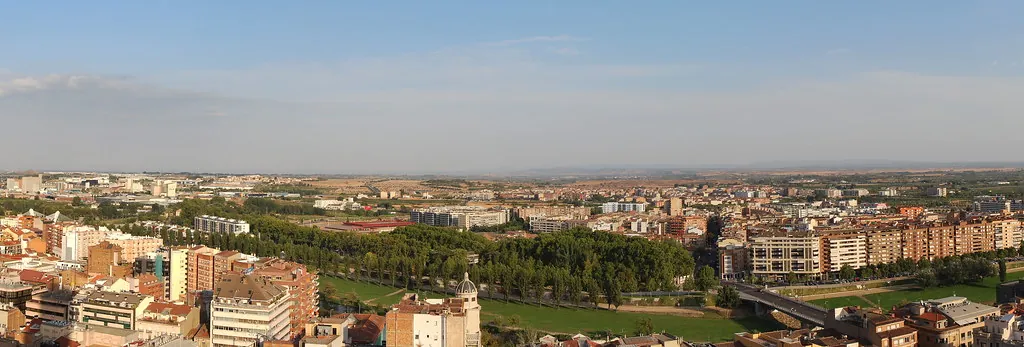
At times, it is possible to climb the bell tower, though it is not always open. When access is allowed, the view explains the setting more clearly than any description. Fields arranged like a chessboard, straight paths running alongside irrigation channels, and in the distance, green lines tracing the course of rivers.
Where the rivers meet
Very close to Almenar, the Segre and the Noguera Ribagorçana come together. It is not a developed site or heavily signposted. It feels more like a stretch of riverside reached by following agricultural tracks and footpaths used by local people.
As the river draws nearer, the soundscape shifts. Fewer engines, more birds, poplar leaves moving in the wind, water brushing softly against sand. In some sections, the river widens and seems almost still. During summer, people from the village and nearby places often come here to spend the afternoon, sitting by the bank or dipping their feet in the water.
This area forms part of the Natura 2000 network, a European system of protected natural spaces. On the ground, that protection is marked in a simple way: a few signs, paths shared by farmers and anglers, and a landscape that remains largely unchanged.
The village rhythm
Almenar does not organise itself around attracting visitors. Life revolves around the countryside and long-established routines. In August, the fiesta mayor, the main annual celebration, brings a shift in atmosphere. Those who have moved away for study or work return, squares fill up at night, and music continues late. During the day, the heat presses down and the village falls into a half-silence.
There are a few cafés and traditional bars, often with terraces when the weather allows. The food follows familiar lines: stews, locally produced meat, cured sausages, and fruit from the irrigated fields when in season.
For those who come to explore the village and walk a little in the surrounding area, spring is usually the most comfortable time. The fields are green, the air carries the smell of damp soil, and the heat of the plain has not yet set in. October has its own appeal too, with harvested plots and straw bales scattered across the land.
August, by contrast, can be intense at certain hours. Strong sun, mosquitoes towards evening, and more activity than usual. On weekdays, things settle back into the everyday pace. The baker opens early, someone parks outside the bar, a tractor moves slowly along the main street.
Almenar does not present grand monuments or a perfectly preserved old quarter. What it offers is something quieter: the calm of an irrigated village, the sweet scent of freshly cut alfalfa, and the stillness of the plain when the wind drops. Sometimes, walking beside the irrigation channels for a while is enough to understand it.