Full Article
about Montoliu de Lleida
Town on a hillock near the Segre; historic industrial chimney
Ocultar artículo Leer artículo completo
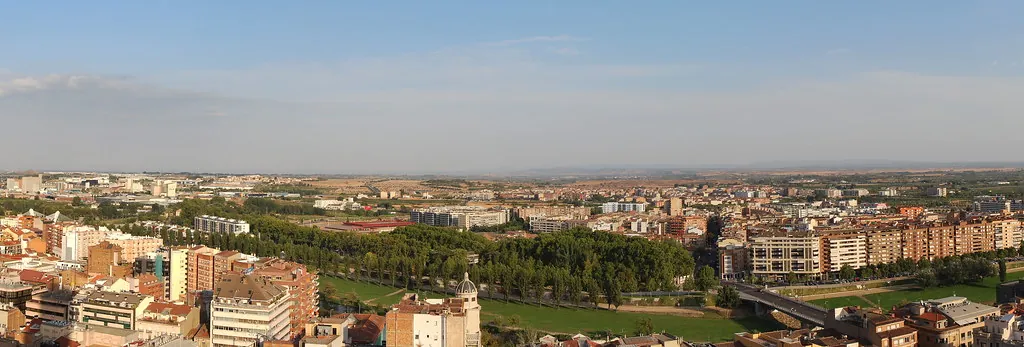
The tractors clock in before the sun. By seven o’clock they’re already threading between the irrigation ditches that gridlock the fields outside Montoliu de Lleida, headlights on, trailers rattling. From the edge of the village you can watch the convoy fan out across one of the flattest landscapes Spain still bothers to map—166 m above sea level, zero gradients, horizon stitched together with peach orchards and regimented rows of lettuce. It isn’t dramatic, but it is hypnotic, and it explains why this scatter of stone houses and corrugated barns refuses to die while other rural corners empty out.
The Arithmetic of a Small Place
Four-hundred-and-eighty-three residents, one baker, two bars, no cashpoint. The parish church doubles as the only obvious landmark, a squared-off tower that looks more like a fortified granary than a house of worship. Narrow streets radiate from it just wide enough for a combine harvester to scrape the paint off both walls. Houses are built from ochre limestone dredged out of nearby Segrià quarries; most have been modernised with PVC windows and roll-down shutters, the Catalan farmer’s answer to British double-glazing. You will not find souvenir tea towels. You will find elderly men sitting on orange-crate chairs, arguing over almond prices in a accent that clips the final syllable off every word.
Water, Mud and the Cyclist’s Chain
Montoliu sits in the middle of a nineteenth-century irrigation jigsaw planned by a civil engineer who liked straight lines. Acequias—concrete-sided channels no wider than a dining table—carry melt-water from the Pyrenees 150 km away. They also make the lanes ideal for flat-tyre cycling: gradients are negligible, tarmac ends abruptly at each farm gate, and every bridge hosts a cloud of swallows ready to dive-bomb reflective helmets. Spring mornings smell of wet loam and fertiliser; by midday the mercury is already nudging 28 °C, so start early or finish late. In August the same roads radiate heat like tandoor walls; locals cycle at dawn and again after 9 p.m., headlights cutting through dust hanging in the air. Winter is the reverse problem: thick fog rolls off the Segre river, visibility drops to 30 m, and the still-warm earth turns the tracks into gumbo. Wellies beat cleats from November to February.
What Passes for Sightseeing
There is no ticket office, no audioguide, no postcard rack. The church opens if the sacristan remembers to unbolt it; inside, the paint is flaking in continent-shaped patches and the only artwork is a nineteenth-century oil of Saint Roch that someone attacked with furniture polish. Walk clockwise round the building and you reach a lane of agricultural warehouses: one stores a 1960s Massey Ferguson that still starts first time, another houses a cooperative fridge stacked with peaches bound for Tesco in the UK. Ask politely and the manager will sell you a 5 kg box for €4—half the supermarket price, though you’ll need to eat them within three days; they haven’t been chemically sedated for travel.
Ten minutes east of the last house the residential grid dissolves into farm tracks that form a perfect right-angle chess board. Each junction looks identical, so memorise something distinctive: a ruined stone hut, a stack of pink irrigation pipes, a sign warning “Perill de mort” if you fancy swimming in the drainage ditches. The reward for not getting lost is a circuit of cherry orchards that explode into white blossom during the first two weeks of April. Photographers arrive from Lleida with step-ladders; the farmers tolerate them as long as no one tramples the drip-feed hoses.
Eating (or Not) Like a Local
Both village bars serve the same menu: coffee, brandy, packet crisps. One offers a plate of snails on Saturday if you order before noon and don’t mind the cook stepping outside for a cigarette while they boil. The nearest proper meal is back in Lleida, fifteen minutes by car down the C-12. There you can choose between modern Catalan tapas—grilled artichoke with romesco, pork jowl slow-cooked in local cider—and the university-canteen end of the market, depending on budget. Bring a cool bag: the fruit cooperative closes at 1 p.m. sharp and peaches don’t travel well in a hot boot.
Timing the Visit
British school-holiday calendars are useless here. Come the last week of April for blossom, or the second half of September when the night temperature drops to 16 °C and the pear harvest is in full swing. August is intolerable unless you enjoy 36 °C shade and streets deserted while everyone watches the Tour de France replay indoors. Winter is atmospheric but bleak: cafes shut early, tractors steam in the dawn like iron horses, and the sole bus to Lleida sometimes cancels if the driver decides the fog is too thick. Allow two nights maximum; Montoliu is a satellite stop, not a base camp.
Getting Here Without Losing the Will to Live
No UK airport flies direct to Lleida-Alguaire; the route was tried and abandoned when the low-cost bubble burst. Fly Barcelona or Reus, ride the AVE high-speed train to Lleida (1 h 05 min, advance fares €35), then confront the awkward final leg. Public bus line 421 leaves Lleida’s provincial station at 7 a.m. and 2 p.m., returns at 1 p.m. and 6 p.m.—four departures, that’s it. A taxi costs €25 each way; try to share with seasonal fruit pickers who split the fare. Cycling the distance is feasible: pancake-flat segregated path most of the way, though you’ll share it with articulated lorries delivering fertiliser. Hire bikes in Lleida at Pedalem Catalunya (€18 per day) but pack a spare inner tube; thorns from poplar cuttings are ruthless.
The Honest Verdict
Montoliu de Lleida will never make a “Top Ten Prettiest Villages” list because prettiness was never the point. It is a working, functional, sometimes dusty place that happens to let visitors watch an agricultural calendar largely unchanged since the irrigation canals were dug. If you need boutique hotels, move on. If you are happy with the smell of wet earth, the clank of a distant tractor and the smug knowledge that your peaches cost less than a London coffee, it delivers exactly what it promises—nothing more, nothing less.