Full Article
about Arbúcies
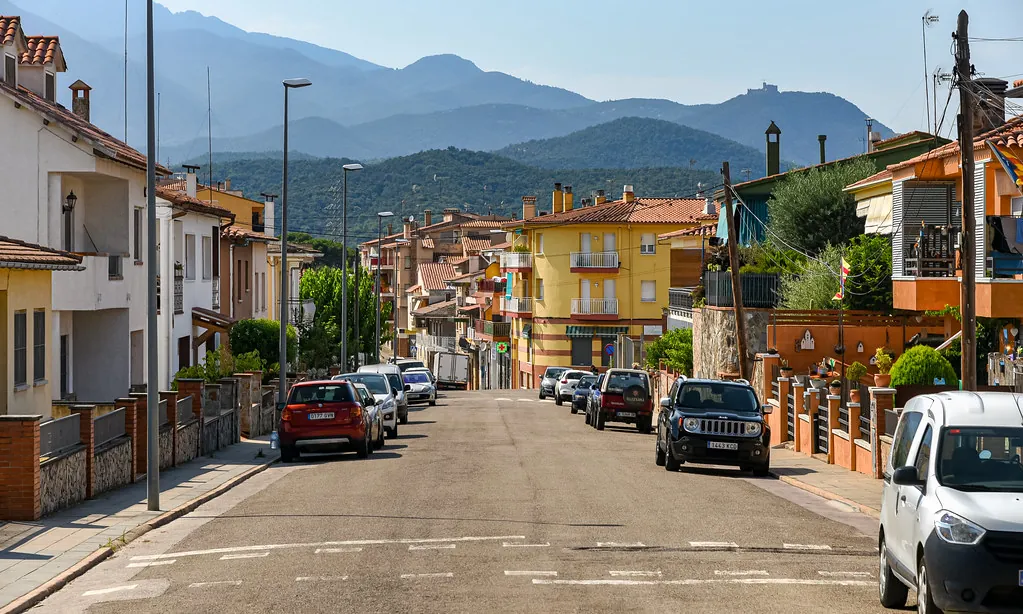
Set in the heart of Montseny; known for its gardens and plentiful water.
Hide article Read full article
A Valley Shaped by Montseny
Tourism in Arbúcies makes most sense when seen through the lens of Montseny. The town lies in one of the valleys that descend from the massif towards the plain of La Selva, in a landscape where water has never been scarce and woodland has set the rhythm of life for centuries.
The present-day centre is relatively compact, yet the municipality extends far beyond it. The surrounding territory is dotted with old masías, traditional Catalan farmhouses, scattered rural parishes and paths that climb steadily towards the castle of Montsoriu. The sense of settlement here has always been dispersed, tied to land and forest rather than to a dense urban core.
In early May, the heart of Arbúcies briefly takes on a different appearance. Residents create carpets of flowers laid out along several streets around the church. They last only as long as the procession that passes over them. The custom is shared with other Catalan towns, but here it retains a notably domestic feel. Petals and dyed sawdust are arranged into patterns by families working side by side, crouched over designs that will vanish within hours.
Montsoriu, the Castle Above the Valley
Montsoriu rises along a ridge of the Montseny and its outline can be picked out from many points in the Arbúcies valley. The position was deliberate. From here it controlled the natural passage between the coast and the interior.
The viscounts of Cabrera expanded the fortress mainly in the 13th and 14th centuries, when it became one of the great Gothic strongholds of Catalonia. What survives today is more than an atmospheric ruin. Large stretches of the walls remain solid, with considerable thickness, and the defensive layout is still clearly legible.
Reaching the summit requires a walk of around an hour along a forest track, with the final section completed on foot. At the top, the logic of human settlement in the valley becomes clear: nearby water, abundant woodland and a sheltered position. The castle’s relationship with its surroundings is easy to read from this vantage point.
Arbúcies occasionally recalls this past with a historical re-enactment dedicated to the so-called Revolta dels Cabrera. The episode is linked to tensions between the local population and feudal authority. Held in some years in mid-March, the event serves mainly to keep local history alive, particularly stories that do not always appear in textbooks.
Rural Churches and a Dispersed Past
Sant Mateu de Joanet was already mentioned in the 9th century, at a time when Arbúcies had not yet consolidated as an urban centre. The church stands a few kilometres from the current town and originally served the scattered masías of the surrounding area.
It preserves a Romanesque apse and a baptismal font bearing inscriptions that still give rise to differing interpretations. To reach it, visitors must leave the car on a track and walk for a few minutes. The setting conveys the logic of early settlement: small rural communities gathered around a parish church.
Closer to town, Sant Pere Desplà contains one of the most singular elements in the area. Fragments of pre-Romanesque wall paintings remained hidden beneath layers of limewash until the late 20th century. The surviving figures, painted in reddish and black tones, form part of an apostolic cycle. They do not rival the great Romanesque ensembles of the Pyrenees, yet they offer a glimpse of how church interiors once looked before later alterations.
The building itself has undergone many changes over time. The pre-Romanesque character survives mainly in the paintings and in the ground plan. When the church is closed, the key is usually managed through the Museu Etnològic del Montseny in the town.
The small group of rural churches is completed by Sant Cristòfol de Cerdans and Santa Maria de Lliors. Both are linked to the early centuries of rural Romanesque architecture. They are low structures, built with irregular masonry and small windows. Occasional religious services are still held there, drawing neighbours from the nearby farmhouses.
The Forest as Larder and Livelihood
Montseny has shaped much of Arbúcies’ traditional economy. Chestnuts, wild mushrooms and small game have long provided a direct supplement to households in the valley. The forest was not simply a backdrop but a source of food and materials.
Towards the end of October, the town usually celebrates the Fira de Tardor, closely tied to this relationship with the woodland. Seasonal produce, especially mushrooms and chestnuts, defines much of the atmosphere during those days. Musicians sometimes appear with the flabiol, a small traditional wind instrument that often accompanies sardanas when the ensemble is reduced. The sardana is a circle dance typical of Catalonia, and the sound of the flabiol is part of its distinctive character.
As evening falls, chestnuts are roasted in makeshift braziers in the square. The scene is simple: smoke rising, paper cones filled with hot chestnuts, people passing them from hand to hand because they are too hot to hold. There is little ceremony around it, just a seasonal ritual rooted in the forest economy.
Moving at an Unhurried Pace
The centre of Arbúcies can be explored quickly, yet the real interest lies beyond it. The climb to Montsoriu is the most obvious excursion. There is also a path that connects with the GR‑5 long-distance trail, avoiding part of the forest track.
The rural churches are signposted with small wooden boards marked “romànic”. At times the turn-offs do not align perfectly with what a GPS might suggest, so it is wise to plan the route in advance.
The Museu Etnològic del Montseny occupies the former Gabella factory. It helps explain how people lived in this valley: the work of the chestnut groves, agricultural tools and the former metalworking activity that once complemented rural life. The museum ties together the threads that run through Arbúcies, from castle to forest to parish church.
Seen as a whole, Arbúcies is best understood not as a single monument or viewpoint, but as a valley system shaped by Montseny. Water, woodland and a network of scattered communities have defined it for centuries. Travelling here means following those connections, from the ridge of Montsoriu down to the quiet churches and the chestnut fires in the square.