Full Article
about Caldes de Malavella
Historic spa town with Roman remains; known for its thermal baths and mineral water.
Hide article Read full article
A giant bottle of sparkling water stands on a roundabout beside the station in Caldes de Malavella. It is the first thing you see when you arrive by train from Barcelona. The message is clear: this is the town of water.
At first it feels almost like a visual joke. Then the sulphur reaches you and it becomes obvious that water here is not a gimmick. It is the reason the town exists, the source of its wealth and the thread that runs through its history. People have been coming to Caldes de Malavella for centuries because of what bubbles up from beneath the ground.
The smell that tells you everything
There is no subtle way to describe it. In certain fountains in the centre, the scent of sulphur hits with the force of a boiled egg left too long in a warm car. It appears suddenly as you walk past, and the first reaction is usually surprise.
That smell is the town’s calling card. The thermal waters emerge at around 60 degrees Celsius and have been doing so for more than two thousand years. The Romans recognised their value and named the place Aquae Calidae, literally “hot waters”.
Over time those springs gave rise to spas and to several companies that bottle the water. The curious part is realising that the same water flowing from public fountains in the centre is what later appears in bottles across much of the country. The modern business is often linked to a 19th-century doctor who promoted the therapeutic qualities of the springs long before anyone spoke about “health tourism”.
You can follow a route through town that links several of these thermal points. It connects the remains of the Roman baths, public fountains and historic buildings associated with bathing culture. The walk helps make sense of how deeply the water shapes the place.
At one of the fountains it is possible to taste it. The flavour resembles a warm, slightly salty aspirin dissolved in water. Refreshing is not the word. Even so, some locals fill large containers as a matter of routine because it has long been said to help digestion. Whether that claim convinces you or not, the ritual itself says a lot about daily life in Caldes.
Two towns in one
Caldes de Malavella feels like it moves at two different speeds.
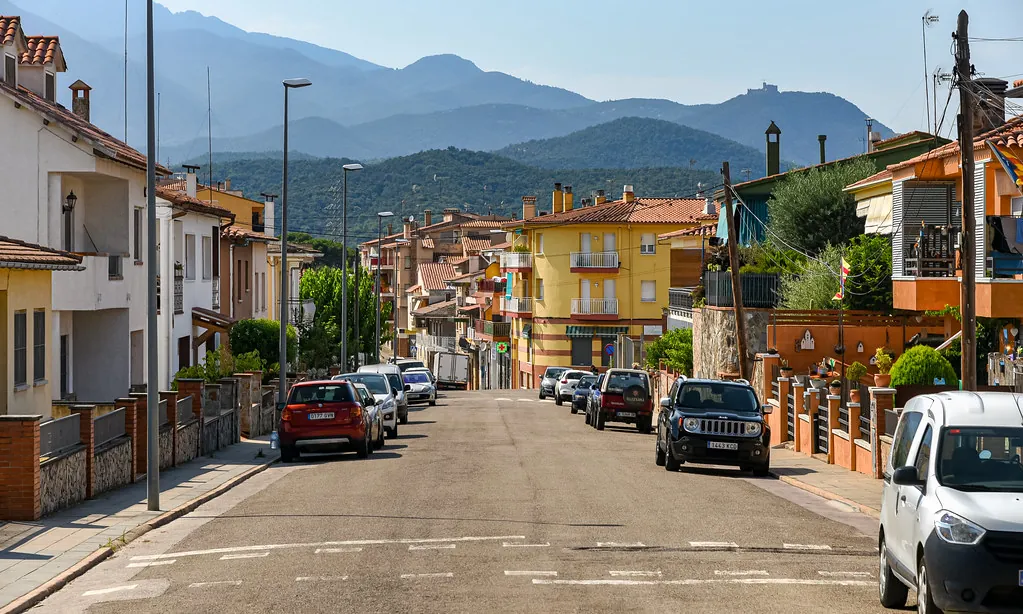
On one side lies the historic centre, with streets that reflect its position at an important crossroads between Girona, the coast and inland Catalonia. On the other side stands the area of spas and former summer villas, with generous gardens and buildings dating from the late 19th and early 20th centuries. Turn a corner and the atmosphere shifts, almost as if you had stepped into another town.
The spa quarter speaks of a time when well-to-do families travelled here to take the waters. The architecture from that period still shapes the streetscape. Meanwhile, the older core keeps the focus on fountains, small squares and traces of Roman infrastructure.
This contrast gives Caldes its particular character. It is neither purely a spa resort nor simply a historic village. It sits somewhere in between, defined by both.
A crater with elephants
Thermal springs are not the only surprise. On the outskirts of town lies a significant prehistoric site called Camp dels Ninots.
The name might suggest a children’s playground, but the reality is very different. Camp dels Ninots is an ancient volcanic crater around three million years old. Within it, palaeontologists have uncovered exceptionally well-preserved fossils of prehistoric animals.
Among the finds is an elephant whose bones appeared almost exactly in the position in which it died. The floor of the lake that once filled the crater seems to have acted as a natural trap, preserving the remains with unusual completeness. For specialists, the site has become a point of reference.
Visits usually take place with prior booking and are accompanied by staff who explain the excavations and their significance. It is not a place for wandering independently, and that structure adds context. By the end, it becomes clear why researchers speak so highly of Camp dels Ninots.
The short distance between the spa town and a crater filled with fossilised animals underlines the odd mix that defines Caldes. Few places combine bottled mineral water and prehistoric elephants within the same afternoon.
The witch, the festival and a very generous plate
Back in the centre, food becomes the focus. Traditional Catalan cooking has a firm place here. A classic option is fricandó with seasonal mushrooms, a beef stew typical of Catalonia. Expect tender meat and a rich sauce built around the flavour of the mushrooms, which bear little resemblance to the standard supermarket variety.
For dessert, coca de llardons often appears. This sweet flatbread includes small pieces of pork crackling. The combination may sound unusual to those unfamiliar with Catalan baking, but the balance of sugar and savoury fat is part of its appeal.
Local identity also shows up in the Festa de la Malavella, usually held in spring. During the celebration, the town constructs a figure of the witch Malavella, parades her through the streets and ultimately burns her amid music and fire. According to legend, this witch lived in a nearby castle and used the hot waters for healing purposes. Today she belongs to local folklore, even if the festival’s finale is not especially kind to her.
The story ties back neatly to the springs. Even in legend, the hot water remains central.
A short escape with substance
Caldes de Malavella works best as a short break. It is not necessarily a place to fill an entire week unless the main goal is to spend extended time in a spa. Nor does it suit a fleeting stop of a few minutes before moving on.
A day or a night allows enough time to explore the Roman remains, follow the thermal fountain route and understand why sulphur hangs in the air. There is space to walk between the historic centre and the spa district, to grasp the contrast between them, and perhaps to arrange a visit to Camp dels Ninots.
What stays in the memory is the coherence of it all. The oversized bottle on the roundabout no longer feels like a joke. It is a summary. In Caldes de Malavella, water shapes the streets, the economy, the legends and even the festivals. Add a volcanic crater with fossil elephants and a plate of fricandó, and the result is a town that makes its point quickly and clearly.