Full Article
about Hostalric
Walled town dominated by a large military fortress; medieval monumental complex
Hide article Read full article
A Scarred Hill Above the Selva
Hostalric still carries the marks of war. On the wall of a house along Carrer Major, the word “Capità” can be seen, painted in lime more than two centuries ago. It indicated the lodging of an officer assigned to the castle. Small traces like this connect the present-day town with a past shaped by sieges, shifting borders and military command.
When Guerau VI de Cabrera granted the town charter in 1243, he set out the distribution of land and legal rights. What that document did not spell out was that this volcanic outcrop of basalt, formed millions of years ago, would become one of the strategic strongholds of the old Principality of Catalonia. The rock itself determined everything that followed.
The Stone That Ordered the Territory
From the 14th century onwards, written references mention the town walls. With them, Hostalric became one of the keys to the comarca of La Selva. The walled enclosure, a little over half a kilometre in length, was not conceived as a grand civic statement but as military infrastructure. It controlled the natural corridor linking Barcelona and France along the coastal strip.
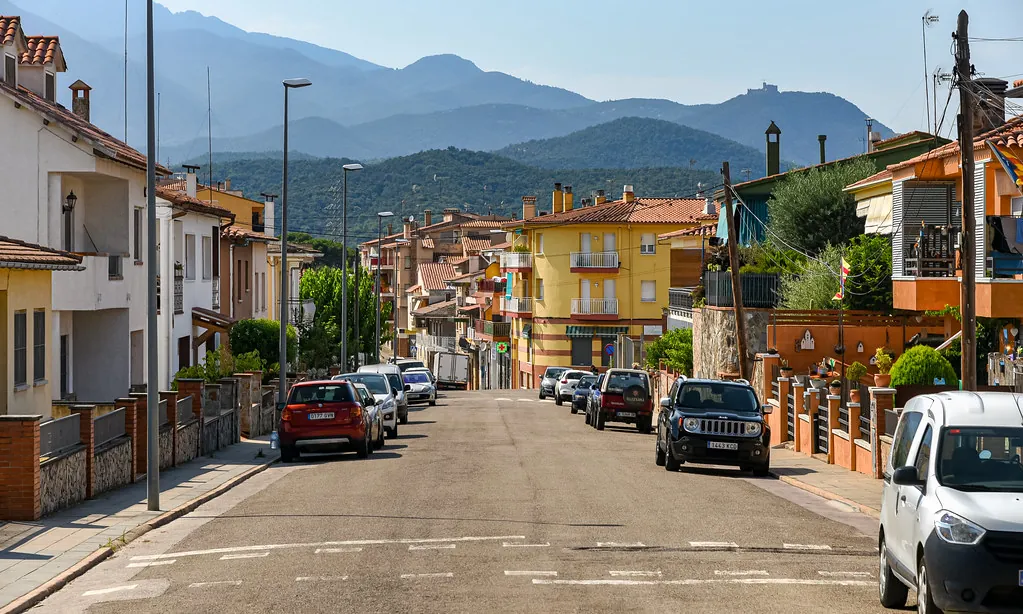
Ten towers defended the complex, and several can still be visited today. Walking their upper levels makes clear how the settlement was organised around defence. The castle, built on the former volcanic cone, explains the shape of the town below: streets slope down towards the plain, and many houses rest directly on the rock.
By the end of the 17th century, the fortress had suffered serious damage during conflicts with France. Its subsequent reconstruction, under the Bourbon monarchy, adapted the site to modern military engineering. Plans drawn up by the engineer Jorge Próspero de Verboom transformed the medieval stronghold into a fortified position equipped with powder magazines, ravelins and protected galleries designed to withstand heavy artillery.
The War of Independence in the early 19th century brought another siege. Contemporary sources describe intense bombardment that left much of the town’s housing destroyed. The scars of those conflicts linger in the urban fabric and in the inscriptions that survive on certain façades.
The Cabrera Route and a Feudal Capital
To understand Hostalric’s political weight in the later Middle Ages, the so‑called Ruta de los Cabrera offers a useful framework. This walk of around two kilometres traces the spaces linked to the powerful Cabrera lineage, originally from the Osona area, who came to control much of north-eastern Catalonia.
The route connects sites that once served administrative functions within the viscounty. It passes through the square where the viscount’s palace stood, the church of Santa María and the buildings where local jurisdiction was exercised. From here, the Cabrera family administered both civil and criminal justice across a broad territory that included much of what is now La Selva and areas around the Montseny massif.
Within the castle, a small interpretative space has been installed in former barracks. Maps and original objects, including seals, keys and documents, explain how the viscounty was organised and how Hostalric fitted into this feudal network. The display is modest in scale, yet it clarifies the town’s former role as an administrative centre as well as a military one.
Flavours That Endured
In the old quarter, a historic house now hosts a centre dedicated to the Sent Soví, a 14th-century Catalan cookbook and one of the earliest known recipe collections in the region. The centre does more than exhibit manuscripts. It also researches and disseminates culinary techniques recorded in the book, from a time when spices such as cinnamon or sugar carried a very different value from today.
That medieval culinary heritage survives in quieter ways too. Local bakeries continue to prepare traditional pastries such as coca de llardons, made with thin dough, pieces of pork fat and pine nuts. These are straightforward recipes that have lasted through habit rather than any formal revival.
Ratafía remains part of the area’s identity as well. This herbal liqueur, typical of the Montseny surroundings, is usually made by macerating a mixture of plants and green walnuts in aguardiente for several weeks. The precise blend varies from household to household. During popular celebrations, especially those around Easter or the festa major in August, bottles prepared within families often appear on the table.
Walking the Walls
A walk along the walls, stretching for just over a kilometre, brings together the geography and the history in a single view. From some of the towers, the plain of La Selva opens out towards the sea. The volcanic ridge dominates the natural corridor through which goods and armies once travelled between the coast and the interior.
The path circling the castle follows the former defensive perimeter. Parapets and lookout positions can still be distinguished, places where soldiers once monitored movement through the valley. At the foot of the hill runs the modern road, which largely reproduces an axis of communication that has existed for centuries.
Below flows the river Tordera, marking the transition between La Selva and the Maresme. In dry periods its bed could be crossed with relative ease. In times of conflict it formed yet another frontier to defend.
Hostalric can be explored in a few hours, yet its present form is the result of several centuries of military and administrative function. Inscriptions on some façades along Carrer Major, “Capità” and “Coronel”, recall that officers once slept here while overseeing this strategic passage. Today the walls remain standing, no longer guarding a border. Freed from that role, they make it easier to understand why this basalt hill mattered for so long.