Full Article
about Riells i Viabrea
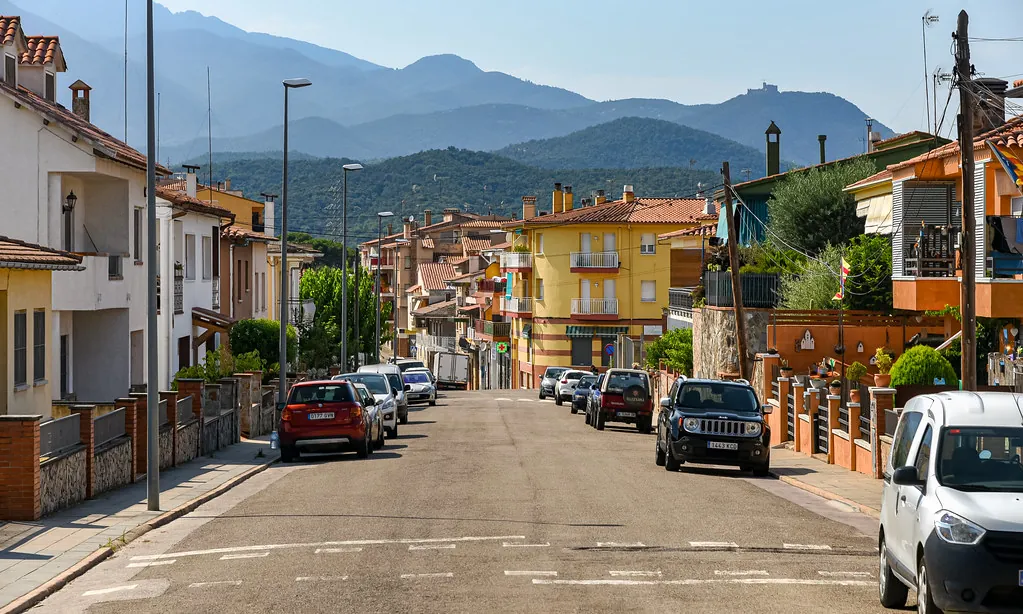
Scattered municipality at the foot of Montseny; wooded natural setting
Hide article Read full article
The smell of pines warmed by the August sun reaches you before the village does. It comes in through the car window as you drive, dry air carrying the scent of resin and roadside dust. Then the sign appears: Riells i Viabrea. The entrance is far from ceremonial. A couple of industrial units, a roadside petrol station, cars parked in the shade, and the quiet rhythm of a place where people come and go without fuss.
Plaça de Can Salvà is a rectangle of stone where sound seems to soften. Conversations drop almost without anyone noticing, perhaps because of the large masia that dominates the square. Its thick walls keep the interior cool even when temperatures outside climb into the thirties. At midday, the plane trees cast diamond-shaped shadows across the ground. This is when neighbours cross the square with their shopping or stop for a quick chat, often glancing towards the mountain and wondering aloud whether the Montseny will bring rain or whether autumn might arrive early this year.
From the northern edge of the municipality, where the last houses begin to thin out, the mountain suddenly takes over the view. The Montseny Natural Park occupies much of the municipal area and its presence is immediate. Fields and residential plots come to an abrupt end and chestnut, holm oak and pine trees begin without transition. A few steps into the forest are enough to feel the temperature drop. The ground turns dark and damp, covered with leaves and moss that soften every footstep.
Where Riells meets Viabrea
Dirt tracks explain the layout of Riells i Viabrea better than any map. One of them heads towards the area of Can Bosc and crosses the blurred boundary between Riells del Montseny, closer to the mountain, and Viabrea, which opens out towards the plain of La Selva.
On the Riells side, masias are scattered across the landscape. Some are centuries old, others restored in recent decades. Their names often begin with the traditional “Can”: Can Cama, Can Falguera, Can Bruguera. The houses stand apart from one another, separated by fields, dry stone walls and paths that climb gently towards the forest.
Descending towards Viabrea, the scenery shifts. The land flattens, housing developments and individual plots become more frequent, and a few olive groves still survive, lending the landscape a distinctive grey-green tone. There is no sign announcing that you have crossed from one area to the other. The change is noticeable in the way the territory is organised, in how the houses sit in relation to the fields and the roads.
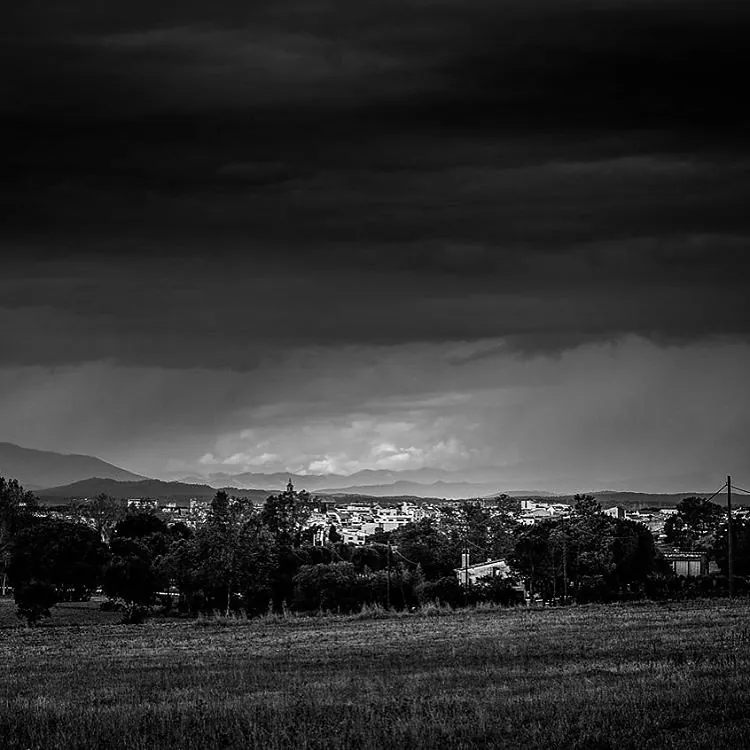
In autumn, early in the morning, the contrast becomes clearer still. Mist often settles in the La Selva depression while the higher ground near the Montseny remains more open. From certain elevated tracks, a white layer can be seen covering the plain, with rooftops emerging briefly above it until the sun gradually dissolves the haze.
Paths shaped by everyday use
Beyond the marked routes of the natural park, Riells i Viabrea is threaded with smaller paths that barely feature on tourist maps. They once linked masias, cut between plots of land or served as shortcuts into the forest. Many are still used by locals.
One path begins near the cemetery and climbs steadily into a pine wood. The ground is carpeted with dry needles that crunch underfoot and release a strong resinous smell that lingers on clothes. In occasional clearings, the remains of old stone constructions appear, linked to former uses of the mountain. Stories are still told in the area of when snow and ice were gathered in the range for practical purposes, although many of those structures are now partly collapsed.
Care is needed on the descent if the ground is damp. Moss coats some of the stones and the path narrows in places, with chestnut branches forming a kind of green tunnel overhead. Emerging from the forest at dusk, the village lies below with its first lights switched on. The contrast between the dark mass of the mountain and the illuminated streets is striking.
At the table in Riells i Viabrea
Home cooking still plays a central role in daily life here. On Sundays, many kitchens are busy from early morning, a pot on the hob and the smell of sofrito slowly filling the room.
Dishes such as fricandó, a Catalan beef stew traditionally cooked slowly with mushrooms, are brought to the table when there is time to prepare food without rushing. Fish from the nearby coast also finds its way here. Blanes is relatively close, and it is common for the catch to become a homemade suquet, a simple fish stew with potatoes prepared more by habit than by strict recipe.
Pa amb tomàquet remains a fixture, assembled directly at the table without ceremony. Bread is sliced open, ripe tomato rubbed straight onto the crumb, then dressed with olive oil and a little salt. In this part of La Selva there are still estates with olive trees, so it is not unusual for the oil to come from local groves or nearby cooperatives.
When the seasons shift
February can feel long in Riells i Viabrea. The sky stays grey for days at a time and the mist is slow to lift. Paths turn muddy and boots come back into the house with half the mountain clinging to their soles.
Other times of year show a different face. In summer, the heat settles over the plain while the forested slopes of the Montseny offer cooler air a short walk away. In autumn, the shifting light and morning fog redraw the boundary between Riells and Viabrea day after day.
Life here follows those gradual changes. The square fills and empties, the mountain alternates between clear outlines and hidden ridges, and the scent of pine returns whenever the sun warms the trees. Riells i Viabrea does not announce itself loudly. It reveals itself in small transitions, in the way forest becomes field and field becomes street, and in how closely daily routines remain tied to the land that surrounds them.