Full Article
about Sant Hilari Sacalm
The town of a hundred springs; forested setting in the Guilleries and spa resorts
Hide article Read full article
Sant Hilari Sacalm has a small ritual. Many visitors arrive with an empty bottle and leave with it filled. It is not about running out of water on the drive. It is simply what people do here. Before heading home, they stop at one of the town’s many springs and top up.
This town in Catalonia is known for its water. Locals often say there are more than a hundred fountains. Few people actually count them, yet it does feel as if a tap appears at every turn, each one marked with a sign that would not look out of place in a laboratory: “Agua mineral natural”.
In Sant Hilari, water is not just something to drink. It is part of the town’s identity.
A Town That Sells Water Before Souvenirs
The reputation of Sant Hilari Sacalm as a spa destination dates back to the late 19th century, when the properties of several springs were officially recognised. From that point on, the town began to build its name around thermal waters and health tourism.
On the outskirts stands the old balneario, a large building with red roofs that looks as though it belongs in an early 20th‑century film. In its heyday, people travelled here to “take the waters”, an expression common at the time. Visitors would spend days drinking mineral water as if it had been prescribed. The idea may sound quaint now, yet it shaped the town’s development.
In front of the former spa there is still a fountain. The water runs cold throughout the year and has a faint mineral tang that is immediately noticeable. Filling a bottle there connects the present with that earlier chapter, when Sant Hilari’s springs drew visitors seeking wellbeing.
The culture of water remains visible today. Rather than focusing on typical souvenirs, the town’s most distinctive takeaway is something that flows freely from its fountains.
Forest at the Doorstep
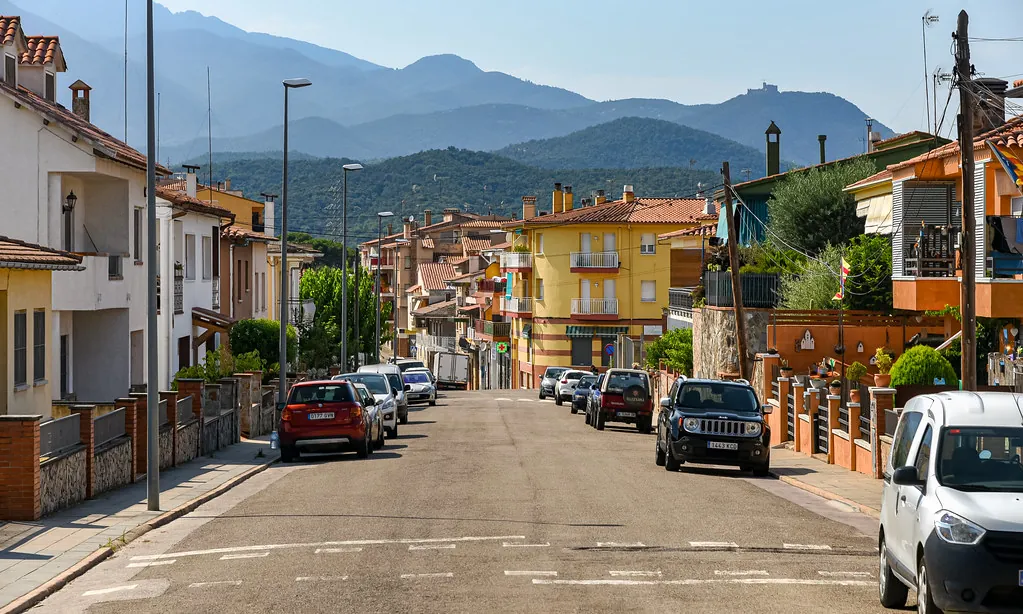
Sant Hilari Sacalm is one of the gateways to les Guilleries. A glance at a map shows how closely the town is wrapped in woodland. Forest is not a backdrop here; it is a neighbour.
The changing seasons make themselves known. Autumn carries the scent of damp mushrooms. In winter, the smell of woodsmoke drifts from chimneys. Step away from the houses and it takes very little time to find yourself among beech trees and chestnut groves.
Several footpaths begin almost within the town itself. Walk for a short while and the streets give way to shaded tracks. The long‑distance trail GR‑178 passes through the area, linking historic routes associated with Serrallonga, the most famous bandit of these mountains. His name still echoes across les Guilleries, part legend, part history.
Mobile reception begins to fade once you move further from the centre. That can feel inconvenient, yet it also reinforces the sense of being properly immersed in the landscape.
For those travelling with children, or anyone who prefers a gentler outing, there is a short circular route connecting several nearby hermitages. It is not demanding, and along the way there are benches and small clearings that invite a pause. It is the kind of walk that offers fresh air and woodland without requiring a full day’s effort.
From almost any path, the impression is the same: Sant Hilari sits among mountains, encircled by trees, shaped as much by forest as by water.
Mushrooms, Stews and Jaumets
The surrounding woods strongly influence local cooking. When mushroom season arrives, they appear across the comarca’s menus. Rovellons and ceps are among the varieties gathered, depending on what the forest yields that year.
Wild boar stewed with mushrooms is a common dish in this area, reflecting both the landscape and long‑standing culinary traditions. Another staple is fricandó, a beef stew with a thick sauce that in many households is still prepared much as it was by earlier generations.
Sweet treats have their place as well. Sant Hilari’s best‑known biscuits are called jaumets. They are butter biscuits widely recognised in the area, and they take their name from a much‑loved local character: an old water carrier who used to walk the streets playing the flabiol, a small traditional flute. The link between water and identity surfaces again, even in something as simple as a biscuit.
Jaumets have a habit of disappearing from the packet faster than expected. They are straightforward, familiar and closely tied to the town’s story.
When Serrallonga Returns
Serrallonga is not confined to signposts along the GR‑178. Each year, towards the end of September, Sant Hilari Sacalm usually holds a festival dedicated to the bandit. For several days the town fills with people dressed as outlaws, craft stalls and street performances. The atmosphere feels more like a popular historical reenactment than a formulaic medieval market.
The figure of Serrallonga, rooted in the mountains of les Guilleries, becomes a shared character. Locals and visitors take part, and the streets turn into a stage.
Another tradition, much older, takes place at Easter. During Holy Week, residents perform a Via Crucis that winds through various streets of the town at night, lit by torches. It has been celebrated for generations and continues to involve a significant part of the community. The scene is solemn and communal, shaped by continuity rather than spectacle.
These events reveal different sides of Sant Hilari: one festive and theatrical, the other reflective and longstanding.
A Slow Visit, A Long Walk
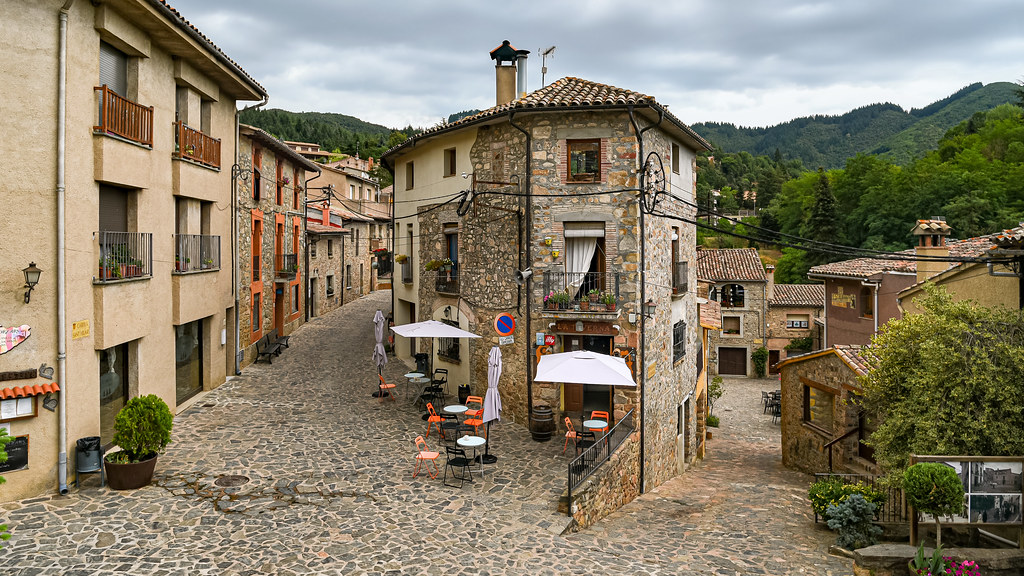
Sant Hilari Sacalm is not a place for ticking off sights in a hurry. It works best at an unhurried pace. A stroll through the centre can be followed by a walk along one of the paths leading into the forest.
The tourist office is housed in an old manor house in the centre of town. It is a useful stop for picking up a map and asking about simple routes or the location of some of the better‑known fountains.
From the town hall, a footpath climbs to a cross on the top of a nearby hill. The walk does not take long. From above, the setting becomes clear: a town set among mountains, surrounded by woodland, with more water than one might expect to find so far from the sea.
Before leaving, many people pause at a fountain and refill their bottle. In Sant Hilari Sacalm, that small gesture feels almost obligatory. Water has shaped the town’s past and still defines its character today.