Full Article
about Vilobí d'Onyar
Municipality home to Girona airport; volcanic landscape of the Crosa
Hide article Read full article
A Village Under the Flight Path
The first thing noticed in Vilobí d’Onyar is not a monument or a square, but the airport. Aircraft fly low overhead and the sound is part of daily life. Girona Airport sits right next to the village and can be heard at any hour. Residents have lived with this for years. In return, there is work linked to the airport and a steady, if occasional, flow of people who stay nearby when the Costa Brava is full.
Vilobí d’Onyar is not a resort and does not try to be one. It feels practical, tied to its location and to the routines of people who move between the airport, nearby industrial estates and the surrounding farmland. For travellers, it often appears as a name on a map close to Girona Airport. For those who stop, it offers a brief look at ordinary life in this part of Catalonia, along with one striking natural feature just outside the village.
Getting There and Parking
Vilobí d’Onyar is easy to reach by road. The C‑25 and the C‑65 run nearby, and from either it only takes a few minutes to enter the village. Once there, parking is usually straightforward. There are open areas close to the town hall and by the football pitch where cars are normally left without much circling.
If arriving via Girona Airport, the journey into the village is short by car or taxi. There is no train station in Vilobí itself. The nearest stations are in other municipalities in the area, so rail travellers need to continue by road for the final stretch.
The layout is simple and distances are short. It does not take long to get oriented, and the compact size makes it manageable even on a brief stop.
A Quick Walk Through the Centre
Vilobí d’Onyar is small. In the space of a morning, most visitors will have seen what there is to see.
The most recognisable building is the church of Sant Esteve. Its bell tower has the look of an old defensive tower and can be spotted from various points around the village. It stands out among the low houses and quiet streets, acting as a visual reference point as you move around.
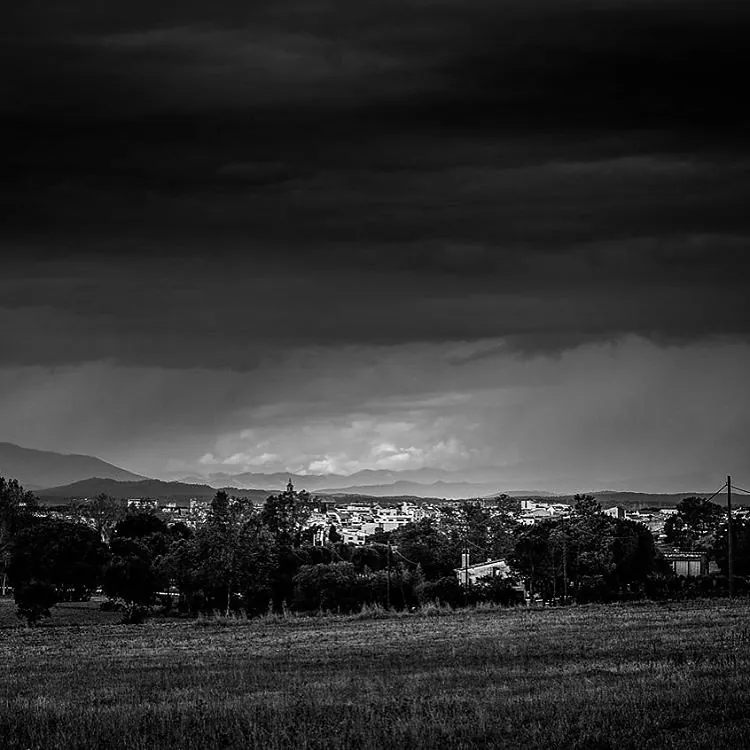
Beyond the church, the village is made up of calm streets, modest houses and very little traffic. The Onyar river passes nearby. There is no long riverside promenade and nothing especially designed for lingering by the water, but its presence shapes the surrounding landscape.
The overall impression is of a working village rather than a carefully staged destination. There are no grand monuments or large historic quarters. What you see is daily life unfolding at its usual pace.
The Volcà de la Crosa
Just outside the village lies its most unusual feature: the Volcà de la Crosa. This is the most distinctive element in the municipality. The crater is enormous, far larger than many expect, and today it is occupied by cultivated fields.
From the rim, it can be difficult at first to imagine that this wide agricultural basin was once a volcano. The transformation over time has softened its appearance. What remains striking is the scale. The sense of space becomes clear when walking around the edge or looking across the interior.
There are paths around the area that can be followed on foot. Some stretches offer little shade, so carrying water is advisable when the sun is strong. The terrain is not described as steep, but it is open in places, and the heat can be direct in summer.
In addition to the marked routes in the wider area, it is also possible to walk along agricultural tracks around the volcano and nearby fields. These are rural paths, shaped by farming activity rather than tourism infrastructure.
Walking in the Comarca
For those who enjoy walking, the surrounding comarca, or county, has signposted routes that pass near Vilobí d’Onyar. Some are linked to stories of the bandit Serrallonga, a figure who is well known in this part of the province of Girona. His name appears frequently in local lore and on route information in the area.
These trails are rural in character. They do not involve major climbs, but there can be sections of stone underfoot and muddy stretches after rain. Suitable footwear makes a difference, particularly outside the dry summer months.
The landscape around Vilobí combines cultivated land with patches of woodland and open ground. It is a setting for straightforward walks rather than dramatic mountain hikes. The appeal lies in the quiet and the sense of space, punctuated at times by the sound of planes overhead.
When to Visit and What to Expect
During the week, the atmosphere reflects a working village. Many people are connected to the airport, nearby industrial estates or agricultural activity. Movement tends to follow work patterns rather than visitor rhythms.
In summer, there is usually a little more activity in the main square. Like many villages in the comarca, Vilobí d’Onyar holds local festivities, with music in the evenings. Outside those periods, the mood is generally calm.
Winter mornings often bring fog. It is not unusual to find the village wrapped in mist early in the day, with aircraft taking off above it. The combination of low cloud and engine noise is part of the seasonal character.
The presence of the airport is constant throughout the year. Early departures are part of daily life, and the soundscape never fully disappears. Anyone sensitive to noise will notice it. For others, it quickly becomes background.
A Practical Stop Rather Than a Showpiece
Vilobí d’Onyar is not a postcard village. It sits next to an airport and revolves around fairly ordinary routines. There are no elaborate viewpoints or curated historic quarters. What it offers is direct and uncomplicated.
For travellers passing nearby, it can be worth stopping to see the Volcà de la Crosa and stretch your legs. A short walk around the crater or through the surrounding tracks gives a sense of the local landscape without requiring much time.
In summer, late morning sun can be intense on the open paths, so shade becomes valuable where it exists. In winter, fog may soften the outlines of the fields and houses. At any time of year, the sound of aircraft forms part of the experience.
Vilobí d’Onyar does not present itself as a destination for days of sightseeing. It is a place of transit and work, with a remarkable volcanic feature on its edge. For those curious enough to pause, that combination offers a brief, grounded view of life in this corner of Catalonia.