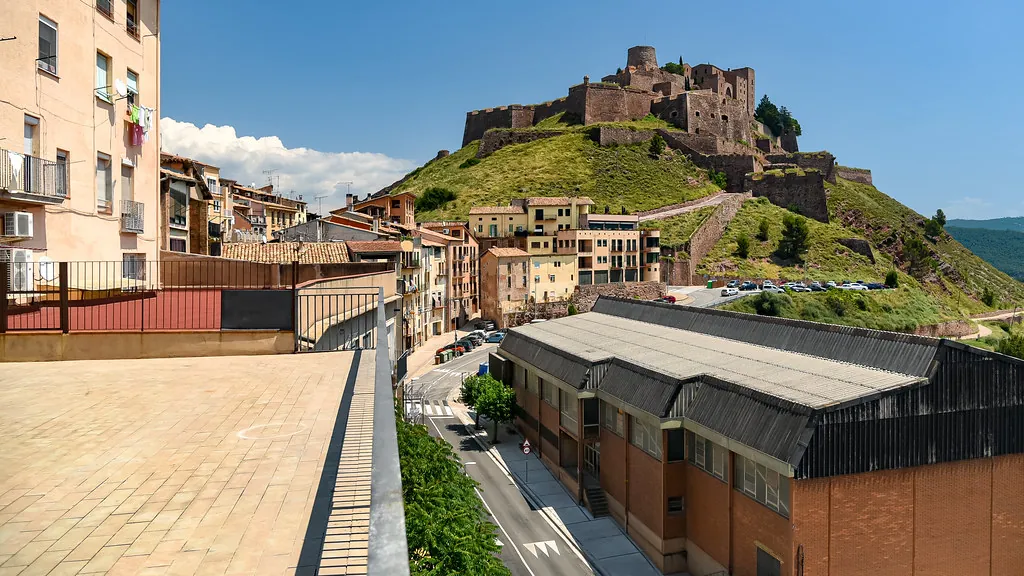
Camí de Clariana de Cardener amb un turó boscós al fons.jpeg
Cèsar August Torras i Ferreri · Public domain
Cataluña · Sea, Mountains & Culture

Clariana de Cardener

The church bell strikes noon, and the only other sound is a tractor reversing into a barn. Clariana de Cardener doesn't do noise. Perched at 500 me...

160 inhabitants · INE 2025
500m Altitude

Why Visit

Mountain Sant Ponç reservoir Kayaking

Best Time to Visit

summer

Main Festival (August) agosto

Things to See & Do
in Clariana de Cardener

Heritage

  • Sant Ponç reservoir
  • Sant Serni church

Activities

  • Kayaking
  • Fishing
  • Hiking

Festivals
& & Traditions

Fecha agosto

Fiesta Mayor (agosto)

Las fiestas locales son el momento perfecto para vivir la autenticidad de Clariana de Cardener.

Full Article
about Clariana de Cardener

Scattered municipality around the Sant Ponç reservoir; ideal for water sports.

Ocultar artículo Leer artículo completo

The church bell strikes noon, and the only other sound is a tractor reversing into a barn. Clariana de Cardener doesn't do noise. Perched at 500 metres in Catalonia's Solsonès region, this scatter of stone farmhouses and smallholdings stretches across hills that roll like a rumpled duvet towards the Cardener river. There's no centre to speak of—just the parish church of Sant Andreu, a bar that opens when the owner feels like it, and lanes where red kites circle overhead while combine harvesters crawl below.

British visitors who make the 110-kilometre schlep from Barcelona usually arrive with the wrong expectations. They’ve ticked “rural escape” on the booking form and picture rustic-chic kitchens, olive-oil tastings, perhaps a boutique hammock. What they get is working farmland: muddy gateways, the smell of silage, and evenings so quiet you can hear your own pulse. It’s either a shock or a revelation.

A Landscape That Still Works

The municipality’s 32 square kilometres are stitched together by unpaved rural tracks—wide enough for a Massey Ferguson, just about tolerable for a hire-car Fiat 500. Fields of wheat and barley alternate with meadows where beef cattle graze. Holm oaks and holly-green oaks cling to the ridges, their acorns fattening free-range pigs that end up as the region’s celebrated embotits. If you picnicked beside one of the dry-stone walls, you’d probably be sharing your spot with a herd of sheep or a farmer on a quad bike checking irrigation pipes.

Spring brings poppies and the scent of fennel; by late June the cereal crops turn gold and the air smells of toast. In autumn the same fields are ploughed into rich chocolate furrows, and morning mist pools in the valleys so dramatically that the sierra of Pinós looks like a chain of islands. Winter can be sharp: night-time temperatures drop below zero, fog lingers until lunchtime, and the Cardener’s narrow bridge ices over. Snow is rare but not impossible; when it arrives the village becomes a cul-de-sac until the council gritter fights its way up the LL-3031.

Walking Without Waymarks

Clariana doesn’t bother with glossy hiking brochures. Instead you get a photocopied map pinned inside the church porch showing three loop trails—none longer than 10 km, all unsigned. The yellow-dotted route to the north climbs through oak scrub to a ridge where you can see the Pyrenees on a clear day. Buzzards mew overhead; wild thyme crunches underfoot. The southern loop follows the river past abandoned watermills now colonised by wagtails. Footing is easy, but after rain the red clay sticks to boots like treacle. Bring gaiters, and carry water: there are no cafés en route, only the occasional spring trickling out of a stone gulley.

Mountain-bikers use the same lanes. The gradients are gentle—this isn’t the Alps—but loose cattle grids and sudden potholes keep you honest. If you meet a tractor, pull over: drivers wave, but they won’t slow down.

Food That Comes From Next Door

The village shop—really the front room of somebody’s house—sells tinned sardines, UHT milk and local eggs that still have feathers attached. It shuts from two to five, and all day Sunday. For anything fancier you drive 14 km to Solsona, whose Saturday market spills across Plaça de Sant Joan with stalls selling formatge artesà, wild mushrooms picked that morning, and lamb so fresh it’s wrapped in the butcher’s own business card.

Clariana itself keeps culinary fuss to a minimum. Can Puig, the only restaurant, opens Friday and Saturday nights plus Sunday lunch. The weekday set menu costs €14 and runs to grilled chicken, chips and a bottle of house red poured into tumblers. Vegetarians get escalivada—smoky aubergine and peppers—followed by cauliflower gratin. Pudding is supermarket ice-cream, but nobody apologises; authenticity here means not pretending to be something you’re not.

If you’re self-catering, phone ahead to the granja in neighbouring Navès and they’ll leave a leg of lamb in a cool-box by the gate. Pay with cash—notes stuffed into an honesty envelope. The meat tastes of rosemary and wild mint because that’s what the sheep ate.

When the Village Decides to Party

Clariana’s annual fiesta happens around St Andrew’s day, late November. Temperatures hover at 8 °C, wood-smoke drifts across the football pitch, and the population quadruples for 48 hours. There’s a communal calçotada—long onions charred over vine cuttings, wrapped in newspaper, dipped in romesco sauce that stains fingers scarlet. Someone produces a barrel of home-brewed ratafia; the village brass band arrives late and plays Catalan rock classics on dented trumpets. By midnight the square smells of grilled onion and aniseed, and even the parish priest is dancing.

Summer brings a lower-key August barbecue: one evening, one paella pan the diameter of a cartwheel, children racing under plane trees until their parents call them in. Fireworks are banned—too dry—so the climax is a torch-lit walk to the chapel on the hill, followed by hot chocolate thick enough to stand a spoon in.

The Practical Bits Nobody Tells You

Sat-nav will send you up a cement-track short-cut from the C-55; ignore it unless you fancy reversing half a kilometre between stone walls. Stay on the main road to the second signed junction—the asphalt is wider and the camber kinder to left-hand-drive British rentals.

Mobile signal is patchy: Vodafone cuts out by the river, EE survives if you stand on the church steps. Wi-fi in most rural houses is beamed via 4G router—fine for email, hopeless for Zoom.

Pack layers regardless of season; altitude makes mornings chilly even in July. A high-vis vest lives in the hire-car glovebox by law, and doubles as walking insurance when fog drops visibility to the length of a cricket pitch.

There is no petrol station. The nearest pump is 12 km away in Cardona—fill up before you arrive, and again before you head back to Barcelona, or you’ll be explaining to the Hertz desk why the tank is empty and the fuel light’s been on since Manresa.

Leaving Without a Fridge Magnet

Clariana won’t sell you souvenirs because nobody thought to make any. What you take away is subtler: the memory of a night so dark you spotted the Milky Way without trying; the taste of bread rubbed with tomato and served on a chipped plate; the realisation that somewhere in Europe life still follows harvests, weather and tradition rather than algorithms. Return visits are rare—its charm lies precisely in not being a place you tick off, but one you remember when the M25 snarls or the office heating fails. Just don’t tell everyone; the tractors prefer the silence.

Key Facts

Region
Cataluña
District
Solsonès
Coast
No
Mountain
Yes
Season
summer

Planning Your Visit?

Discover more villages in the Solsonès.

View full region →

More villages in Solsonès

Traveler Reviews