Full Article
about Riner
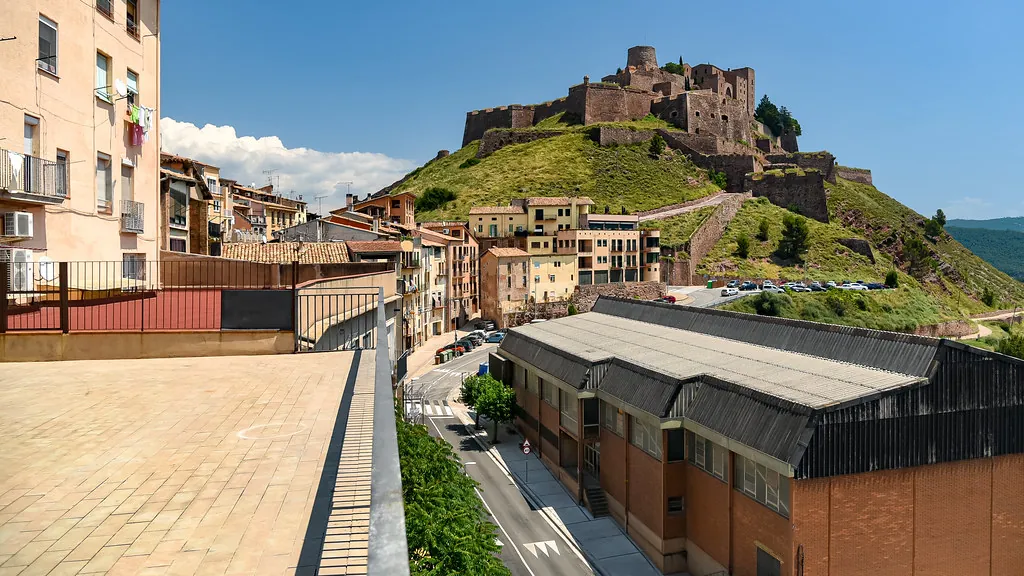
Known for the striking Santuario del Miracle and its baroque altarpiece.
Hide article Read full article
Arriving Where the Road Seems to End
Riner is the sort of place where you arrive and briefly wonder if you have taken a wrong turn. The road stretches on between fields, the houses thin out, and you begin to question the directions. And yet, this is exactly where you are meant to be.
Tourism in Riner revolves around that feeling. This small municipality in the comarca of Solsonès has around 269 inhabitants, scattered across traditional farmhouses and small clusters of homes. There are more tractors than foreign-registered cars. It does not feel like a tourist destination. It feels more like stepping into the everyday rhythm of a place that continues to function on its own terms.
The territory sits at roughly 800 metres above sea level, shaped by gentle hills. Nothing dramatic. The landscape resembles a slightly rumpled sheet: you climb a little, dip a little, and open fields are always nearby. Among them stand oaks and pines, with agricultural tracks linking one masia to another.
Stone houses define the scenery. Some have been restored, others look as though they have endured many winters without much concern for updating appearances. Thick walls, sloping roofs, courtyards where trailers or stacks of firewood still fit comfortably. Everything points to a place where, for centuries, the priority was working the land rather than presenting the village to visitors.
Sant Martí de Riner and the Scattered Masías
The church of Sant Martí de Riner acts as a reference point. It is not large, and it makes no attempt to be. It resembles the small country hermitages often found on rural walks: solid, simple and built to last.
Its origins are usually placed in the Romanesque period, although it has undergone alterations over the centuries. Thick masonry walls, small windows and a discreet bell tower give it a modest presence. It is not the kind of building that overwhelms you on arrival. Appreciation tends to come slowly, perhaps after sitting quietly nearby, listening to the wind or to the occasional car passing in the distance.
Beyond the main settlement, masías are spread across the municipality. Some are still inhabited by families who work the land or keep livestock. Others serve as second homes. They can be recognised by their stone doorways and narrow balconies. Many stand beside cultivated fields or along small rural tracks. Most are private homes, so observing from the path is enough.
There is no central square bustling with activity, no line of monuments competing for attention. The interest lies in how everything fits into the landscape and continues to serve a purpose.
The Solsonès Landscape Through the Seasons
The character of the Solsonès countryside becomes clear quickly in Riner. Cereal fields dominate, interspersed with patches of woodland and small hills that shift in colour as the year progresses.
In spring, the terrain turns green, almost like a freshly painted board. By summer, the cereal ripens to gold and the fields resemble a dry carpet that rustles when the wind passes through. Autumn darkens the land again, especially where the soil has been newly worked.
Walking along these paths has the feel of rural routine. It is like going for a stroll after Sunday lunch at a grandparent’s house in the countryside. There is no need for a strict plan. Follow one track, turn when it feels right, and head back as the sun begins to drop.
From some of the higher points, the land opens out towards the rest of the Solsonès and, on clear days, towards more distant mountain ranges. These are not marked viewpoints with information panels. They are simply stretches where the path widens and the scenery suddenly appears in full view, inviting a pause before carrying on.
Silence is part of the experience. The kind that is occasionally broken by a tractor somewhere far off, or by wind moving through the trees.
Walking and Cycling Without the Fuss
Riner suits those who want to walk without becoming fixated on named routes or signposted circuits. Agricultural tracks cross fields and small wooded areas. Some pass by old vegetable plots or springs that were traditionally used by local farmers.
Signage is not always clear. It helps to carry a map or have offline maps on a phone before setting out. Nothing extreme is required, but a bit of orientation goes a long way in a place where paths can look similar.
Cycling also fits naturally here. Secondary roads carry little traffic, and the gradients are gentle. These are not dramatic mountain passes. It feels more like pedalling along a quiet county road that climbs gradually for a while and then descends so gently you barely notice.
The terrain’s soft undulations make it approachable. Effort comes in small increments rather than steep bursts, and the open landscape means there is always something to look at while moving through it.
Eating and Local Produce
In a municipality this small, a wide-ranging dining scene is not to be expected. Daily life revolves far more around agricultural and livestock production than around serving visitors.
Across the wider comarca, lamb raised locally and traditional embutidos, Spanish cured sausages, are common. For a broader choice of places to eat or shop, it is usual to head towards nearby towns such as Solsona, where there is more movement and activity.
Riner itself remains focused on its primary work. Fields are cultivated, animals are tended, and life continues largely independent of tourism.
Is It Worth the Detour?
Riner does not function like those villages where you arrive, park, take a few photographs and feel you have seen everything within the hour. The experience is closer to visiting someone who lives in the countryside. The plan is simply to be there.
Walk for a while. Look at the fields. Listen to genuine quiet.
If the aim is to tick off monuments or wander through lively streets, it may feel sparse. If the interest lies in understanding how a rural comarca like the Solsonès actually breathes and operates, Riner makes sense. It is straightforward, calm and honest about what it is.
Sometimes that is more than enough.