Full Article
about Solsona
Capital of Solsonès; a baroque, episcopal city with rich folklore (giants).
Hide article Read full article
A town that notices your arrival
The first signal in Solsona is a bell. It rings out from the Torre de les Hores and the sound carries through the stone arcades, making its presence felt straight away. This is not a place where visitors slip in unnoticed. There is a sense of being quietly assessed, as if the town itself were deciding what to make of you.
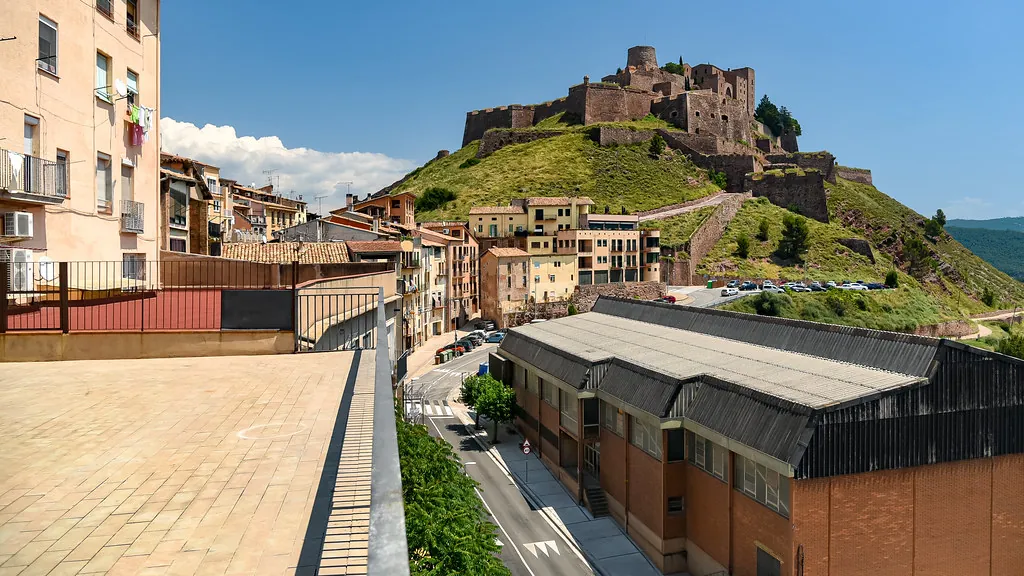
Solsona sits on a hill above the river Cardener, a tributary of the Segre. Here the water feels modest in scale, more like a steady domestic presence than a dramatic landscape feature. The old town clings to the slope in a tight network of steep streets, lined with ochre stone houses and baroque doorways that could belong to a historical drama.
What stands out is the absence of the usual tourist clutter. There are no souvenir shops at every turn, no background music drifting through the streets, no clusters of visitors posing for photos. Instead, the dominant sounds are footsteps and the occasional murmur of everyday life, a neighbour heading out to buy bread, a brief exchange under an archway.
A cathedral of many lives
The cathedral is the natural starting point. Its story is layered: it began as a Romanesque building, took on Gothic ambitions, and eventually settled into a Baroque appearance. The result feels slightly mismatched, though in a way that adds character rather than confusion.
Inside, the atmosphere is closer to a provincial basilica than to Spain’s grandest cathedrals. It does not aim for overwhelming scale, yet it holds attention. The main altarpiece stands out, an elaborate composition of gold and plaster that catches the light and draws the eye. Visitors often linger here, sitting quietly and looking up, with the faint scent of wax adding to the sense of stepping into another time.
There is an impression of history that once carried weight in daily life, when decisions made within these walls were believed to shape eternal outcomes. That feeling lingers, even if the pace of the present is much calmer.
When a donkey takes centre stage
If the visit happens in February, Solsona reveals a very different side. Its Carnival has a reputation for playful absurdity. The origin story centres on a donkey that entered the town hall in the nineteenth century. One version says it was thirsty, another suggests it had been drinking. Either way, the incident became legend.
Today, that story is recreated each year with a papier-mâché donkey hoisted up the bell tower. The figure spins above the square and releases water onto the crowd below, to loud applause. The scene is intentionally ridiculous, and that is precisely the point. Spectators join in knowing full well what is coming, and getting splashed is part of the experience.
Even outside Carnival, there is a sense of humour beneath the surface, though daily life is far more restrained. Solsona has long been an episcopal seat, and that heritage still shapes its tone. The town carries itself with a certain neatness, as if it still expects to be observed.
Under the arcades of the plaça Major, life unfolds at close range. People greet one another as they pass, stopping briefly to talk before moving on. The scale of the surrounding region, the Solsonès, is small enough that many of these encounters feel familiar. It gives the town a social rhythm that is easy to notice.
Modernism and quiet landscapes nearby
A short drive away lies Olius, home to a Modernista cemetery that feels strikingly different from anything in the town centre. Designed by Bernardí Martorell, a disciple of Gaudí, it combines stone and iron with a strong symbolic style. The result is both artistic and slightly unsettling.
Iron crosses twist into unusual shapes, and the tombs resemble sculptural works rather than conventional memorials. The atmosphere encourages a slower pace. Sound seems to carry more than expected, and even footsteps become noticeable in the stillness.
From there, the route can continue towards the Santuario del Miracle in the municipality of Riner. A Benedictine monastery was built here at the beginning of the twentieth century. The road winds through pine forests, gradually opening up to wider views.
At the top, the landscape shifts. Below lies the reservoir of the Llosa del Cavall, its surface broken by the surrounding mountains. From this vantage point, it appears almost like a fragmented mirror set into the terrain.
For those travelling by bike, the area offers several gentle routes. One of them, the route of les Moles, runs for several kilometres over fairly flat ground. It is the kind of ride that invites a relaxed pace, without much attention to distance or speed.
The trumfo and the taste of the region
Food in Solsona has its own local identity, beginning with the humble potato. Here it is known as trumfo, and the name carries enough weight to inspire its own traditions. In November, a fair is usually held celebrating both the trumfo and the black truffle, two products closely associated with the colder months in this area.
Beyond seasonal events, the everyday cooking reflects the region’s character. A typical dish is the carn d’olla de Solsona, a substantial stew made with meat, butifarra and vegetables. It is served in a clay pot and has a reputation for being filling enough to slow the day down afterwards.
Another local speciality is formatge de tupí, a sheep’s cheese matured with oil and sometimes a touch of liqueur. Its flavour is strong and can be surprising at first, though it tends to grow on those who try it more than once.
Meals here feel grounded rather than elaborate, shaped by climate and tradition rather than presentation. They match the pace of the town itself.
A place without urgency
Solsona does not rely on major attractions or dramatic highlights. There is no coastline, no large-scale infrastructure designed to impress, no constant push for attention. Instead, it operates on a quieter frequency.
Time passes without much insistence. Streets fill and empty gently, conversations overlap under the arcades, and the bell continues to mark the hours. The town leaves an impression that builds gradually, more like a familiar tune than a spectacle.
That understated quality is what defines Solsona. It does not try to compete with larger destinations, nor does it need to. The experience comes from settling into its rhythm, noticing its details, and allowing its character to reveal itself at its own pace.