Full Article
about Corbera Debre
Ocultar artículo Leer artículo completo
The church door is locked, but through a fist-sized hole in the wood you glimpse a single plaster saint still standing where the roof used to be. Above her, sky. Around her, walls scalloped by shrapnel. Nothing else has survived in the old quarter of Corbera d'Ebre except the silence, and even that feels provisional—broken only by the wind that moves through empty window frames like a latecomer to the service.
At 337 metres above the Ebro valley, the village is high enough for the air to thin and the light to sharpen. In July the plateau shimmers; by December the tramontana wind can skin knuckles raw. The climate is a compromise between coastal mildness and inland extremes—one reason why vines, not tourists, still dominate the slopes. Come in late April and you get the best of both worlds: mornings crisp enough for a fleece, afternoons warm enough to sit outside with a glass of garnatxa blanca while the stone releases its stored heat.
Two Towns, One Graveyard
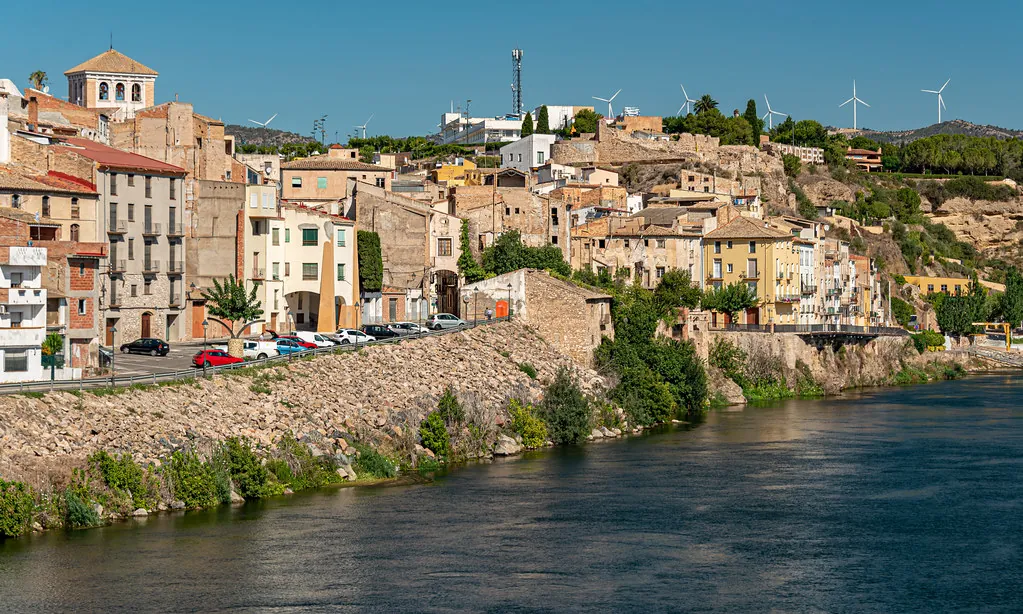
Corbera is really two settlements stacked on top of each other. After three days of bombardment in July 1938, the hill-top houses were abandoned overnight; in the 1940s the survivors simply walked downhill and started again. The new streets—low, whitewashed, sensible—now house 1,100 permanent residents, a post office, two bakeries and a school whose playground bells echo faintly up the slope. From the modern plaza you can reach the ruins in under ten minutes, but most visitors drive the paved service track that corkscrews to an upper car park. Skip this shortcut in August and you’ll understand why: the gradient is 18%, the sun is a fist, and the only shade belongs to a single fig tree halfway up.
Entry to the ruined quarter costs €2, paid to a caretaker who materialises at 10 a.m. and locks the gate again at 2 p.m. sharp. Winter weekends only; out of season you ring the mobile number taped to the booth and someone trudges up with the key. Once inside, you are free to wander a grid of roofless houses whose floor tiles still show the faded pigment of 1930s encaustic work—ox-blood red, cobalt, a green that might once have been jade. Signs advise caution; nothing is roped off, so mind the sudden staircases that end in thin air.
Photographers arrive early. At 8 a.m. the east wall of the church catches the sun full-on, every pockmark legible. By late afternoon the light flips, painting the valley vineyards in caramel and revealing the Ebro itself—a silver vein 6 km away that you could mistake for a road. Tripods are tolerated, drones less so; the caretaker once confiscated one that buzzed too close to the bell-less tower.
Walking the Front Line
The battle that froze Corbera in time was the Republic’s last major offensive. Between July and November 1938 the slopes around the village changed hands twice; trenches were dug into limestone so hard that pick-marks are still visible. Several way-marked trails start from the ruined quarter, the easiest a 5-km loop that drops to the river and climbs again through almond terraces. Expect loose scree, no shade, and the occasional rusted buckle half-buried in the path. Take more water than you think—guides report finding plastic bottles abandoned by hikers who underestimated the 30 °C dry heat of early May.
Maps are free from the interpretation centre four minutes’ walk below the car park. Inside, a scale model lights up in sequence to show troop movements; headphones offer George Orwell’s diaries in clipped English. The exhibition takes 25 minutes if you read everything, fifteen if you skim, but linger over the aerial photograph taken by a Luftwaffe reconnaissance plane on 2 August 1938. You can match each crater to the houses that no longer exist.
Cyclists use the same trails, though the terrain is better suited to gravel bikes than road machines. A popular half-day ride follows the old railway bed from Móra la Nova to Miravet, passing Corbera at kilometre 24. The gradient never exceeds 3%, but the wind can arrive like a slammed gate—locals joke that Terra Alta has two seasons: the tramontana and the mosquitoes.
What to Eat When the Past Has Killed Your Appetite
Back in the new town, Restaurant El Portal keeps lunch simple: grilled chicken, chips, and pa amb tomàquet—the Catalan answer to beans on toast. Their menú del día is €14 and they’ll produce an English menu without being asked. If you need something stronger, the cooperative cellar opposite the school sells Terra Alta whites by the litre. The garnatxa blanca is floral rather than oaky, closer to a dry Muscat than to Chardonnay; Brits who claim not to like Spanish whites are converted after the first sip. Bottles start at €4.50 if you bring your own carrier; they’ll vacuum-seal it for the flight home.
For pudding, try the pastisset de moniato, a sweet potato turnover that tastes like pumpkin pie without the spice. The bakery runs out by 11 a.m. on Sundays, so queue early behind the farmers who’ve come in from the fields still wearing their pruning knives.
Getting There, Getting Away
The village sits 45 minutes inland from the AP-7 toll road. Reus is the nearest airport (55 km), but most British visitors arrive hire-car in hand from Barcelona after a night in town. Roads are good until the final 12 km of the TV-3023, where tarmac narrows and stone walls press close—mirror-scraping territory for anyone used to British B-roads. In winter, fog pools in the valley; if the thermometer drops below 3 °C, carry chains—gritters are as rare as traffic lights.
Accommodation is limited. There are three small guesthouses, none with more than eight rooms. Book ahead for the May battle commemorations or the September wine harvest; otherwise you can usually find a bed the same day. Prices hover around €65 for a double, breakfast included. Don’t expect minibars or concierge services—Corbera still runs on the premise that if you need something, you ask at the bar.
The Upshot
Corbera d'Ebre will not entertain children who want flumes or Wi-Fi. Phone signal drops in the ruined quarter, and the closest supermarket is 14 km away in Gandesa. What it offers instead is a place where history has not been sandblasted for convenience. You can stand in a bedroom whose ceiling is now only sky, hear the cicadas restart their engine, and understand—in a way no textbook repeats—that war is not a story about armies but about roofs.
Come for two hours and you’ll leave haunted. Stay for two days and the valley starts to talk back: the scrape of pruning shears at dawn, the smell of wild thyme crushed under boot, the way the new church bell answers the old one that no longer rings. If that conversation sounds worth having, put Corbera on the map. If not, keep driving—the AP-7 will carry you south to the coast in time for cocktails, and the ruins will wait for someone else to notice the hole in the door.