Full Article
about Mora Debre
Ocultar artículo Leer artículo completo
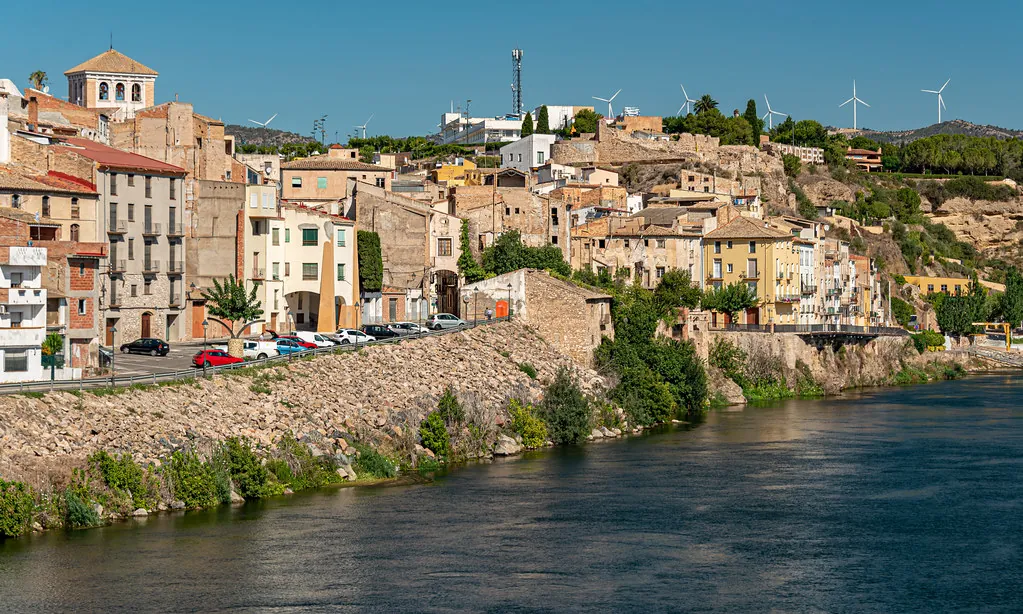
The river turns so sharply at Mora d’Ebre that the town is almost wrapped in a single loop of water. From the medieval ridge you can watch the Ebro change colour three times a day—steel at dawn, jade by lunchtime, bronze when the low sun hits the poplars. At barely 38 m above sea level the village sits lower than most of Britain’s canal towns, yet the surrounding cliffs give it the feel of a gorge settlement. The result is a micro-climate: mornings soft enough for almonds to set, afternoons hot enough to ripen peaches the size of cricket balls.
A Bridge, a Bombardment, a Market
The twentieth-century suspension bridge is the first thing you see, its slender deck strung between sandstone bluffs like a harp. Floodlights switch on at 21:30 sharp, and locals stroll out after supper to watch the reflection wrinkle with carp. Walk to the midpoint and you stand directly above the 1938 front line; Republican and Nationalist trenches stared at each other from opposite banks during the Battle of the Ebro. Interpretation panels are bolted to the railing, short enough to read before a breeze carries your hat away. For deeper detail, the tiny interpretation centre on Carrer Major opens Tuesday to Saturday, admission €3, and will lend you a laminated map of bunkers on the southern ridge. Wear trainers; the footpaths are goat-narrow and the limestone flakes underfoot.
Back in the old quarter the streets are barely two arm-spans wide, engineered for mules, not SUVs. The church of Sant Joan was rebuilt after civil-war bombing; step inside and you’ll notice the baroque façade is actually a 1940s pastiche, the stone too clean, the saints too symmetrical. The square outside hosts Saturday’s fruit market: three stalls of tomatoes still dusty from the field, one knife-grinder who sings to himself, and a van dispensing fresh orange juice for €1.50 a glass. No fridge magnets, no sarongs, just the weekly shop.
River Time
Mora d’Ebre measures the day by water. Fishermen launch at first light, herons perched on their outboards like unpaid crew. By ten the kayaks appear, bright plastic beads threaded along the current. British families usually book the 10 km “family descent” starting 5 km upstream at Miravet; the water is Grade I, essentially a brisk float with one rapid loud enough to make children shriek. Pick-up is at the riverside car park beside the cooperative winery, so parents can load cases of Garnatxa Blanca straight into the boot. Morning slots are essential; after 13:00 the wind funnels up-river and progress becomes a paddle-powered slog.
If you prefer to stay dry, follow the riverside promenade west for 25 minutes to the platja fluvial, a crescent of coarse sand dredged each spring. The water is slow, chest-deep at its deepest, and watched by lifeguards July–August. Weekends fill with multi-generational Spanish families who will offer you slices of watermelon in exchange for help inflating lilos. British visitors report the cleanest river swim of their trip—just don’t expect loos; there’s one portable cabin and the queue is long after 11.
Heat, Hills and History
Summer temperatures flirt with 38 °C, and the streets empty from 14:00 to 17:00. August is worst: half the restaurants nail plywood over their doors and head for the coast. Spring and early autumn are kinder—mid-twenties, nights cool enough for a cardigan, almond blossom or autumn crocus colouring the bluffs. Winter is mild by British standards (daytime 12–15 °C) but the mist lingers like wet wool and the bridge lights look spectral through it. Parking is free year-round on Passeig de Ribera, a plane-tree strip that keeps the car cool; from there it’s a flat five-minute push into the centre—handy if you’ve loaded up on olive oil and are worried about clutch smell.
History buffs should tackle the 6 km ridge loop south of town. Start at the signposted corral de las trincheras; within ten minutes you’re among stone-lined dug-outs still scarred by shrapnel. The route is way-marked but faint—download the free Wikiloc file before you leave Wi-Fi. Take water; the only fountain is back in the village and the hillside reflects heat like a bread oven.
What to Eat, When to Eat It
Kitchens shut 16:00–20:00 sharp. Attempting to order dinner at 18:30 is like trying to buy a pint in a British pub at 10:55 on a Sunday morning—technically possible, culturally awkward. Evening service begins at 21:00; if children need feeding earlier, head for Bar Milano on the riverfront, where toasted sandwiches appear until 22:30 and staff tolerate Lego on the floor.
Restaurant Les Coques does a restrained paella de mar i muntanya—chicken, crayfish, no rabbit bones to negotiate. Coca de recapte, the local flatbread, arrives cut into rectangles: roasted aubergine, red pepper and butifarra sausage on a base thinner than a Ryvita—easy comfort food for fussy teens. Calçots, the long spring onions, are available January–March; bibs are compulsory and locals will cheerfully demonstrate the dipping-and-slurping technique. Dessert is crema catalana, cinnamon-heavy; ask for the blow-torch to be applied table-side if you like theatre with your sugar crust.
Wine lists favour Terra Alta whites—Garnatxa Blanca light enough for lunchtime, cheaper than water in some bars. Brits used to New-World labels may find the flavour shy, but it’s the perfect foil for grilled sardines and costs under €14 a bottle in the cooperative shop.
Getting There, Getting Out
Reus is the nearest airport: 75 minutes on the AP-7 then the C-12 river road, a drive that suddenly feels like Provence when the almond trees flower. Barcelona El Prat adds thirty minutes but offers more UK routes. Car hire is essential; public transport means a train to Móra la Nova, 4 km away, then a taxi that may or may not answer the phone. Roads are good until the final roundabout where sat-navs panic—ignore the lady and follow signs for “Poble” not “Polígon”.
Leave space in the boot for olive oil—five-litre cans are €18 at the cooperative—and a couple of bottles of Priorat if you detour west. The village’s Monday-morning market is mostly clothes; the real food action is Saturday, so plan your journey home accordingly.
Mora d’Ebre will not change your life. It offers no infinity pools, no Michelin stars, no sunset drum circles. What it does give is a place where the river still dictates the timetable, where the bakery knows every child by name, and where a British accent earns a nod rather than a surcharge. Turn up with reasonable Spanish, a tolerance for late meals, and a willingness to walk the bridge twice a day, and the town will treat you like extended family—just don’t expect them to open the kitchen before nine.


