Full Article
about Constantí
Town with major Roman heritage, including the Centcelles villa and its unique Early Christian mosaics.
Hide article Read full article
A bend in the Francoli
The name Constantí is often linked to the emperor Constantine, although there is no evidence he ever came this way. The setting is better explained by geography. At this point, the river Francolí curves into a wide meander, leaving a strip of fertile land along its right bank. That small agricultural valley, very close to the ancient city of Tarraco, was too valuable to remain empty. The Romans settled here early on and established a rural complex that still shapes how Constantí appears in discussions of ancient art.
This relationship between river, soil and settlement continues to define the place. Even now, the surrounding landscape reads as productive land rather than a backdrop, and the proximity to Tarragona, the Roman Tarraco, helps explain why such a site would have mattered.
The mosaics of Centcelles
The Roman villa of Centcelles is the main reason many people make their way to Constantí. At first glance, it does not look especially imposing. The principal building resembles an agricultural structure more than a Roman monument, with stone walls, a pitched roof and a notably restrained appearance.
Inside, however, the character changes. A domed chamber preserves mosaics from the 4th century that are often cited among the earliest examples of Christian art in the Roman world. The decoration includes hunting scenes, human figures, geometric motifs and images associated with early Christianity. Among them is a representation of Christ flanked by apostles.
The full interpretation of this iconographic programme remains under debate. For a long time, the building was understood as a mausoleum linked to a high-ranking figure in late Roman Tarraco. More recent research suggests it may have been a residential complex with changing functions over time. What is not disputed is its importance. The site forms part of the World Heritage listing connected to ancient Tarraco.
A visit is fairly short. Most of the attention centres on the domed room, and it is worth allowing a moment for your eyes to adjust to the low light before trying to pick out the individual scenes.
Layers of the medieval town
The present-day town stands on earlier layers, something common in settlements across the Camp de Tarragona. Remains of the medieval fortifications survive in fragments. The walls are documented from the 13th century and were later reinforced. Today, the most visible element is a tower incorporated into Carrer de Sant Pere. It can easily go unnoticed without prior knowledge of what it is.
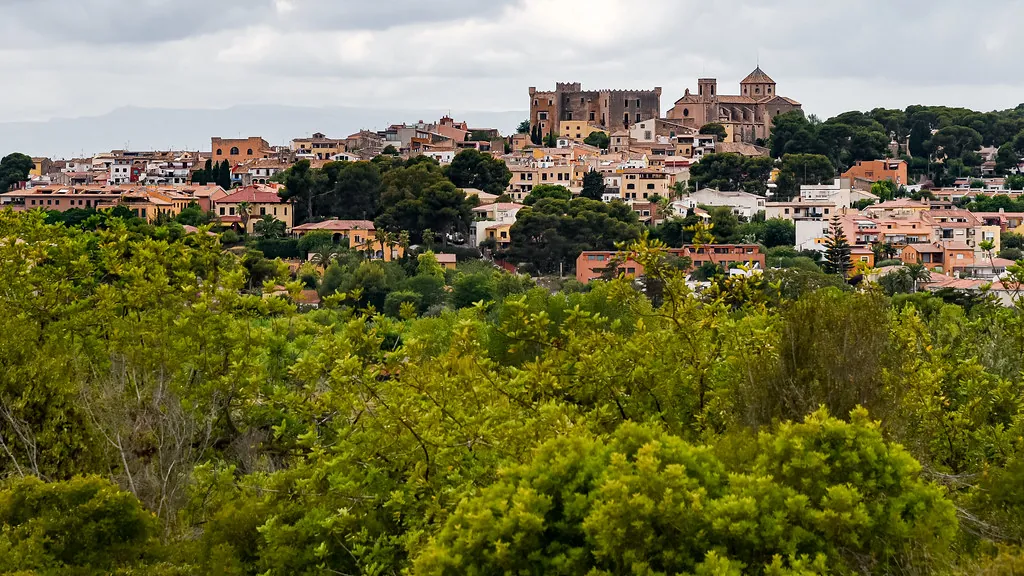
The church of Sant Feliu, completed in the 17th century, follows a fairly restrained neoclassical style. Its interest lies less in its architecture than in its position. It stands on the highest part of the town. From nearby, the logic of the settlement becomes clear: the valley of the Francolí stretches out towards Tarragona, while cultivated fields occupy much of the immediate horizon.
These elevated views help place Constantí within its surroundings. The town is not separate from the land around it, but closely tied to it, both historically and in its present layout.
Vines, cooperative life and the seasons
The landscape around Constantí remains distinctly agricultural. Vineyards, plots of hazelnut trees and other cultivated fields line the roads leading out of the town. The local agricultural cooperative continues to play a central role in the economy, something still reflected in the rhythm of the farming calendar.
Wine forms part of this tradition, although there is no strong visitor-focused narrative built around wineries here. Production tends to be channelled through the cooperative and nearby farms, rather than presented as a tourist experience.
In winter and early spring, another element closely tied to the area comes into view: the calçotades. These gatherings revolve around calçots, a type of spring onion typical of Catalonia, grilled directly over an open flame. They are usually organised in private homes or on family plots, following a long-established custom in the Camp de Tarragona. The format is simple: calçots, romesco sauce, toasted bread and local wine.
Getting there and moving around
Constantí lies a short distance from Tarragona and can be reached by car in a matter of minutes from the city. There are also road connections with the interior of the Camp region.
The centre of the town is easy to explore on foot. From the main square, the church is quickly reached, and with a small detour, the medieval tower as well. The Roman villa of Centcelles sits on the outskirts, surrounded by fields.
It is advisable to check opening times in advance for the archaeological site, as they can vary depending on the time of year. Beyond that, a visit to Constantí tends to be calm and relatively brief. The town continues to function primarily as an agricultural municipality near Tarragona, with its Roman heritage appearing almost unexpectedly among the cultivated land.