Full Article
about Salomó
Famous for its Baile del Santo Cristo, declared a Festive Heritage Element of National Interest
Hide article Read full article
A Small Settlement in the Interior of the Camp de Tarragona
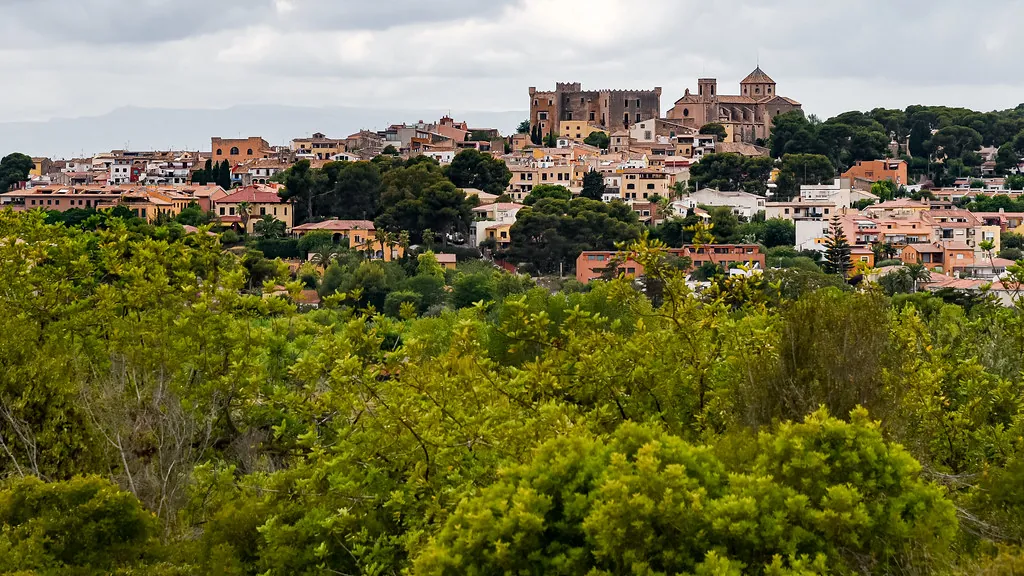
Salomó appears in medieval documents linked to the settlement of the interior of the Camp de Tarragona. After the Christian conquest in the 12th century, small communities such as this were organised around parish churches and farmland that supplied nearby cities, especially Tarragona. The pattern has never entirely disappeared. Salomó remains a small village surrounded by fields, where the rural scale still shapes daily life.
With just over 500 inhabitants, Salomó lies in the inland part of the Tarragonès, away from the better-known coastal strip. The landscape here is defined by dry farming. Vineyards, almond trees and some olive groves spread across the gentle hills that encircle the village. These crops have been present for centuries in this part of Catalonia. They explain both the local economy and the shape of the land itself.
The agricultural calendar can still be read in the fields. Almond trees begin to blossom towards the end of winter. In summer the vines dominate the view. Autumn brings the grape harvest, one of the oldest tasks in the comarca, or county, and a reminder of how long viticulture has been rooted in this area.
Sant Esteve and the Village Core
The main building in Salomó is the parish church of Sant Esteve. The origins of the church date back to the Middle Ages, although its current appearance reflects later alterations, probably from the early modern period. It is not a monumental structure. Its importance is historical rather than architectural, as for centuries the parish organised much of the village’s social and administrative life.
Sant Esteve stands in the centre of the settlement. Around it cluster the oldest streets, irregular in layout and shaped by slow, gradual growth rather than formal planning. Some houses still preserve stone doorways and elements of traditional architecture typical of agricultural villages in the Camp de Tarragona.
The old quarter is small enough to grasp in a short walk. There is a central square, the church and a handful of streets opening out towards what were once rural paths leading to the surrounding fields. The scale makes it easy to understand how the village functioned: compact, practical and closely tied to its farmland.
Farmhouses and an Agricultural Landscape
Scattered around Salomó are several masías, traditional Catalan farmhouses. These rural houses formed part of family-run agricultural holdings that combined vines, cereals and almond trees. Some remain inhabited or connected to farming activity today.
This pattern of dispersed settlement has been common in the Camp de Tarragona since the early modern period. It allowed families to work plots of land at some distance from the village centre without giving up life in the community altogether. The result is a landscape where isolated houses sit among fields of dry crops and low hills.
Walking along the agricultural tracks helps make sense of this relationship. The houses, the fields and the slight rises in the terrain are closely linked. The land is not dramatic, but it is clearly shaped by centuries of cultivation.
Rural Paths Between Vineyards
A network of rural paths connects Salomó with nearby municipalities such as La Nou de Gaià and Nulles. For generations these routes were used for farm work and for exchanges between villages. They form part of an older system of communication that predates modern roads.
The relief is gentle, with no major slopes. From some of the higher points, on a clear day, the horizon stretches as far as the Mediterranean. The sea remains distant, but its presence can be sensed in the wider geography of the Tarragonès.
These paths cross a landscape that has been carefully worked. Vineyards, almond plots and dry-stone walls mark out former properties. The stone margins, built without mortar, are a familiar feature in many rural areas of Catalonia and reflect long-standing agricultural practices.
Traditions That Continue
The main annual celebration, the festa major, is held in honour of Sant Esteve, the village’s patron saint. As in many small municipalities in Catalonia, it combines religious events with popular activities organised by local residents. The parish remains a reference point, even if village life today is no longer structured exactly as it was in the past.
In January Salomó celebrates Sant Antoni, a festival closely linked to the rural world. Traditionally it included the blessing of animals and gatherings in the square. Sant Antoni is widely associated in Catalonia with livestock and agricultural life, and its presence in the calendar reflects the village’s farming background.
Beyond the festivals, the rhythm of the year continues to follow work in the fields. Winter pruning, almond blossom at the end of the cold season and the grape harvest as summer draws to a close all mark the passage of time. Even for those not directly involved in agriculture, these cycles remain visible in the surrounding landscape.
Understanding a Visit to Salomó
Salomó can be explored quickly. The interest lies less in individual monuments and more in understanding the context: a small agricultural settlement in the interior of the Tarragonès that has changed less than other villages closer to the coast.
A walk through the centre followed by time on the surrounding paths is usually enough to get a sense of the place. The compact old quarter reveals how the village grew around its church and square. The tracks leading outward show how closely the community has always depended on dry farming.
Those interested in rural architecture can look out for old stone doorways on some houses and for the dry-stone walls that still divide many fields. They are modest features, yet they speak clearly of continuity.
Salomó does not present itself as a destination of grand sights. It offers something quieter: a view of inland Catalonia shaped by vineyards, almond trees and parish life, where the agricultural calendar still leaves its mark on the land.