Full Article
about Vilallonga del Camp
Agricultural and industrial municipality with a much-venerated Roser hermitage and a cinema museum.
Hide article Read full article
Vilallonga del Camp announces itself with a smell.
Arrive on a Saturday morning and the first thing in the air is hazelnut. Not the synthetic sweetness of ice cream flavouring, but the real scent, like hazelnuts toasted in a frying pan at home, the aroma that clings to clothes long after you have left the kitchen. In Vilallonga del Camp, that smell appears almost at once.
It makes sense. Here, hazelnut trees are not a decorative feature in the landscape. They are part of the working fields that surround the village and support much of the area. The scent is simply a by-product of daily life.
A Village That Shifted Its Ground
Vilallonga has a story attached to its layout. According to local tradition and some medieval documents, the settlement did not always stand exactly where it does today. At the end of the 13th century, during the reign of Peter II the Great, the centre was reorganised and the population moved slightly from its original site.
This was no orderly relocation in the modern sense, but it explains something you notice when walking through the centre. The street plan is fairly regular. Roads do not twist into a maze and the whole place feels laid out with a certain logic, as if at some point someone decided to keep things simple.
Dominating the village is the church of Sant Martí. Construction began at the end of the 18th century, and there is a clear ambition to build something substantial for what was, and remains, a small community. The façade leans towards the baroque, with generous ornamentation. Step inside and the atmosphere changes. The space is more restrained and filled with light, already moving towards a neoclassical style. That contrast is common in churches of the period. Projects often began with one artistic intention and adapted along the way to practical realities.
The result gives Vilallonga a focal point without overwhelming it. Sant Martí anchors the village, both visually and historically.
The Walk to the Ermita del Roser
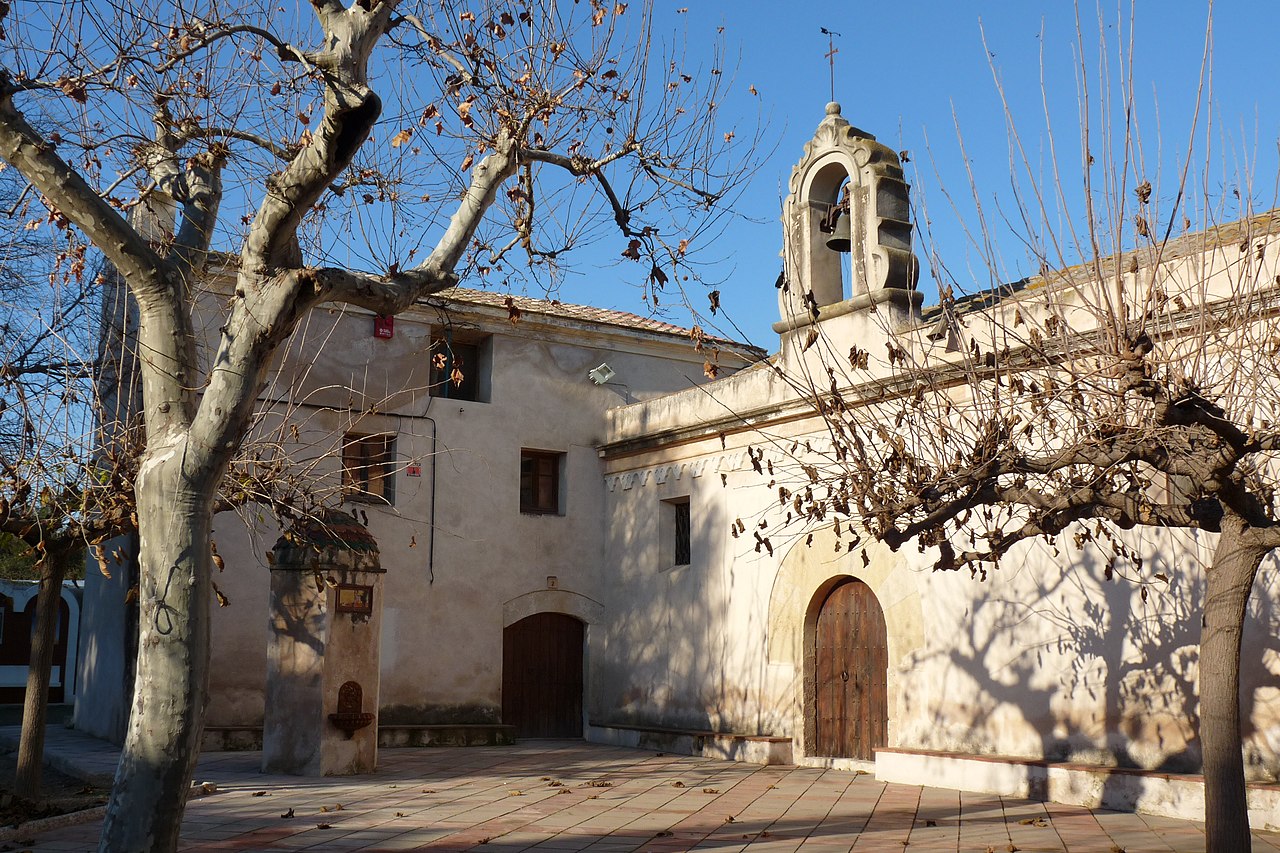
On the outskirts there is a short walk that locals know well: the path to the ermita of the Mare de Déu del Roser. From the centre, a track leads out and after roughly a kilometre you reach the small sanctuary.
On a map it looks straightforward. In reality, the wind that sweeps across the Camp de Tarragona can be forceful, and the final stretch tilts gently uphill. It is nothing dramatic, but neither is it a completely effortless stroll.
The chapel is often closed, which is typical of many small rural shrines. The real reward is outside. A stone bench offers a place to sit, and from there the agricultural patchwork of the Camp spreads out in front of you. Vineyards and hazelnut groves dominate the view, along with open fields. The village sits below, noticeably smaller than it seemed from the road.
It is the kind of spot where five planned minutes easily turn into twenty. There is little noise, only the wind and the sense of open space.
When Hazelnuts Take Centre Stage
Visit in autumn and you may coincide with the Fira del Roser, traditionally held at the beginning of October. This is not a market designed purely for weekend visitors. Farmers and local produce are at the forefront, reflecting what truly sustains the area.
Hazelnuts appear everywhere, worked into bread, folded into sweets and transformed into homemade liqueurs. Strike up a conversation with someone who grows them and you are likely to receive a compact lesson on varieties, harvests and how farming has changed in recent years.
Tasting a freshly picked hazelnut is a small revelation. It sounds trivial, yet it has the same effect as trying a really good tomato for the first time. Until you do, you may not realise how different something so simple can be.
The fair reinforces what the everyday smell already suggests. In Vilallonga, the hazelnut is not a symbol created for visitors. It is an essential part of local work and identity.
Giants in the Summer Square
During the summer festivities, Vilallonga brings its giants out into the streets. One of them represents Alfonso I the Chaste, the monarch who, according to tradition, granted the town its charter in the 12th century.
The ritual will be familiar across many towns in Catalonia. There are parades through the streets, live music, sardanas danced in circles and children watching the towering figures with a mixture of awe and curiosity. Sardanas, a traditional Catalan dance, are performed hand in hand in a ring, steps measured and communal.
As evening falls and the heat eases, the square fills with people talking as if it were their own front room. In a small village, that atmosphere is hard to describe from the outside. Most people know one another. Conversations drift from harvest prospects to whether there has been enough rain this year.
The giants, the music and the gathering in the square are not staged spectacles. They are extensions of the same daily rhythm that shapes the fields beyond the last houses.
The Quiet Appeal of Vilallonga
Vilallonga del Camp does not compete with the headline destinations of Catalonia. It does not have a vast old quarter or a single monument that defines it from afar. What it offers is something less showy and more grounded in routine.
In the morning, cars park in a hurry as someone rushes to work. A tractor passes down a street. Neighbours pause in doorways for an unhurried chat. Beyond the houses, hazelnut groves stretch out and remind you what much of this area depends on.
A visit works best at an unforced pace. Walk through the centre and notice the regular pattern of its streets. Head out along one of the surrounding tracks towards the fields or up to the ermita del Roser. Sit for a while and look across the landscape of the Camp de Tarragona.
Vilallonga may not fill an entire day with sights. Yet the memory that lingers is surprisingly vivid. It is the scent of toasted hazelnuts in the air, carried on the wind across vineyards and open ground. For many places, that would be a minor detail. Here, it tells you almost everything you need to know.