Full Article
about Bellpuig
Historic town with a top-tier Renaissance convent and a motocross tradition.
Hide article Read full article
The mausoleum of Ramon Folc de Cardona-Anglesola occupies a side chapel in the convent of Sant Domingo. It stands slightly apart from the main visitor route and is often reached almost by chance. Behind protective glass lies the Renaissance sarcophagus: pale marble, finely carved reliefs and a calm, distinctly Italian air that feels unexpected in the middle of the Urgell plain. It is no exaggeration to say that one of the most notable Renaissance funerary sculptures in Catalonia is here, in Bellpuig, a municipality in the province of Lleida that many people know only for the road that cuts through it.
On weekdays the Plaça Major is usually quiet. Beneath the arcades of the town hall are some of the few patches of shade in the centre, and by mid-afternoon there may still be someone seated there waiting for the bus to Tàrrega. Bellpuig has not greatly altered its scale or pace. It continues to function as the agricultural hub for its immediate surroundings.
The Cardona family and the convent of Sant Domingo
Much of the town’s historical profile is explained by the presence of the Cardona family. In the late fifteenth and early sixteenth centuries, the lords of Bellpuig promoted a series of religious foundations and public works here, consolidating their authority across this part of the plain.
The convent of Sant Domingo is the principal expression of that ambition. Its foundation is linked to Ramon Folc de Cardona-Anglesola, who served as viceroy of Naples under the Crown of Aragon. The building is large for a municipality of this size and follows the Dominican model: a spacious church designed for preaching and a restrained cloister where the proportions between the galleries and the central courtyard create a notably balanced space.
In one of the side chapels stands the mausoleum of Ramon Folc de Cardona himself. It was made in Naples in the first third of the sixteenth century and later transferred to Bellpuig. The ensemble introduced a fully Renaissance sculptural language into Catalonia. Allegorical figures, heraldic shields and the composition of the sarcophagus respond more to the artistic climate of Italy than to the late Gothic style that still prevailed in many local workshops at the time.
It is not monumental in size, but it is in intent. The tomb reads as a public declaration of the political and military rank of the man it commemorates.
Bellpuig and the plain of Urgell
Bellpuig lies at the centre of the Urgell plain, a sedimentary depression shaped by the rivers Segre and Corb. For centuries this was harsh dry farmland, dominated by cereal crops and little else. Change came in the nineteenth century with the construction of the Canal d’Urgell, which allowed irrigation to spread across much of the comarca.
That hydraulic system transformed the local economy. The landscape is still defined by open fields, yet the arrival of water made it possible to diversify crops and stabilise harvests. A significant part of the town’s activity continues to revolve around agriculture and the services connected to it.
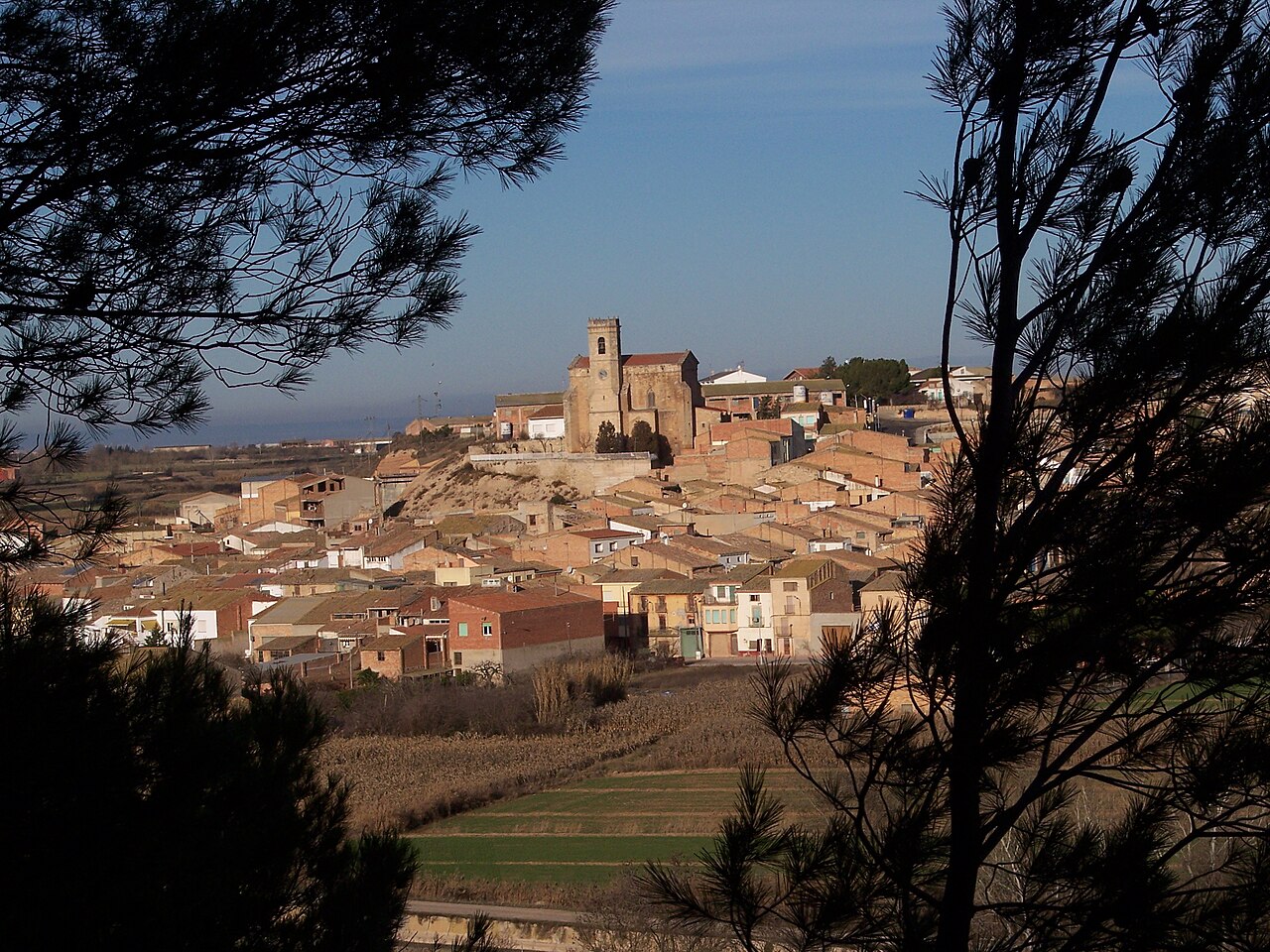
The urban layout reflects this logic. The main streets converge on the Plaça Major, where commercial exchanges were historically concentrated. The arcades are not decorative flourishes. They were built to shelter those selling or negotiating grain and livestock. On some houses along the carrer Major, large doorways can still be seen, once wide enough to allow carts to pass through.
The overall impression is of a settlement that grew in step with the needs of its surrounding farmland, rather than one shaped by defensive walls or industrial expansion.
The sanctuary of the Mare de Déu
On a small hill to the east of the urban centre stands the sanctuary of the Mare de Déu de Bellpuig. Local tradition traces the origin of this devotion back to the Middle Ages, although the current building dates from reconstructions carried out after the Civil War, when the previous structure was badly damaged.
The climb is short and ends at an atrium overlooking the entire municipal area: the town centre, the agricultural warehouses on the outskirts and the continuous stretch of fields that characterises this part of Urgell.
The venerated image is a small Gothic alabaster carving. Its proportions, with a somewhat large head and hands, recall other devotional sculptures from the fourteenth century. Among local residents it is often known as the Moreneta de l’Urgell, a reference to the darker tone the stone has acquired over time.
The sanctuary connects the town to a devotional landscape that extends beyond its streets and squares, linking cultivated land with older religious traditions.
A nearby excursion: les Avellanes
Some distance from Bellpuig, in the direction of La Noguera, stands the monastery of Santa Maria de Bellpuig de les Avellanes. It does not belong to the municipality, yet it forms part of the same historical landscape of the inland plain of Lleida.
Founded in the twelfth century by Premonstratensian canons, the monastery gained particular relevance during the Early Modern period. Several of its abbots, especially in the eighteenth century, assembled notable libraries and maintained correspondence with scholars of their time. The church retains the austere character typical of the order, although the architectural complex underwent reforms in different stages.
Together with the convent of Sant Domingo in Bellpuig, it helps to situate the town within a wider network of religious institutions that shaped the cultural life of the region over centuries.
Practical orientation
Bellpuig lies between Lleida and Tàrrega, along the C-14 corridor. It also has a railway station, which connects it to the surrounding area.
The visit itself is straightforward and compact. The convent of Sant Domingo and its Renaissance mausoleum form the clear focal point. From there, the Plaça Major and the carrer Major offer a sense of how the town functioned as a local agricultural centre. A short ascent leads to the sanctuary of the Mare de Déu, where the view opens out across the fields of Urgell.
Bellpuig does not rely on spectacle or scale. Its interest rests on the contrast between a quiet farming town and a Renaissance monument conceived in the orbit of Naples. In the middle of the plain, behind a pane of glass in a side chapel, Italian marble tells a story that reaches far beyond the road that passes through the town.