Full Article
about Ciutadilla
Known for its imposing medieval castle overlooking the Corb valley; medieval atmosphere
Hide article Read full article
A Castle on the Cereal Plains of Urgell
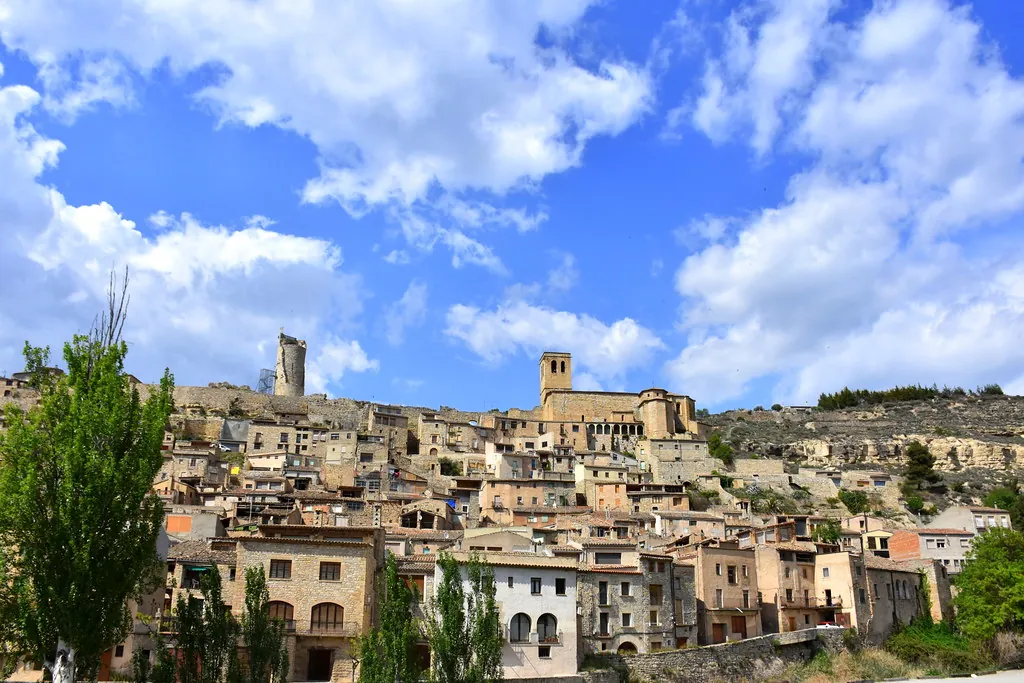
Ciutadilla sits on the wide plain that stretches around Tàrrega, in inland Catalonia. The landscape is open, defined by dryland crops and villages placed at a distance from one another. The first thing you notice is the castle. Its size seems disproportionate for a village of fewer than two hundred people, and it prompts the question of why it was built here, in this specific spot on the Urgell plain.
The comarca has been agricultural for centuries, and Ciutadilla’s layout reflects that history. The streets are short and practical, the houses built from local stone with a focus on utility rather than ornament. A few façades still show carved coats of arms, markers of the families who once managed the land and local affairs from here.
The castle doesn’t crown an isolated hill. It rises directly from the village, its main tower visible across the fields long before you arrive. Its presence anchors the settlement, both visually and historically.
The Castle and the Parish Church
The Castle of Ciutadilla has medieval origins but was largely reshaped during the Renaissance into a residential palace. The main tower still gives a clear sense of how territorial control was exercised across this flat terrain. The building has seen cycles of use and neglect, like many in the area, but its volume remains imposing against the low skyline of village roofs.
Beside it stands the parish church of Santa María. The building shows different construction phases, and the interior is sober, typical of rural churches in the comarca. Its importance is more communal than artistic, a space tied to the rhythm of village life rather than grand architecture.
Walking the streets, you see semicircular arched doorways, thick stone walls, and old agricultural buildings now part of homes. Ciutadilla doesn’t have a monumental old quarter. What it preserves is the logic of a farming settlement, where every lane and structure relates to work on the land.
From the edge of the village, the plain opens up. Cereal fields change from green to gold with the seasons, broken by lines of almond trees. On very clear days, you can make out the faint, distant line of the Pyrenees to the north.
Paths Around the Village
A visit here is short. After walking the central lanes and up to the castle, the natural step is to follow one of the agricultural tracks that circle the municipality.
These paths are flat, used by farmers and locals. They give you a proper sense of the scale of this landscape—broad and open, not dramatic. A bicycle is a good option for covering more ground.
The open fields are habitat for steppe birds and birds of prey that use the thermals rising from the plain. Birdwatching here is less about rare sightings and more about observing how species adapt to a farmland environment shaped over generations.
Ciutadilla fits into a wider exploration of the comarca. Tàrrega, a few kilometres away, is the service centre for the area. Other villages like Guimerà, with its intact medieval layout, or towns in the Sió valley such as Agramunt, are within a short drive. This village works as one point in a broader understanding of inland Catalonia.
Festivals and Community Rhythm
The summer Festa Major is the busiest time. It functions as an annual reunion for residents who live elsewhere. The schedule typically includes music and gatherings in the main square, bringing a different tempo to streets that are quiet for most of the year.
Other celebrations, like those around Christmas or the parish feast day, are community events first. They are brief periods where the sense of gathering returns, highlighting the contrast with the village’s usual calm.
How to Visit
Ciutadilla is reached by local roads from Tàrrega, crossing the agricultural plain. From Lleida, the drive takes about forty-five minutes.
The village centre can be seen in under an hour. Most visitors combine it with other points in the comarca. For overnight stays or a wider choice of meals, Tàrrega is the usual base.
Ciutadilla is defined by that initial contrast: a small community on a vast plain, watched over by a castle that seems to belong to a larger place. Its interest lies in that juxtaposition and in the quiet persistence of rural life here.