Full Article
about Guimerà
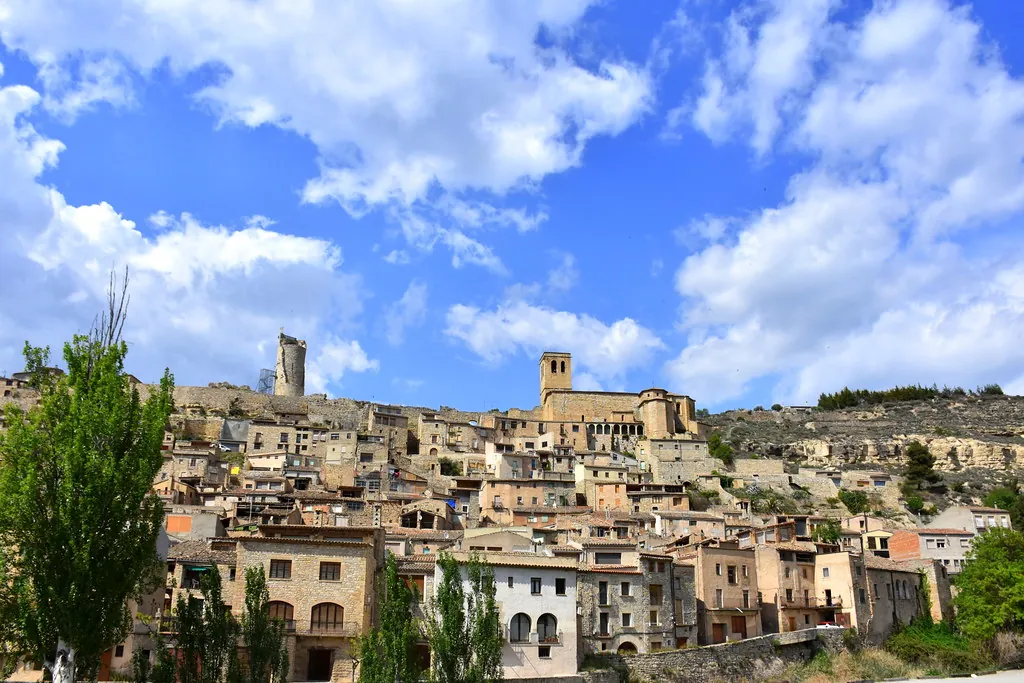
One of the prettiest medieval villages; maze-like streets and a castle on the hilltop.
Ocultar artículo Leer artículo completo
The bells of Santa María strike eleven just as a tractor coughs into life below the Gothic portal. For thirty seconds, medieval quiet gives way to agricultural reality, then the lane falls silent again. This is Guimerà in microcosm: a fortified hill-town where the Middle Ages survive not as costume drama but as daily backdrop for 255 permanent residents and the occasional stray tourist who has driven 45 minutes inland from Lleida.
A Hill That Still Keeps Watch
At 555 metres above the cereal-coloured Urgell plain, the village occupies the same strategic perch it held in the 14th century, when Catalan borderers needed warning of Aragonese trouble from the south. The difference today is that the only invaders arrive by hire car and usually leave before supper. English is scarce—one bar owner, two holiday-cottage hosts, and the retired teacher who sometimes gives impromptu tours—so smartphone translation apps prove more useful than guidebooks.
The urban fabric is intact enough to please purists: stone houses grow straight from bedrock, narrow lanes zig-zag uphill like a donkey track, and every second doorway frames a carved keystone or heraldic shield. Yet nothing feels manicured. Laundry hangs from wrought-iron balconies, geraniums occupy olive-oil tins, and the smell of wood-smoke drifts out of chimneys even in May. The effect is lived-in rather than museum-like, the architectural equivalent of a tweed jacket with elbow patches.
Park at the first widening of the access road; the upper streets taper to shoulder width and reversing downhill past a delivery van is not recommended. From the small gravelled square, a five-minute climb through the Portal de la Força brings you into the heart of the medieval nucleus. The gateway’s voussoirs are worn smooth by centuries of boots, and the groove for the portcullis is still visible—details that cost nothing to examine and provide more atmosphere than many paid heritage sites.
What You Actually Do Here
Sightseeing is self-paced and largely horizontal. Allow ninety minutes to circuit the core: up to the sober sandstone church, along the line where the wall once stood (houses now plug the gaps), then down past the 16th-century Casa de la Vila with its miniature balcony for proclamations. There is no ticket office, no audio guide, and—crucially—no souvenir gauntlet to run afterwards. The only commercial intrusion is a lone vending machine selling chilled almond milk outside the municipal storeroom.
Photographers should climb before breakfast. At dawn the east-facing slopes glow terracotta, while mist pools in the Segre valley below. By eleven the light flattens and the first day-trippers from the monastery route at Vallbona begin to clog the alleys, though “clog” here means six people and a dog. Bring water; public fountains exist but are intermittent, and summer temperatures can touch 35 °C even at this altitude.
Gentle walking routes strike out into the surrounding dry-farm landscape. A signed loop south to Rocallaura (5 km) threads between almond and olive groves, passing a derelict stone limekiln that children will insist is a smugglers’ hideout. The gradient is mild, shade scarce, so a hat and 500 ml of water per person are minimum kit. Spring brings drifts of yellow fennel and the clacking of stone-curlews; autumn smells of warm thyme and second-cut alfalfa.
Eating and the Afternoon Shutdown
Culinary options are limited but honest. Cal Porxo, the only full-service restaurant, opens its stone-vaulted dining room at 13:30 and stops taking orders when the daily produce runs out—often by 15:00. House specialities read like a Catalan farmhouse greatest-hits album: grilled lamb chops scented with rosemary, snails baked in clay with aioli, and the cold almond-garlic soup ajo blanco that tastes, to British palates, like liquid marzipan sharpened with garlic. Vegetarians can request escalivada (smoky aubergine and pepper) or the local white beans stewed with saffron. A carafe of Costers del Segre red rarely breaks €12 and slips down like a mellow Côtes du Rhône.
Outside July and August the village subscribes to the provincial siesta with evangelical zeal. Bars pull metal shutters at 14:00; the grocery—one room doubling as post-office counter—reopens at 17:00 but stocks little beyond tinned tuna, cured sausage and ice-cream. Smart visitors stock up in Tàrrega’s supermarkets 12 km away before tackling the mountain road. Cash is king: the nearest ATM is equally distant, and the grocer cannot process cards for less than €10.
Festivals and the Other 50 Weeks
Guimerà’s calendar contains two spikes of excitement. The Medieval Fair, last weekend of July, hauls in craft stalls, falconry displays and a battalion of sword-swirling re-enactors. Overnight population quadruples, parking backs up to the C-1412 junction, and the stone acoustics echo with drums until midnight. August’s Festa Major is more neighbourhood affair: outdoor sardana dancing, communal paella under fairy lights, and a late-night disco in the football field that the older residents pretend not to hear. Both weekends are fun if you like crowds; otherwise treat them as periods to avoid.
For the remaining fifty weeks the village reverts to hush. In January thin sunshine brushes the roofs and daytime highs hover at 8 °C; by April almond blossom froths over the terraces and thermometer readings double. Winter can bring a fleeting dusting of snow that turns the access road entertainingly slick; chains are rarely needed but second-gear momentum is your friend. Summer nights remain warm enough to sit outside until past ten, though mosquitoes from the irrigation channels rise with the moon.
Practicalities Without the Bullet Points
Driving remains the only realistic approach. From Reus airport allow 75 minutes: pick up the A-2 towards Lleida, peel off at Bellpuig, then follow the LV-3021 as it narrows, twists and finally spits you out above the plain. Car hire desks at both Reus and Lleida keep normal commercial hours; petrol stations on the A-2 close earlier than British motorway services, so refill before the exit ramp. Buses from Lleida reach neighbouring Tàrrega twice daily but terminate there, leaving a €25 taxi ride up the hill.
Accommodation is dispersed rather than centralised. Four stone houses have been sensitively split into tourist apartments—think beams, thick walls and wood-burning stoves—while two private rooms operate under the rural tourism scheme. Expect €70–€90 per night for a two-bedroom flat, less out of season, with Wi-Fi that copes with email but wilts under Netflix. Breakfast provisions (coffee, ensaïmada pastry, fresh orange juice) are left in the fridge; after that you’re on your own.
Parting Shot
Guimerà will never tick the “must-see” box for travellers who equate value with volume. It offers no beach, no cathedral, no Michelin stars. What it does give, generously, is silence broken only by church bells and swifts, stone that has stayed put for six centuries, and the mild epiphany that somewhere still exists where life’s rhythms follow the almond harvest rather than the algorithm. Turn up with modest expectations, a phrasebook and an elastic sense of time, and the hill will return the favour.




