Full Article
about Bausen
The northernmost village in Catalonia; known for its beech forest and the lovers' legend.
Hide article Read full article
At the Western Edge of the Val d’Aran
Tourism in Bausen begins with its position on the map. This small municipality lies at the far western end of the Val d’Aran, very close to the French border and slightly removed from the valley’s main routes. At around 930 metres above sea level, the village rests on a gentle hillside surrounded by meadows and Atlantic woodland.
The population numbers only a few dozen residents. That scale shapes everything. Walking through its streets, there is an evident sense of calm that reflects both its size and its distance from the busier settlements on the valley floor.
Bausen has never played a central role in the Val d’Aran in the way that other towns have. Historically, life here revolved around livestock and the use of mountain resources. The layout of the village reflects that past. It is small and compact, with paths that lead directly out towards bordas, hay meadows and mountain trails.
Visitors who make the journey tend to do so out of curiosity, or because they want to explore the quieter villages of the valley. Bausen still maintains a close, direct relationship with the landscape that surrounds it, and that connection is clear as soon as you step beyond the last houses.
Stone, Slate and a Small Chapter of History
The parish church of Santa María occupies a slightly elevated position within the village centre. Its origins are Romanesque, although like many Pyrenean churches it was altered over the centuries. Rather than a monumental building, it acts as a visual reference point and a focal point for the community’s history.
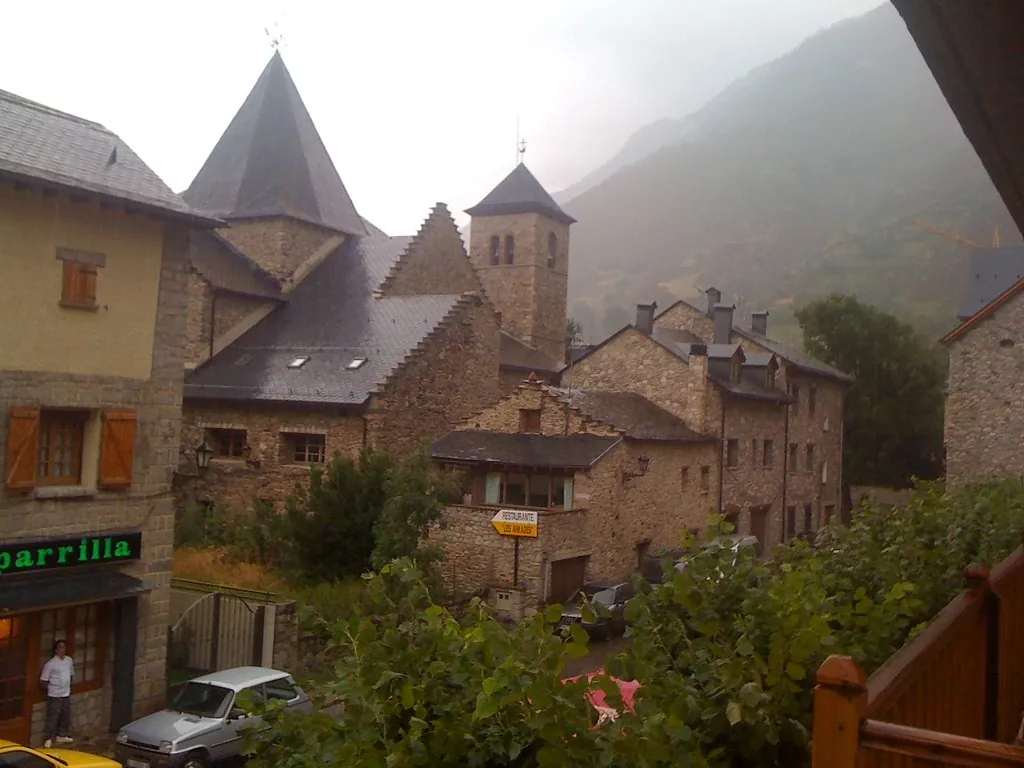
The rest of Bausen follows architectural patterns shaped by climate and terrain. Stone houses with slate roofs line the narrow streets. Many have wooden balconies and thick walls designed to withstand the long winter months typical of the Pyrenees. The overall effect is practical rather than decorative, rooted in the demands of mountain life.
On the outskirts stand the bordas, traditional rural constructions linked to hay storage and livestock. For generations they formed an essential part of the local domestic economy. Their presence reinforces the sense that this is a place built around seasonal agricultural rhythms rather than trade or large-scale development.
There is also a small but striking episode in Bausen’s local history. At the beginning of the twentieth century, the community built a civil cemetery so that a local woman, who had been denied religious burial, could be laid to rest. The cemetery still exists today and is often mentioned as an unusual collective gesture for its time. It adds a human dimension to the village’s story, one rooted in solidarity and shared decision-making.
Forests, Meadows and Mountain Paths
Bausen stands in a part of the Val d’Aran where woodland dominates the slopes. Beech and fir forests cover much of the surrounding terrain, alternating with open meadows near the inhabited core. The Atlantic moisture that enters from France is particularly noticeable here and explains the density and lushness of the vegetation.
Paths leading out of the village connect with old livestock and forestry routes. Some cross long stretches of forest, where the canopy filters the light and the ground often remains damp. Others open out onto prairies that offer a clearer sense of the village’s position on the hillside.
These are not alpine routes in the dramatic sense sometimes associated with the Pyrenees. Instead, they are representative of the wetter side of the Aranese Pyrenees, where greenery and shade define the experience. The landscape feels enclosed and textured rather than vast.
Autumn brings another seasonal activity. It is common to see people walking these woods in search of mushrooms. Foraging has a long tradition in the valley, though anyone interested should check the current regulations before collecting. The practice is part of local rural culture, closely tied to knowledge of the forest and respect for its cycles.
Community Life in a Small Village
As in many small villages in the Val d’Aran, much of Bausen’s communal calendar centres on the summer months. That is when residents who live elsewhere during the rest of the year return, and when patron saint festivities are typically held. These celebrations function above all as opportunities for families to gather and reconnect.
Across the Val d’Aran there are also seasonal festivities linked to fire and the changing of the seasons. Some are connected to the well-known Pyrenean fallas, traditional fire celebrations that take place in different villages depending on the year. These events form part of a cultural heritage that remains active in the valley. Although not specific to Bausen alone, they are part of the broader context in which the village participates.
Life here does not revolve around large events or visitor attractions. Instead, it follows the rhythms of a small mountain settlement where continuity matters more than spectacle.
Reaching Bausen and Practical Notes
The usual access to the Val d’Aran from the southern side is via the Vielha tunnel. Once in the valley, the route continues towards the lower course of the Garona river before turning onto a local road that climbs up to Bausen. The final kilometres include bends and narrow stretches, typical of hillside villages in the Pyrenees.
The village itself can be explored in a short time, and it is best discovered on foot. Anyone planning to walk along the nearby paths should wear suitable mountain footwear, even for relatively short outings. The ground tends to remain damp for much of the year due to the Atlantic influence.
Bausen has limited services. It is practical to organise shopping or refuelling in larger towns in the valley before driving up. The appeal of coming here lies elsewhere. It offers a chance to understand how a small Pyrenean village functions, slightly apart from the most travelled routes of the Val d’Aran, and closely tied to its landscape and traditions.