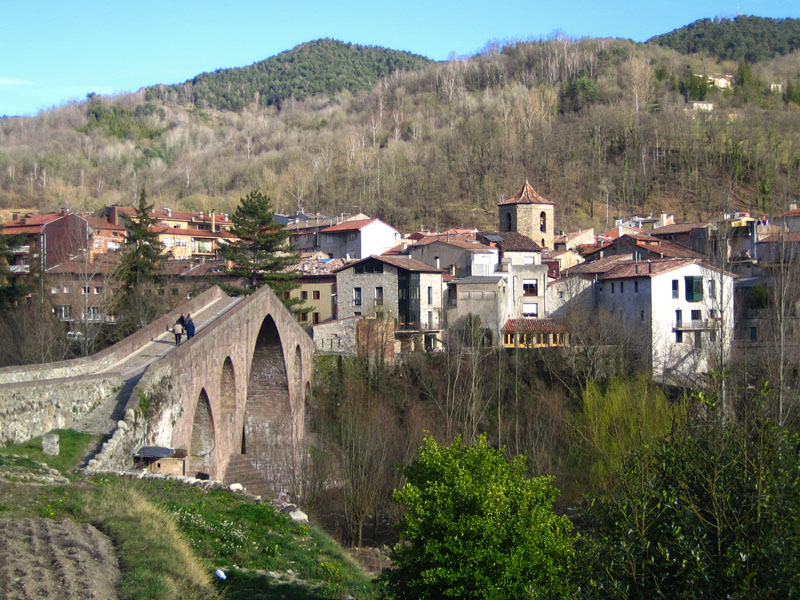
Una noia posant a l'antiga construcció medieval anomenada Eth Casteret, al municipi de Bossòst.jpg
Antoni Bartumeus i Casanovas · Public domain
Cataluña · Sea, Mountains & Culture

Bossòst

The Garona river is barely 35 kilometres old when it reaches Bossost, still narrow enough to leap across in places if you're reckless. Stand on the...

1,189 inhabitants · INE 2025
710m Altitude

Why Visit

Mountain Church of the Purification Rafting

Best Time to Visit

year-round

Main Festival (August) agosto

Things to See & Do
in Bossòst

Heritage

  • Church of the Purification
  • Portilhon
  • Garonne Promenade

Activities

  • Rafting
  • Cycling (Portilhon)
  • Shopping

Festivals
& & Traditions

Fecha agosto

Fiesta Mayor (agosto), Feria de Bossòst (octubre)

Las fiestas locales son el momento perfecto para vivir la autenticidad de Bossòst.

Full Article
about Bossòst

Tourist and commercial town on the Garonne; noted for its Romanesque church and mountain pass.

Ocultar artículo Leer artículo completo

A Valley That Doesn't Do Pass-Through

The Garona river is barely 35 kilometres old when it reaches Bossost, still narrow enough to leap across in places if you're reckless. Stand on the stone footbridge at dawn and you'll see the water has the colour of gunmetal, carrying snowmelt from peaks that hide France just seven kilometres upstream. This is the last village in the Val d'Aran before the Portilhon pass, and it behaves like it—half Spanish administrative formality, half frontier trading post where Occitan greetings slip naturally between Catalan vowels.

At 710 metres Bossost sits lower than most Pyrenean resorts, which means winters arrive late and leave early. The compensation is a gentler climate for most of the year; almond trees flower in March when Baqueira's lifts are still running. Stone houses shoulder together along lanes barely two metres wide, their slate roofs angled to shed the Atlantic storms that funnel up the valley. Heraldic shields carved in grey granite date from the fifteenth century, when mercenary soldiers returned from French wars and built houses thick enough to withstand both weather and politics.

Church, River, Market: The Daily Triangle

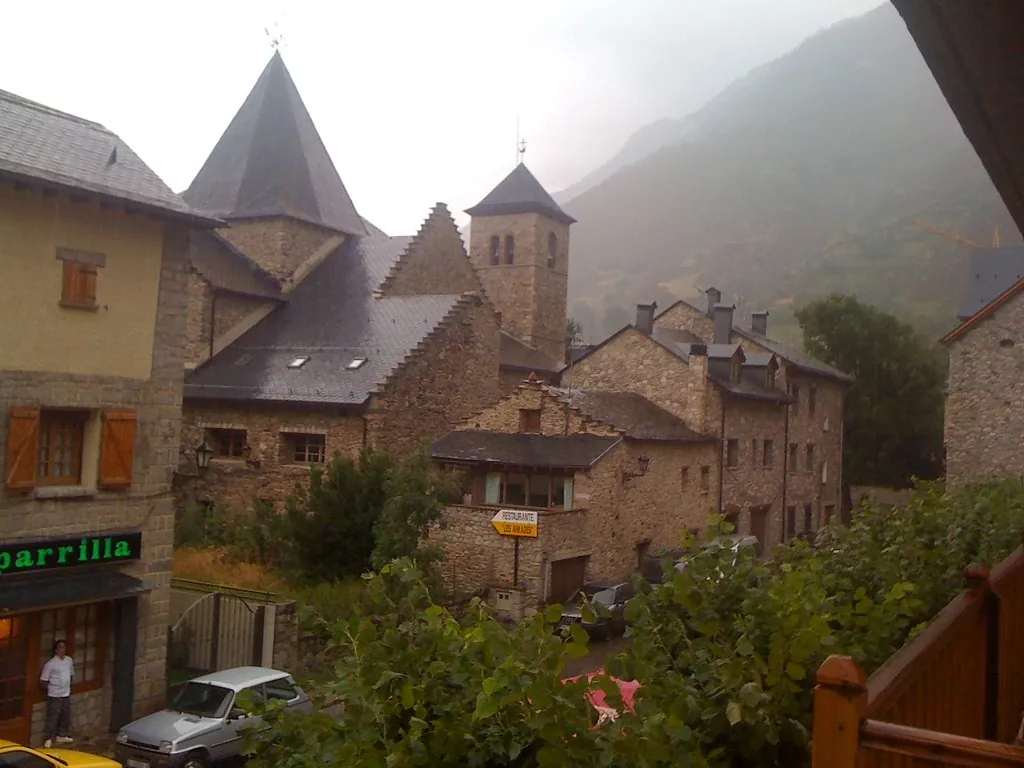
The Romanesque tower of Santa Maria de la Purificación rises octagonal, a style particular to Aranese churches designed to shed snow. Inside, the air smells of beeswax and damp stone; twelfth-century capitals show rabbits being chased by hunters whose faces have been worn smooth by five centuries of fingertips. Sunday mass is still delivered in Aranese, the local Occitan dialect that carries more French cadence than Spanish. Visitors are welcome to sit at the back, though photographing the baroque altarpiece during communion will earn sharp looks from pensioners who've occupied the same pews since 1953.

Market day is Sunday morning only. Eight stalls line the small plaça: one baker, one cheesemaker, a couple selling saucisson d'Ossau sliced to order. The riverfront promenade—Eth Grauèr to locals—offers free parking all day, unusual in valley villages increasingly reliant on metered income. By eleven o'clock café tables spill across the road; order a café amb llet and you'll receive a bowl-sized milky coffee that costs €1.60 if you stand at the bar, €2.20 seated. Prices rise by twenty cents in August when French families detour off the N-230 to avoid Spanish motorway tolls.

Walking Tracks That Start at the Bakery

Leave the village southwards and the Camin Reiau follows the Garona's east bank for three flat kilometres to Les, the next settlement. The path is an old mule track, paved in parts with granite setts polished to a shine. Information boards appear every kilometre in Aranese, Spanish and French; English appears only on winter safety posters advising helmet use when icicles hang from cliff faces. Spring brings wild garlic and the sound of cuckoos; autumn smells of mushroom and woodsmoke from smallholdings where pigs are fed on chestnuts.

For something steeper, cross the main road and climb the GR-211 towards the Artiga de Lin. The trail gains 600 metres in four kilometres, switchbacking through beech woods until the valley floor spreads below like a green carpet. Allow three hours return; the path can be icy well into April, so carry microspikes even if the village is balmy. Halfway up you'll pass a stone hut selling fresh sheep cheese on summer weekends—€6 for a round that fits in a coat pocket and tastes of thyme and wild rosemary.

Winter Trade-Offs: Skiing versus Silence

Baqueira-Beret lies nineteen kilometres east along a road that can close during heavy snow. When that happens the valley feels cut off; supermarkets run low on fresh milk and petrol stations impose €30 limits. Yet Bossost rarely loses power for long—Aran operates its own hydroelectric grid, a legacy of strategic importance during Franco years when smugglers used mountain passes to move everything from cigarette papers to downed Allied airmen.

Staying here instead of on the slopes saves roughly €80 per night on hotels, and village restaurants charge a third less than mountain huts. A plate of civet de jabalí—wild boar stew thickened with dark chocolate—costs €16 at riverside Caçador, compared with €24 up the hill. The trade-off is a 35-minute drive each morning on roads that require snow chains at dawn but may be bare tarmac by lunchtime when the sun clears the peaks.

Eating Without the Ski-Resort Mark-Up

Local menus assume hunger. Portions arrive generous enough to split; waitstaff will bring an extra plate without comment if you ask "per a compartir" in any combination of Catalan, Spanish or sheepish English. Olla aranesa, the valley stew, combines white beans, cabbage and three kinds of pork in a broth that sets like jelly when cold—order it at midday and you won't need supper. Thursday evening is pintxo-pote: bars serve a drink plus tapa for €2 between seven and nine. Children aren't shooed away; teenagers queue alongside grandparents, everyone clutching the same small plates of tortilla or croqueta.

Vegetarians struggle. One restaurant offers goat-cheese salad, another will replace ham with roasted peppers on request, but the concept remains foreign. Gluten-free bread appears only at the Thursday market stall and sells out fast; coeliacs should stock up in Vielha's larger supermarkets before arriving. Desserts are straightforward—crespèths (thin crêpes) with local honey, or tupí cheese mashed with brandy and quince paste that tastes like mild cheddar meets Christmas pudding.

Leaving Without the Hard Sell

Bossost doesn't beg for return visits. The tourist office keeps winter hours only, staffed by a woman who'll hand you a photocopied map and return to her crossword. Hotels rarely exceed three stars; most accommodation is self-catering apartments where keys are left under flowerpots and Wi-Fi passwords taped to the router. Mobile signal drops to Edge in parts of the old quarter; embrace it or drive two kilometres towards the border where French masts give you back 4G and roaming charges kick in again.

Drive out at sunrise and the village shrinks in the mirror, stone roofs glowing pink above river mist. You'll remember the cold smell of the Garona, the way Aranese vowels curved around market greetings, how bread tasted when it emerged from a wood oven at seven in the morning. No souvenir shops sell fridge magnets; the place assumes you'll take nothing away except fuller lungs and the knowledge that some borders are linguistic, not political. If that sounds like enough, come before August. If not, the road to France is always open—except, of course, when the snow decides otherwise.

Key Facts

Region
Cataluña
District
Val d'Aran
Coast
No
Mountain
Yes
Season
year-round

Planning Your Visit?

Discover more villages in the Val d'Aran.

View full region →

More villages in Val d'Aran

Traveler Reviews