Full Article
about Sant Antoni de Vilamajor
Quiet town at the edge of Montseny, perfect for summer.
Hide article Read full article
First Things First: Parking and Scale
Anyone considering tourism in Sant Antoni de Vilamajor should start with something practical: where to leave the car. There is free parking behind the town hall, and it tends to fill up early. By mid-morning, it is common to circle along the BV-5107 waiting for a space to open up. There are few obvious alternatives close to the centre.
This already tells you something about the place. Sant Antoni de Vilamajor covers 13.7 square kilometres and has around 6,724 residents. The centre fits into a very small area: carrer Major, carrer Vell, the church square and little more. It is not a town of grand avenues or large monuments. You can walk across the historic core in a short time.
What You Will Find in the Centre
The parish church of Sant Antoni Abat is documented as far back as the 12th century. The current building has undergone alterations over time, so it is not an untouched Romanesque structure. Inside, there is the distinct smell of wax. Outside, a bench often hosts locals passing the morning, looking at their phones or chatting about the day.
Carrer Vell contains one of the older houses in the centre, known for its stone doorway and slightly uneven lintels. The door is almost always closed and it is not open to visitors. It stands more as a reminder of the town’s past than as a sight you can explore from within.
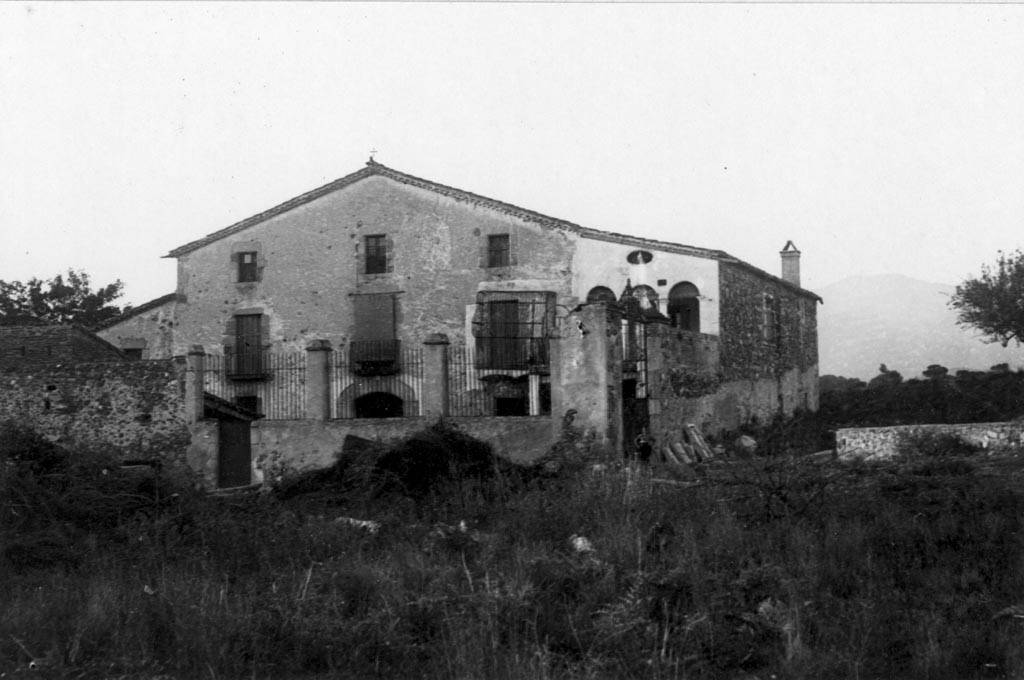
Cal Perpunter, the large farmhouse that now houses the town hall, can be entered. Inside there is a tiled corridor, a municipal noticeboard and a service counter. It functions as an administrative building and feels like one. There are no exhibition rooms or decorative displays to linger over.
That is essentially the historic core. A brief stroll is enough to see it all. Sant Antoni de Vilamajor does not compete with larger Catalan towns for architectural landmarks. Its appeal lies elsewhere.
Why People Come: Food and Local Produce
Most visitors make the detour from the C-35 for one main reason: to eat. There are few other strong motives to turn off the main road.
For centuries, vineyards and market gardens have shaped this area on the edge of the Montseny. That agricultural tradition continues. Several restaurants in and around the town work with nearby produce. It is common for tomatoes to come from a neighbouring plot or for lamb to arrive from a nearby village in the comarca.
There are also small wineries in the area, and some establishments serve wines from the Vallès. At weekends it is wise to book ahead. During the week, menus often depend on what is available in the kitchen that day. When a particular stew runs out, it simply runs out.
This flexible, product-led approach defines the local dining culture. Sant Antoni de Vilamajor is not presented as a culinary capital, yet food is the most consistent reason people choose to stop here.
Montseny Within Reach
The municipality borders the Parc Natural del Montseny, and that proximity shapes daily life. Trails begin near the BV-5107 and along agricultural tracks that leave directly from the village.
One option is the route to the Font del Gavatx. It is short, with a gentle uphill stretch, and ends at a stone fountain. In summer, dogs often stand in the water to cool off.
For those wanting something longer, the climb towards Turó del Samon extends the walk. The landscape is typical of this part of the Montseny: holm oaks, forest tracks and occasional wide views when the day is clear.
Another possibility is the Camí de les Fonts, which follows the stream towards the sanctuary of Sant Lleïr. There is shade along the way and sections where damp stone can be slippery. Proper footwear with a decent sole is advisable, especially after rain.
The old trade in mountain ice has disappeared, and the nevaters no longer bring blocks of ice down from the heights. Yet some of the cobbled paths remain. They show that goods once moved through these hills long before modern roads were built.
Sant Antoni de Vilamajor works well as a base or pause point for anyone heading into the Montseny. It is close enough to feel connected to the natural park, without the higher visitor numbers found deeper in the mountains.
Local Festivities to Keep in Mind
Certain dates change the rhythm of the town. On 17 January, the Festa Major d’Hivern takes place for Sant Antoni. In front of the church, a large log is burned and animals are blessed. For much of the day, the air smells of pine smoke.
On the night of Sant Joan, a traditional midsummer celebration across Catalonia, a bonfire is lit with the Flama del Canigó. This flame is symbolically brought from the Canigó mountain in the Pyrenees. The square fills with families and improvised tables.
August brings the Festa Major d’Estiu, usually on the third weekend. There are activities for children, sardanas in the square and an evening concert featuring cover songs.
If crowds are not appealing, September feels calmer. The pace returns to that of an ordinary Vallès town, and several businesses take a day off during the week.
Making the Most of a Day
Arriving early improves the chances of parking behind the town hall. From there, a walk around the centre takes about half an hour.
After that, the choice depends on the weather. If conditions are good, one of the Montseny routes is the natural extension. In hot weather, the restored former washhouse known as Espai Francesc Bardera offers a reference point, and there is shade near the stream.
Later in the afternoon, the square becomes slightly livelier again, with people stepping out for a drink or simply sitting for a while.
A straightforward approach works best: combine a short walk with a long lunch. Sant Antoni de Vilamajor does not offer major monuments or museums. Its strength lies in its location, close to the Montseny, and in its function as a calm stop before or after heading into the hills.


