Full Article
about Castellnovo
Town in the Palancia valley, marked by the castle of Beatriz de Borja; surrounded by orchards and irrigation channels in a quiet setting.
Hide article Read full article
A Short Turn-Off to Somewhere Slower
Some places are found almost by accident. You are heading towards Segorbe, spot a turning, and think, “let’s see what’s there.” Five minutes later you are parking beside a quiet square where everything seems to move at a slightly slower pace. Tourism in Castellnovo works much like that. It is not somewhere people come in search of headline monuments. It is the kind of village where you feel inclined to step out of the car and wander without much of a plan.
Castellnovo sits in the Alto Palancia comarca, very close to Segorbe, in the interior of the province of Castellón. The surrounding landscape is typical of this part of inland Comunidad Valenciana: gentle hills, terraces planted with olive and almond trees, and plenty of pine on the higher ground. The look of it shifts with the seasons. In winter the earth appears dry and dusty. When the almond trees blossom, white patches suddenly spread across the fields.
With just under a thousand residents, Castellnovo retains the atmosphere of a place where people still know each other. There are no major attractions and no flood of visitors. Quite the opposite. Streets are calm, houses built in stone, and daily life seems to follow its usual rhythm.
A Small Historic Centre to Explore at Your Own Pace
The historic centre of Castellnovo is compact. In theory, you could see most of it within an hour. In practice, it usually takes longer because small details slow you down: an old wooden door, a wrought-iron balcony, a façade where the original stone shows through beneath the plaster.
The streets are narrow and occasionally slope uphill. They were not designed with cars in mind, so it often makes sense to leave the vehicle in the lower part of the village and continue on foot. Within minutes you reach the main square or a street that bends without much logic, as happens in many villages that grew gradually around an original core.
From time to time, you come across an old washhouse or a corner where it is still possible to imagine what daily life looked like before water and electricity arrived through pipes and cables. These features have not been turned into museum pieces. They simply remain where they always were.
The Church Tower as a Landmark
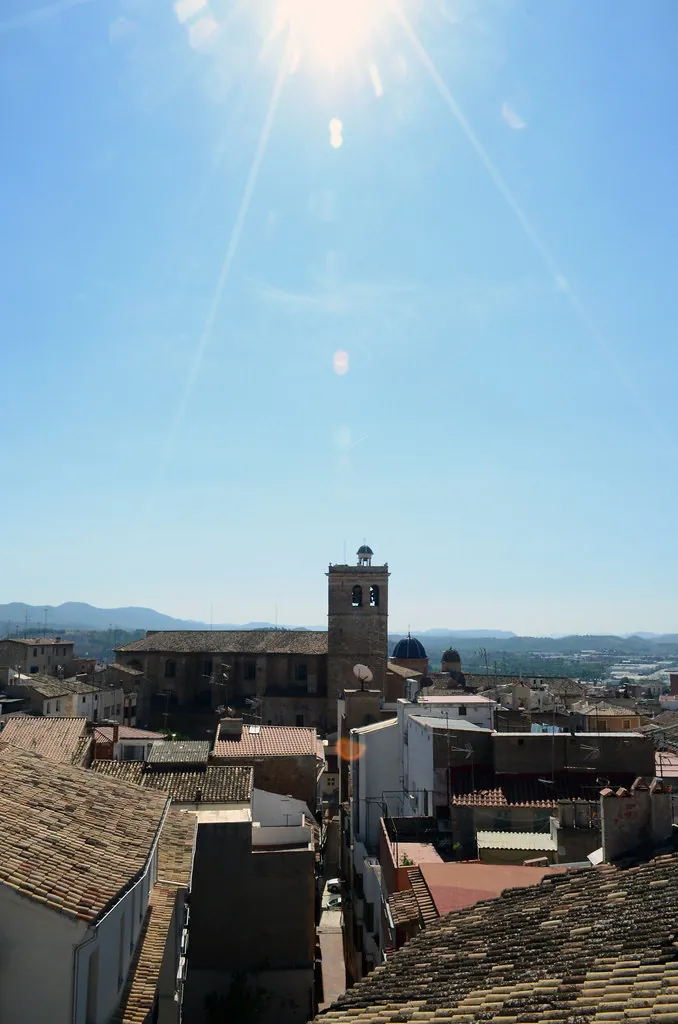
The parish church of the Asunción stands out from a distance. Its tower rises above the rooftops and soon becomes a useful point of reference once you enter the village.
The building itself is restrained, similar in style to many churches in the area. Thick walls, small windows, and a presence that feels practical rather than grand define its character. From the streets around it, several lanes climb towards the higher parts of the old town.
Paths Through Fields and Farmhouses
Beyond the last houses, the countryside around Castellnovo invites you out for a walk. This is not high mountain terrain or a network of routes that demand a full day. The paths are rural tracks that cross fields and low hills.
Walkers and cyclists quickly leave the built-up area behind and find the familiar patchwork of the Valencian interior: plots of olive trees, scattered almond trees, stretches of pine and the occasional masía standing alone. A masía is a traditional rural building linked to agricultural life, and for decades these structures shaped everyday existence in this part of the region.
When the almond trees flower, usually between late winter and early spring, the landscape changes noticeably. White and pale pink blossoms spread across the fields while the soil beneath is still dry. The contrast catches the eye even if you are not someone who normally pays close attention to such things.
Local Flavours
Food in this area is based on what has long been available nearby: olive oil, almonds, honey and cured meats. It is not an elaborate cuisine. The focus is on local produce and recipes passed down through generations.
Traditional pastries tend to appear during festivals and local fairs. Sweets flavoured with aniseed, rosquillas and soft nougat made with nuts are typical. These are homemade-style treats that many families in the village continue to prepare.
Village Festivals That Still Feel Local
The patron saint festivities take place in August in honour of the Virgen de la Asunción. During those days the atmosphere shifts. There are more people in the streets, religious events and popular activities, and the sense of summer reunion when residents who live elsewhere return for a few days.
In January, bonfires are lit for San Antonio Abad. In many Valencian villages at this time of year, the pattern is similar: fires in the street, neighbours gathered around talking, and simple food shared among friends.
Holy Week is also marked in Castellnovo, with processions passing through the streets of the old town. It is not a large-scale spectacle but something closely tied to the local community.
Getting There
Castellnovo lies very close to Segorbe. From the Mudéjar motorway, the A‑23, you take the exit towards Segorbe and then follow a local road for a few kilometres. As soon as you leave the main route, the scenery changes quickly. Fields open up, and the smaller roads of Alto Palancia begin to wind through the countryside.
It is one of those short detours that, if you are already travelling through the area, is worth making to stretch your legs and see what life looks like in a village that continues at its own unhurried pace.