Full Article
about Peñíscola
One of Spain’s prettiest towns, crowned by the Papa Luna castle; a walled old quarter above the sea and long beaches.
Hide article Read full article
First impressions of Peñíscola
If you are heading to Peñíscola, think about the car before anything else. The old town sits on a rocky headland and the streets are narrow. There is no parking at the top. Most visitors leave the car in the parking areas by the seafront promenade and walk up. In summer it pays to arrive early. By mid-morning there is already plenty of movement.
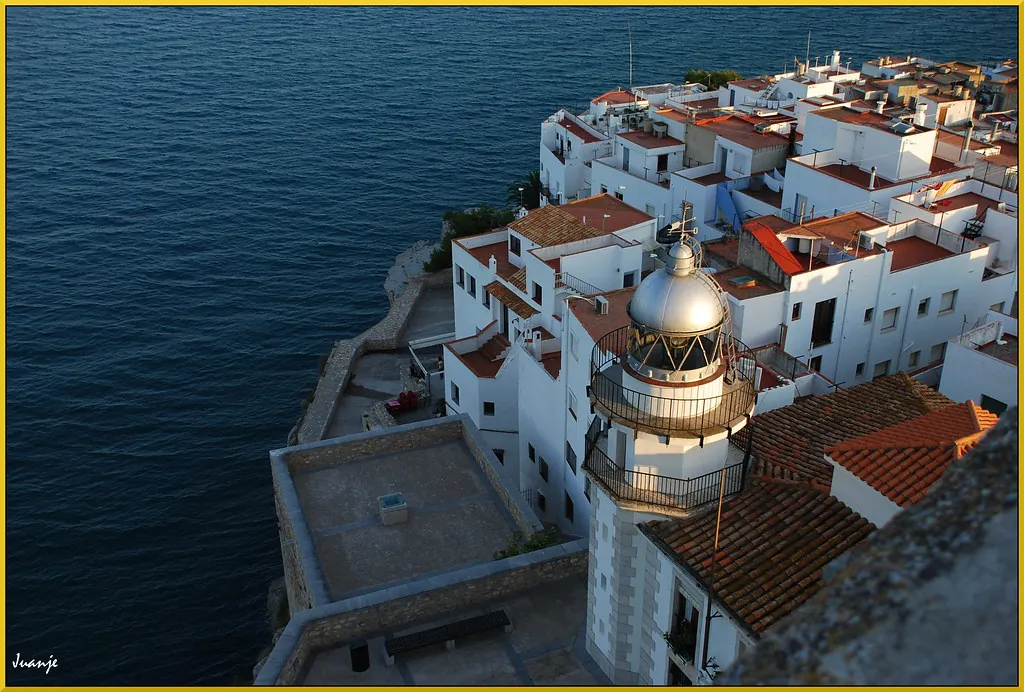
Peñíscola has around 8,400 inhabitants and belongs to the Baix Maestrat district, in the north of the Comunidad Valenciana. From a distance the town is easy to recognise. A rock pushes out into the sea, crowned by a castle. The image is striking. Once inside, however, everything feels smaller than it looks in photographs.
The old quarter occupies almost the entire rock. Streets are cobbled, the slopes are short but constant, and there are many steps. Moving around with a pushchair or reduced mobility can be difficult. In hot weather, the effort is greater than it first appears.
The Castle of Papa Luna and the old quarter
At the centre stands the Castillo del Papa Luna, a sober fortress that dominates the narrow strip of land linking the rock to the mainland. Benedict XIII, known in Spain as Papa Luna, spent his final years here. His figure still shapes the identity of the town, and several summer activities revolve around him.
Inside the castle there are no lavish decorations or spectacular halls. The appeal lies elsewhere. The real highlight is at the top, on the terraces, looking out over the coastline and towards Playa Norte. From here, the shape of Peñíscola becomes clear: rock, sand and open sea.
Around the castle, stretches of muralla, the old defensive walls, remain in place. Several historic gateways connect the lanes of the old quarter. The route is short and manageable. In about an hour it is possible to see everything at a relaxed pace. Some sections have uneven surfaces, so it is wise to take it slowly.
In the middle of the old neighbourhood stands the iglesia de Santa María. It is Baroque in style and fairly simple inside. Many people step in briefly as they pass from one steep street to the next. It forms part of the natural flow of a visit rather than a standalone attraction.
The overall impression of the historic centre is compact. Distances are short, but the constant changes in level make the visit feel more demanding than the map suggests. Footwear matters here. The cobbles are irregular, and the climbs, though not long, are steady.
Beaches on both sides of the isthmus
Peñíscola relies heavily on its beaches. On one side of the isthmus lies Playa Norte, long and urban, with the castle always visible in the background. This is the town’s classic postcard view. In high season it fills up quickly and the atmosphere is lively.
On the other side is Playa Sur, smaller and closer to the port. It tends to be calmer when the sea is rough, although there is less space overall. The contrast between the two beaches helps explain the geography of the place. One faces open water with a broad stretch of sand, the other sits more sheltered beside the harbour.
The seafront promenade runs along much of the newer part of town. A walk here makes the layout easy to understand. Peñíscola is a tongue of rock joined to the mainland by a strip of sand. From certain angles, the separation between old and new is clear. The historic core rises abruptly, while behind it the modern town spreads out with apartment blocks and long avenues.
The port and everyday life
The puerto pesquero remains active. Early in the morning, fishing boats can still be seen returning and unloading their catch. Some of the fish sold in town comes directly from here, depending on the season. It adds a practical, working rhythm to a place that is often viewed mainly as a holiday destination.
Outside the old quarter, Peñíscola functions like any large coastal town in the area. There are residential blocks, wide streets and a noticeable increase in activity during the summer months. Nothing unusual, simply the pattern common to much of this stretch of Mediterranean coastline.
This contrast between the historic rock and the more recent expansion defines the town. The postcard view may focus on the castle and walls, yet most daily life happens below, near the promenade and the port.
Summer atmosphere and local festivities
Towards the end of summer, Peñíscola usually celebrates its patronal festivities in honour of the Virgen de la Ermitana. The programme includes religious events, music and fireworks by the sea if the weather allows. During these days, the town takes on a more festive rhythm, especially in the evenings.
Throughout the busiest months there are also concerts and historical re-enactments linked to the figure of Papa Luna within the old quarter. These activities are mainly designed for the summer night-time atmosphere, when temperatures are lower and the narrow streets fill with people.
The link to Benedict XIII is not just historical. It shapes the way Peñíscola presents itself during the high season, with events that recall his presence in the castle and his final years on this rock above the sea.
Before you go
Castellón is a little over an hour away by car, depending on traffic. The old N‑340 road and the motorway run nearby, making Peñíscola straightforward to reach by road.
Comfortable shoes are essential. The surface in the old quarter is uneven and the slopes are more tiring than they look. If you can choose the time of day, early morning or late afternoon is preferable. At midday in July or August, the climb up to the castle feels longer, especially under the sun.
Peñíscola is easy to understand in a short visit. The route through the old town is compact, the beaches frame both sides, and the castle anchors everything above. Its scale is modest, its layout clear. The effort lies in the ascent, and the reward is the view back over the sand and sea.